
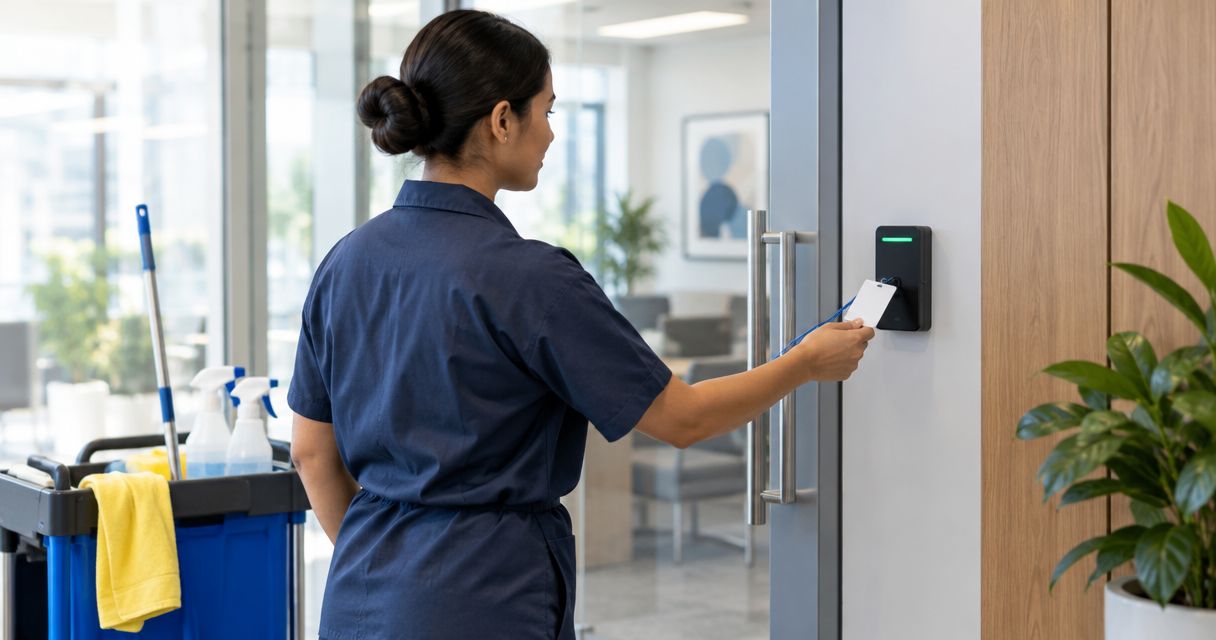
Instead of issuing new keycards at every visit, manage cleaning crew temporary badge access by assigning each approved cleaner a reusable credential with facility-approved doors, schedules, and an end date, where your access system supports those controls. Keep the physical card while the assignment remains authorized; change or revoke its permissions when the person, schedule, or cleaning scope changes.
Key takeaways
- Cleaning crew temporary badge access needs named credentials, approved doors, scheduled permissions, and a clear revocation owner.
- Hi Shine provides dedicated commercial janitorial teams for Greater Philadelphia facility and property managers.
- Reusable keycards still need expiration controls; keeping a card does not mean keeping permanent access.
- Approve replacement cleaners before arrival, and test the complete cleaning route before the first unattended shift.
Why this matters
A cleaner arriving at a locked service entrance is an access failure, not proof of a missed cleaning task. Your records need to distinguish denied entry from work that was never completed.
Hi Shine commercial cleaning is for Greater Philadelphia facility managers who need dedicated teams and clear accountability. Put access arrangements into the same onboarding record as the cleaning scope; the cleaning vendor onboarding guide covers the broader handoff.
For your 2026 access plan, separate the credential from the authorization. The card identifies the approved holder; its permissions determine where and when that person can enter. Reusing the card is practical only when someone owns those permissions.
Before you start
- Name the decision-makers. Identify the facility or property manager who approves access, the administrator who changes permissions, and the cleaning supervisor who supplies the roster. Confirm who handles after-hours entry failures.
- Collect the working details. Gather approved names, cleaning routes, service windows, restricted rooms, credential identifiers, assignment end dates, and the building’s lost-card procedure. Keep personnel information in an authorized location.
- Check the hidden dependencies. Door access does not automatically grant elevator access, tenant-suite access, or alarm authorization. Confirm what your installed system supports before planning scheduled permissions or automatic expiration.
This workflow uses operational instructions rather than software button names. Your security administrator must map each action to the installed system’s actual controls; there is no universal access-control interface.
How do you set up cleaning crew temporary badge access?
Set up cleaning crew temporary badge access around a named person, an approved route, an authorized service window, and a documented end condition. Do not issue an unrestricted card just to solve an arrival problem.
The following configuration units keep reusable cards tied to current assignments rather than leaving access open indefinitely.
Approved roster and ownership
- Ask the cleaning supervisor for the people assigned to your facility. Separate regular team members from substitutes awaiting approval.
- Confirm each person through your facility’s identity-verification process before assigning a credential. Do not place sensitive identity documents in an ordinary cleaning checklist.
- Record the credential identifier against the approved holder. If a card changes hands, revoke the former assignment before reassignment under your security procedure.
- Name the access approver and the revocation owner. Record how the cleaning supervisor reports departures, substitutions, and lost cards.
- Set the assignment end condition: a scheduled expiration, a contract milestone, or an administrator-controlled review where automatic expiry is unavailable.
Use a small access register with enough detail to resolve an incident without collecting unnecessary personal information:
| Record field | What to enter | What it establishes |
|---|---|---|
| Approved holder | Authorized cleaner’s name | Who is assigned the credential |
| Credential identifier | Identifier used by security | Which credential to disable |
| Authorized route | Approved doors and areas | Where entry is permitted |
| Service window | Approved working period | When entry is permitted |
| End condition | Expiration or review trigger | When authorization must be reconsidered |
| Responsible owner | Named facility-side contact | Who acts on changes |
Expected result: Security can trace an active credential to an approved person and identify who must disable it. An unapproved substitute does not inherit access merely by joining the shift.
Door permissions and service windows
- Walk the actual cleaning route with the facility contact. Include the entrance, supply storage, assigned rooms, waste route, and exit.
- Identify excluded areas explicitly. A route through an office corridor does not authorize entry to a laboratory, records room, medication area, or tenant’s private space.
- Ask the security administrator to apply the supported door permissions and service schedule. Keep alarm instructions separate from the badge record and distribute them only through approved channels.
- Resolve exceptions before activation: holidays, tenant overtime, elevator restrictions, and work that finishes outside the usual window.
- Document whether scheduled access blocks entry only or also affects movement between controlled areas. Have security confirm exit arrangements under the building’s procedures.
Expected result: The approved cleaner can follow the assigned route without gaining unrelated access. For your 2026 setup, record the approved schedule itself rather than relying on a calendar invitation as authorization.
Entry test and shift handoff
- Arrange an attended test before the first unattended cleaning shift. Use the assigned credential rather than a manager’s card.
- Test the service entrance and each controlled point needed along the route, including elevators and tenant doors where applicable.
- Confirm the alarm handoff with the authorized building contact. Do not assume that a successful badge scan disarms an alarm.
- Test the reporting path for denied entry. The cleaner should know whom to contact and what information to provide without posting credentials or security instructions in an open group message.
- Record the test outcome and unresolved restrictions. Mark inaccessible work as blocked by access rather than completed.
Expected result: The team can complete the authorized route and report a lockout without borrowing credentials, propping doors, or improvising an entrance.
The handoff follows a simple sequence: Approved roster, Door permissions, Entry test, and Access review. Each stage needs an owner; an issued card alone does not prove readiness.
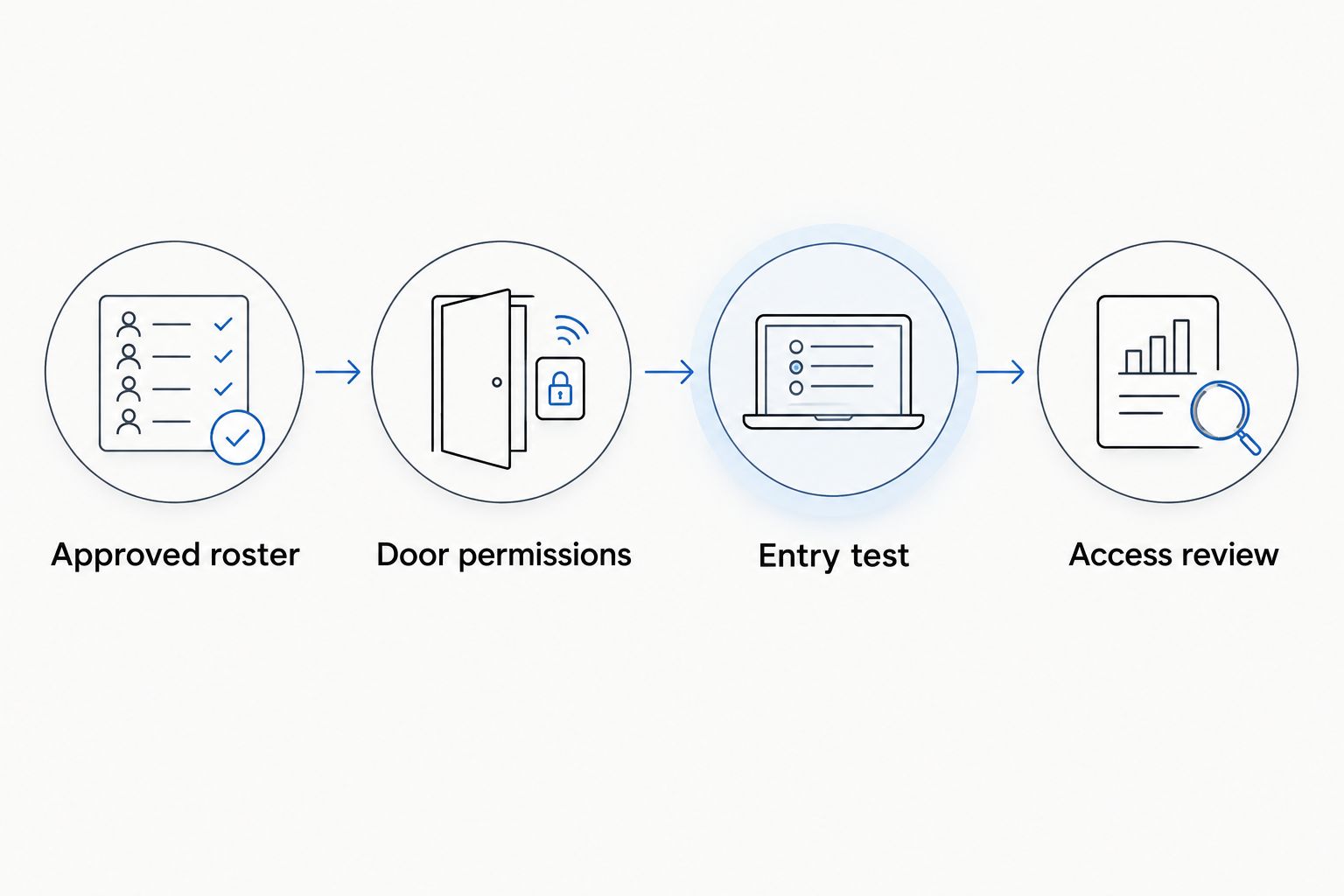
Test the complete authorized route before the first unattended cleaning shift.
Keep the test record with the facility’s operational handoff. It should identify the failed checkpoint and responsible contact without exposing alarm codes or other security instructions.
Access review and revocation
- Require the cleaning supervisor to report assignment changes through the agreed channel. A roster update is a request for action, not proof that permissions changed.
- Have the authorized administrator disable access when a cleaner leaves the assignment, a credential is lost, or authorization ends.
- Review active access against the current roster at the interval approved by your facility. Investigate credentials that remain active without a current assignment.
- Record who completed each change and when. Confirm the change in the access system instead of treating an email request as completion.
- Recover physical cards under the building’s procedure, but do not delay revocation while waiting for a card to return.
Expected result: Permission changes follow personnel changes, and an unreturned card does not remain an active credential. Your 2026 review should reconcile people, permissions, and assignment status—not merely count cards in a drawer.
Handle substitute cleaners without issuing permanent access
A replacement cleaner needs approval even when the regular team already has building access. Approve the person first; select the permitted entry method second. Do not lend the absent cleaner’s credential to the substitute.
Use the same roster process, but limit authorization to the approved replacement assignment. If your system supports time-limited permissions, ask the administrator to apply them to the substitute’s individually assigned credential. If it does not, follow the building’s documented temporary-access or escorted-entry procedure.
Before the replacement shift, confirm:
- The substitute’s identity and facility approval are complete.
- Required orientation and site-specific authorization are complete.
- The permitted route matches the work assigned that night.
- The end condition and revocation owner are recorded.
- The cleaning supervisor knows whether unattended entry is authorized.
Do not mistake screening for access permission. Background requirements depend on the facility and jurisdiction; screening requirements for childcare cleaners address a separate question from which doors a credential opens. A screening document does not replace your facility’s approval, orientation, or access decision.
For Greater Philadelphia biotech and medical facilities, keep general janitorial routes distinct from rooms requiring additional site authorization. Hi Shine provides dedicated commercial janitorial teams; your facility still controls access approval and restricted-area permissions.
Troubleshooting access failures
The badge works at the entrance but not inside
Check the failed door, elevator, or tenant boundary against the authorized route. Ask the administrator to confirm the relevant permission rather than copying another person’s entire access profile.
If the area is intentionally restricted, revise the cleaning handoff. Record the work as inaccessible until the facility supplies an authorized arrangement.
The badge works during the day but fails at night
Have security check the assigned access schedule, holiday settings, and system time. Confirm whether the cleaner arrived within the authorized service window.
Do not fix a schedule mismatch by granting unrestricted access. Correct the approved window or arrange the documented exception.
A substitute arrives without approval
Use the facility’s authorized escalation or escorted-entry procedure. Do not share a regular cleaner’s card or allow entry behind another person.
Tell the facility contact which work is affected and obtain a decision. Unapproved entry is not an acceptable way to preserve the cleaning schedule.
A cleaner reports a lost card
Notify the designated security contact and disable the missing credential under the building’s procedure. Follow the identity-verification process before assigning a replacement.
Record the replacement separately from the lost credential. Finding the old card later is not permission to reactivate it.
A badge event appears, but a cleaning task is unfinished
Treat entry records and service records as different evidence. A successful door event establishes use of a credential at that checkpoint; it does not establish completion of every cleaning task.
Compare the access record with the task report, supervisor follow-up, and any documented restrictions. For your 2026 accountability review, keep “entered the building,” “reached the assigned area,” and “completed the work” as separate questions.
Customize your workflow
Put access responsibilities into your facility handoff instead of leaving them in separate email threads. Identify who supplies roster changes, who approves them, who updates permissions, and who confirms completion.
Ask Hi Shine commercial cleaning teams about the assigned roster, substitution communication, and coordination with your building contact during a facility discussion. Use those answers to document responsibilities; do not assume a cleaning agreement includes access-system administration.
When requesting a commercial cleaning quote, describe controlled entrances, restricted areas, tenant boundaries, and after-hours contacts. Share sensitive security details only through your facility’s approved process.
Extend the same workflow across locations without copying permissions blindly. Each building needs its own approved route, responsible contact, and exception process. A cleaner authorized at one property is not automatically authorized at another.
FAQ
Can cleaning crews reuse the same temporary badge?
Cleaning crews can reuse individually assigned badges when the facility authorizes reuse and maintains appropriate permissions. Keep the credential tied to its approved holder, with a documented expiration or review process.
How do I set up cleaning crew temporary badge access?
Set up cleaning crew temporary badge access by approving the person, defining permitted doors and service windows, assigning a credential, and testing the route. Name the administrator responsible for permission changes and revocation.
Can a replacement cleaner use another cleaner’s keycard?
Do not transfer a named cleaner’s keycard to a replacement. Approve the substitute and follow the facility’s credential-assignment or escorted-entry procedure so the access record remains attributable.
What if our access system cannot schedule temporary permissions?
Use the building’s approved temporary-access or escorted-entry process rather than assuming scheduling features exist. Document the authorization period and assign an administrator to revoke access when it ends.
Does a working badge mean the cleaning crew can disarm the alarm?
A working badge does not establish alarm authorization. Confirm alarm responsibilities separately with the authorized facility or security contact before unattended work begins.
Who should deactivate a cleaner’s badge after an assignment ends?
The facility’s designated access administrator should deactivate the credential. The cleaning supervisor reports the assignment change, and the responsible facility contact confirms that revocation occurred.
Does Hi Shine manage the building’s badge system?
This workflow leaves badge administration with your authorized facility or security team. Hi Shine provides dedicated commercial janitorial teams; document roster communication and access responsibilities during onboarding.
One last thing
A returned keycard is not proof that access has been revoked. Confirm the credential’s status in the access system, then close the assignment record. Make that confirmation part of your 2026 offboarding checklist, even when the physical card is already back in your hand.