Biotech Cleaning Vendor Checklist Philadelphia 2026
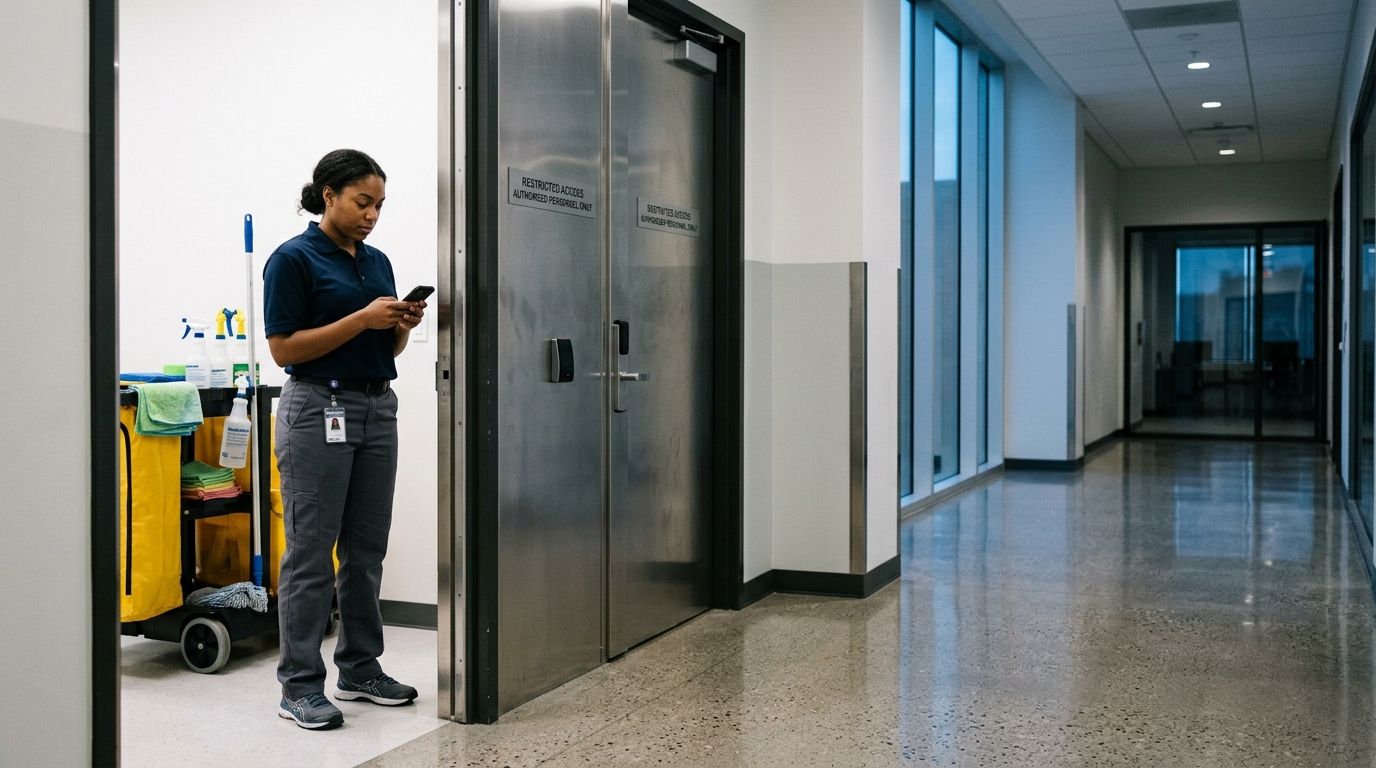
Biotech facility cleaning in Philadelphia is a controlled janitorial program for approved offices, common areas, restrooms, locker rooms, and facility-defined adjacent spaces. In 2026, vendor selection starts with boundaries, access control, documentation, and a correction process tied to the facility's real operating requirements.
- Biotech facility cleaning needs a written boundary between janitorial work and controlled research procedures.
- Dedicated crews reduce repeated badge setup, route training, and site-specific onboarding.
- Hi Shine uses HI-Q™ checklists, $5MM insurance, and 24/7 owner access.
- A 90-day risk-free trial should measure access accuracy, task completion, and issue correction.
What a Philadelphia biotech cleaning bid must prove
A biotech cleaning proposal is incomplete unless it names the approved zones, assigned crew, badge process, service windows, documentation, waste handoffs, and correction owner. This checklist is for procurement: it turns broad vendor claims into requirements that can be verified before award.
The facility defines the boundaries. The vendor must show how its staffing, route, records, and escalation process will follow them.
Hi Shine's biotech and life sciences cleaning program is designed for Greater Philadelphia facilities that need accountability in approved commercial areas. Hi Shine fits biotech facility managers who want a dedicated team, a repeatable checklist, and direct access to the account owner.
Map every zone before the walkthrough
Create a room-level responsibility map before vendors price the work. Label each zone as included, excluded, conditional, or assigned to a specialist team. Repeat those labels in the walkthrough notes, proposal, checklist, and onboarding materials.
Your 2026 map should cover:
- Administrative offices and conference rooms.
- Lobbies, corridors, shared spaces, and loading approaches.
- Restrooms, breakrooms, and locker rooms.
- Approved equipment-adjacent areas.
- Restricted laboratories and controlled environments.
- Ordinary trash and recycling routes.
- Facility-managed or specialist waste streams.
- Rooms available only during defined service windows.
Avoid labels such as lab-adjacent without listing the exact rooms and surfaces. A boundary is useful only when the cleaner, supervisor, security team, and facility contact interpret it the same way.
Assign each task and exception to an owner
Every included task needs an operating owner. Every excluded or conditional task needs an escalation owner. This prevents the cleaning team from guessing when access is blocked or an unexpected condition appears.
For each task, document:
- Who wrote and approves the instruction.
- Which workers are authorized.
- Which products and equipment are permitted.
- What access or timing restriction applies.
- What condition stops the work.
- Who receives the first notification.
- How the task is rescheduled and closed.
In 2026, the most useful instruction tells a cleaner both what to do and when not to proceed.
Build the checklist by zone and sequence
A generic line such as clean common areas is too vague for a controlled facility. The checklist should follow the route workers use to enter, service, document, and leave each approved zone.
Hi Shine's HI-Q™ Quality System converts facility specifications into repeatable checklist tasks. The purpose is operational: reduce missed trash, skipped rooms, incomplete restrooms, and unresolved exceptions by making each task visible.
Each checklist line should name:
- Exact room or zone.
- Surface or task.
- Required frequency.
- Approved sequence.
- Access condition.
- Completion or exception status.
- Escalation contact.
- Correction confirmation.
The checklist should remain tied to the current floor plan and access policy. Update it when rooms change use, routes close, schedules shift, or the facility changes task ownership.
Control crew assignment and access
Every staffing change can trigger new badge approvals, route orientation, confidentiality reminders, alarm instructions, and facility-specific onboarding. A stable team reduces that repeated management work, but the replacement process still needs written controls.
Ask vendors to document:
- Whether the team is dedicated or rotating.
- Who supervises each shift.
- How staffing changes are reported.
- Who approves badges, keys, and alarm codes.
- How replacement workers receive site instructions.
- When access is removed after an assignment ends.
- Who maintains the authorized-personnel list.
Do not accept access control as an informal exchange between the cleaner and front desk. The 2026 service plan should match the facility's security process from the first shift.
Schedule work around research operations
Cleaning can disrupt a facility without entering a restricted laboratory. Corridors, locker rooms, restrooms, waste routes, elevators, and loading areas may be unavailable during shift changes, equipment moves, or active workflows.
Build service windows around:
- Research and production schedules.
- Shift start and end times.
- Security coverage.
- Equipment movement and maintenance periods.
- Approved waste-movement windows.
- Deliveries and loading activity.
- After-hours contacts.
Separate routine tasks from periodic work that needs advance approval. In 2026, each task should have a normal window and a fallback process when that window closes.
Define waste-stream handoffs
The janitorial vendor should not identify, move, or dispose of facility material by assumption. Mark ordinary trash and recycling clearly, then document the point where facility staff or a specialist provider takes ownership.
The handoff plan should specify:
- Approved containers.
- Materials the janitorial team must not touch.
- Staging locations.
- Full-container and spill escalation.
- Movement windows and route restrictions.
- The facility contact who resolves uncertainty.
- How unresolved material is isolated from ordinary waste.
The vendor's role must match the signed scope. Do not treat proximity to a regulated process as authorization to perform it.
Put exception reporting ahead of incident response
Most cleaning failures are ordinary exceptions before they become incidents: a locked door, an active room, missing supplies, blocked equipment, or an unidentified material. The team needs a short, documented path for each one.
Require the process to state:
- Which conditions trigger an immediate stop.
- The first facility contact.
- The vendor escalation contact.
- What information may be recorded.
- Whether photographs are prohibited.
- Who decides whether work resumes.
- How completion is verified later.
Hi Shine provides 24/7 owner access for urgent service issues. The facility should still name its own authorized decision-maker for protocol and access questions.
Verify insurance and operational risk controls
Insurance is one part of vendor risk review. Access discipline, scope boundaries, approved products, equipment control, staffing records, and incident procedures are the controls that prevent routine errors.
Hi Shine carries $5MM in insurance coverage. Compare that amount with the facility's lease and vendor requirements. Also verify:
- Current certificate documentation.
- Renewal tracking and notification.
- Incident and property-damage reporting.
- Product approval and safety-document ownership.
- Equipment storage and control.
- Subcontractor disclosure, if applicable.
- Responsibility for keys, badges, and alarms.
In 2026, insurance should support the operating model, not replace the review of how work is actually controlled.
Use the first 90 days as a measured trial
A proposal cannot show how a team behaves when a room is blocked, a shift runs late, a badge fails, or a task is missed. A live service period can—if the scorecard is defined before work begins.
Hi Shine offers a 90-day risk-free trial. Track:
- Checklist completion by zone.
- Access and lock-up accuracy.
- Stability of the assigned team.
- Blocked tasks and their closure time.
- Repeat misses by room or task.
- Response after urgent feedback.
- Fit with shift changes and facility routes.
At the end of 90 days, document which controls worked, which gaps require correction, and whether the operating model fits the facility.
Biotech cleaning service models at a glance
| Service model | When it fits | What to verify | Main management tradeoff |
|---|---|---|---|
| In-house facility team | The site needs direct control over staffing and daily priorities | Hiring, supervision, coverage, and training | The facility owns the full operation |
| Commercial janitorial team | Approved office and common-area work is the main scope | Boundaries, crew stability, access, and documentation | Specialist work remains separate |
| Controlled-environment specialist | A defined space requires specialist procedures | Exact qualifications, authorization, and records | The scope may not cover ordinary facility areas |
| Mixed-provider model | Commercial and specialist work are clearly separated | Handoffs, routes, schedules, and incident ownership | Coordination fails when boundaries are vague |
| Multi-location model | Several facilities require shared commercial terms | Site-level staffing and escalation | Local execution still needs separate review |
These service models solve different operating problems. Use the room map to decide which scope belongs with which team instead of asking one vendor to claim every capability.
Questions to ask every biotech cleaning vendor
Use the facility walkthrough to get written answers to these questions:
- Which exact rooms and surfaces will your team service?
- What work will your team refuse without written authorization?
- Who will be assigned to the building on the first shift?
- How are badge and staffing changes communicated?
- How will a blocked task be recorded and closed?
- Who answers after hours when an approved task is missed?
- How will the checklist change when a room changes use?
- What will you measure during the first 90 days?
The answers should name roles, records, and next steps. General promises about quality do not control a shift.
Common biotech cleaning procurement mistakes
Using one scope for every space
Different zones have different owners and access rules. The contract and checklist must preserve those distinctions.
Assuming laboratory cleaning means specialist cleanroom work
Laboratory cleaning is a broad category. Verify the exact environments and procedures a vendor is authorized to service, and assign specialist work separately when required.
Allowing unapproved replacements
A replacement worker may understand janitorial work and still lack site authorization, route knowledge, or facility-specific instructions. Require notice and controlled onboarding.
Leaving blocked tasks undocumented
A locked room can become a silent miss. Record the exception, notify the owner, and confirm when the task is completed.
Treating insurance as the complete risk program
A certificate does not define the work. Boundaries, trained personnel, access controls, and exception procedures manage daily risk.
FAQ
What should biotech facility cleaning include?
The scope should name approved offices, common areas, restrooms, locker rooms, floors, ordinary waste routes, access limits, frequencies, and exception procedures.
Does biotech facility cleaning include cleanrooms?
Not automatically. Cleanroom work requires an explicit specialist scope and the qualifications and facility approvals appropriate to that environment.
Should biotech facilities use dedicated cleaning crews?
A dedicated team reduces repeated access setup and site-specific onboarding. Replacement procedures still need notice, approval, and documented instructions.
How should cleaning work around lab shifts?
Map service windows to shift changes, security coverage, equipment movement, and approved facility routes. Give each task a normal window and fallback process.
Can janitorial staff handle regulated waste?
Only tasks expressly assigned in the approved scope should be performed. The facility must define containers, handoffs, restricted material, and the specialist owner.
What insurance should a biotech cleaning vendor carry?
Required coverage depends on the facility's lease and vendor policy. Hi Shine carries $5MM in insurance coverage, which should be compared with those requirements.
How should a biotech facility test a new cleaning vendor?
Measure checklist completion, access accuracy, team stability, blocked-task closure, repeat misses, and urgent response. Hi Shine offers a 90-day risk-free trial for this test.
One last thing
Ask what the cleaning team will refuse to do without written authorization. A credible vendor can describe its boundaries as clearly as its capabilities. That discipline protects the facility manager, the research environment, and the cleaning team in 2026.