
Multi-Tenant Office Building Cleaning Philadelphia (2026)
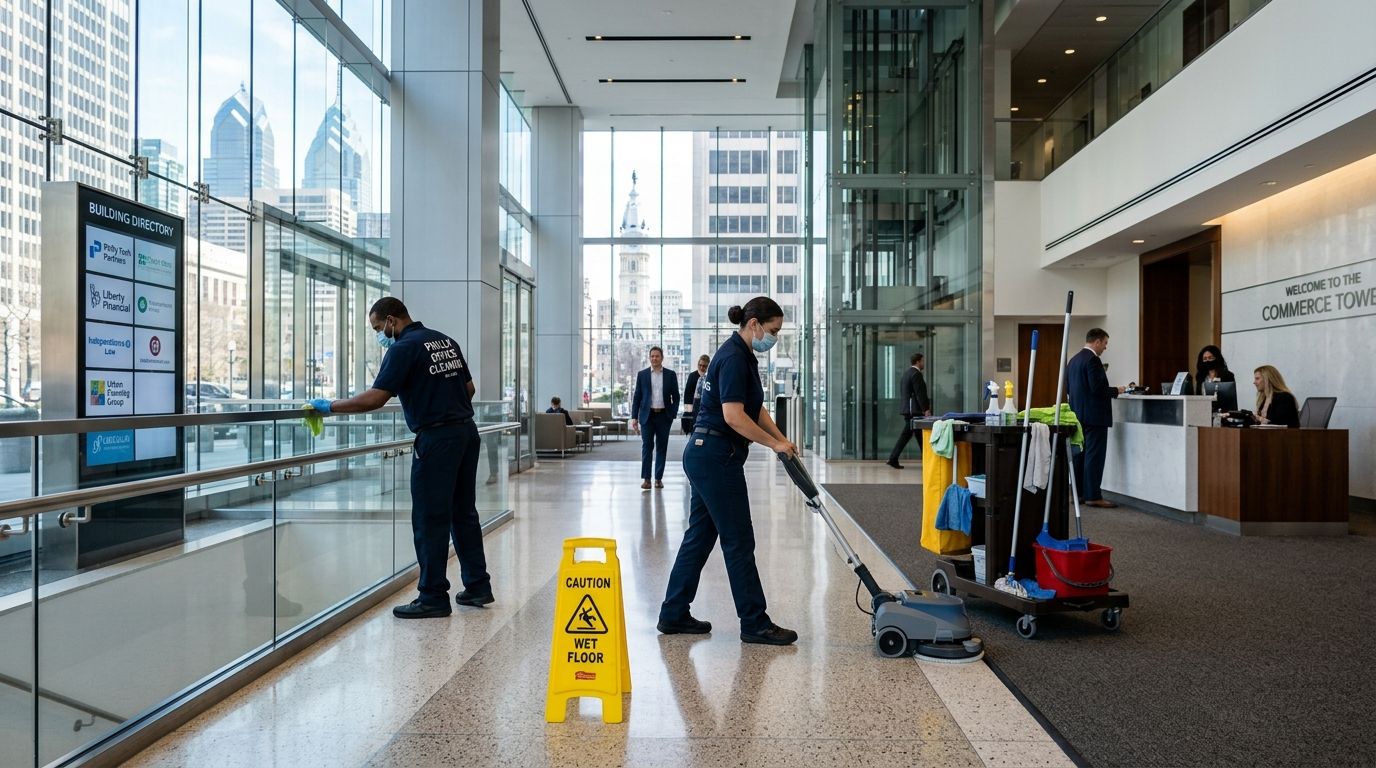
If you manage a multi-tenant office building in Philadelphia, cleaning is not housekeeping — it is lease retention. This 2026 guide sets up a janitorial program built for multi-tenant reality: shared areas, tenant-level demands, after-hours logistics, and a proof trail you can show a tenant or an ownership group.
- In multi-tenant buildings, cleaning failures surface as tenant complaints, not vendor complaints.
- Separate common-area scope from tenant-served work in writing.
- Set frequency by measured traffic, not by square footage.
- Dedicated crews and HI-Q™ checklists make each night provable.
- Start on a 90-day risk-free trial, then scale the program.
Why multi-tenant buildings fail differently
In a single-tenant office, a missed task annoys one client. In a multi-tenant building, the same miss lands on the tenant in suite 6A, and their frustration routes straight to you. The failure modes are structural: a Center City lobby that gets dirty again by 10 a.m., restrooms on different floors used at different intensities, elevators that collect fingerprints faster than any nightly route covers, and a stream of tenant requests arriving all day while the cleaning happens at night.
Programs built for single-tenant offices break under that load. If the vendor's nightly route assumes empty floors, common-area standards collapse during business hours. If tenant requests go into a ticket queue nobody owns, they accumulate into escalations — and eventually into renewal conversations. The fix is not more cleaning hours. It is structure: a scope written for shared-space reality, staffing built for continuity, and reporting that proves the night's work.
Hi Shine runs exactly this model across Greater Philadelphia. For the full baseline of what a commercial office program should include, start with our commercial office cleaning services; this guide covers the multi-tenant layer on top of that foundation. And because Philadelphia buildings carry their own logistics — loading windows, badge systems, parking for after-hours crews — it is worth working with a company headquartered here. Hi Shine has served Philadelphia facilities since 2007, from Center City high-rises to neighborhood professional buildings.
1. Separate common-area scope from tenant-served scope
Start with a written scope that splits the building into two documents:
- Common-area scope — lobby, entry glass, elevators and cabs, corridors, public restrooms, loading areas, stairwells, shared kitchens, trash rooms, and parking access points.
- Tenant-served scope — suite interiors cleaned at each tenant's request, with per-suite task lists, frequencies, and access limits documented suite by suite.
This split prevents scope creep, where a tenant asks a night crew for extra work and your pricing quietly absorbs it. It also gives you a clean answer when a tenant asks why their suite is handled differently from the common areas: the difference is a documented scope decision, not a judgment call a crew made on a Tuesday night.
Property managers who skip this split usually discover it in year two, when one tenant's informal requests have turned into an unpriced daily routine. Recovering that ground mid-contract is hard. Writing it down before the first shift is free.
2. Set frequency by measured traffic, not by floor plan
Not every shared area deserves the same frequency. A ground-floor lobby in Center City sees thousands of passes a day; a sixth-floor corridor sees dozens. Match the schedule to the traffic:
- Lobby and entry: the highest-frequency area in the building. Define glass, floors, mats, and reception surfaces by hour, not by night.
- Elevators and corridors: buttons, rails, and panels are high-touch surfaces that need a specified check frequency, not ad-hoc attention.
- Public restrooms: the number-one complaint area in most multi-tenant buildings. Set a documented check schedule by floor traffic, not one generic nightly standard.
- Trash rooms and docks: define who hauls what where, on what schedule, before the first missed pickup — not after.
The pattern that works: high-traffic areas get specified daytime attention plus nightly service; low-traffic areas get nightly service only. Pricing should follow the traffic map, not the square footage. Building-wide uniform frequency is the most common way property managers overpay for underused floors — and the most common way underused floors still generate complaints, because the money went everywhere except where tenants actually look.
3. Build a tenant request structure with three rules
Tenant requests are the operational edge case that kills most multi-tenant programs. Your structure needs three explicit rules:
- Route: one channel for tenant requests, so nothing arrives through side doors a vendor cannot see.
- Acknowledge: every request gets a response from a named person, not a portal receipt.
- Close the loop: the tenant hears the outcome — fixed, scheduled, or escalated — not just "we received it."
If your vendor cannot commit to all three in writing, you will spend your days as the go-between, translating complaints into work orders. Hi Shine gives every client 24/7 owner access, so a tenant's after-hours issue reaches the owner directly — no ticket lottery, no "someone will get out there next week."
Test the structure before you need it. Send a routine request through each vendor's channel during the sales process and time the response. The speed you see while they are competing for your building is the ceiling, not the floor, of what you will get after signing.
4. Staff for continuity, not just coverage
The staffing question in a multi-tenant building is not headcount — it is whether the same people show up every night. Ask every vendor to commit to the same crew in writing. Continuity is what lets a night crew recognize abnormal conditions: a leak in the trash room, a propped door after hours, a suite with unusual activity.
The same faces are also a security asset. Badged, expected, known to your security desk and your front-desk tenants — that is what a dedicated team gives you. A program built on rotating subcontractors cannot offer it, because there is no team to know the building. Hi Shine staffs dedicated teams, carries $5MM in coverage, and updates your roster and access list in writing whenever staffing changes.
Continuity also compounds on documentation. A crew that has written the same building's reports for a year produces records you can trend; a crew that changes monthly produces noise. When you review any vendor's reporting, ask how long the crew generating it has been assigned to your building. The answer tells you how much weight the trend carries.
5. Make quality auditable, not promised
A program without documentation is unprovable, and in a multi-tenant building unprovable means losing the argument. The HI-Q™ Quality System defines every task, records completion, and flags blocked tasks with a reason instead of letting them disappear. For a property manager, that answers the two questions a tenant is most likely to ask: did cleaning happen last night, and what did you do about the missed restroom?
It also changes your vendor conversation. "Quality" stops being an adjective and becomes a record. When a task is blocked — a locked suite, a maintenance issue — it is flagged with a reason instead of silently skipped, so a tenant complaint gets answered with documentation rather than an apology.
6. Plan periodic work on a separate calendar
Floor care cycles, high dusting, and detail work do not fit a nightly route. Build a separate periodic calendar — quarterly floor care, scheduled high dusting, annual deep work — documented and reported like the nightly scope. If a proposal lumps periodic work in as "included," ask to see the completed periodic work from the past two quarters. If nobody can show it, it was not done.
7. Compare proposals on identical terms
Before you compare price, normalize the proposals: same common-area list, same tenant-served terms, same frequencies, same periodic calendar, same reporting expectations. Build a one-page grid with every bidder as a column and every checklist item as a row. The cells you cannot fill from a proposal are the answers that vendor is hoping you will not ask for.
Then rank every proposal on four questions: Is the scope split written down? Is the staffing dedicated? Is the quality system auditable? Is the escalation path a real person? Price is the fifth question, not the first.
8. Red flags that should end the conversation
Some answers disqualify a vendor faster than any price advantage can justify them:
- "We'll build the scope after we start" — a vendor who cannot scope your building before winning the bid will improvise on your dime.
- "We send whoever is available" — said plainly, this is a rotating-crew program at a dedicated-team price.
- "Our checklists are internal" — documentation you cannot see is documentation you cannot use in a dispute.
- "The insurance certificate is coming" — legitimate vendors produce certificates in a day; delays mean gaps.
- "We can start Monday" — onboarding includes key control, badge lists, and site instructions. A vendor that skips them is improvising inside your building.
Any one of these is worth a second look. Two together usually mean the low price was priced by leaving these answers out.
Start on a trial, not a leap of faith
A vendor confident in its program will prove it before asking for a multi-year commitment. Hi Shine starts every engagement with a 90-day risk-free trial — long enough to see real performance across ordinary weeks, short enough to exit cleanly if it is not there.
When you are ready for a concrete number, request a free building assessment and we will scope your common areas and tenant-served floors line by line, with the trial terms in writing.
FAQ
How often should common areas in a multi-tenant office be cleaned?
Match frequency to traffic: lobbies and entry glass daily with daytime checks, elevators and corridors nightly, and public restrooms on a documented check schedule set by each floor's traffic.
Should tenants pay for their own suite cleaning separately?
Best practice is a written split: common areas under the building contract, suite interiors under per-tenant terms. That prevents scope creep and keeps pricing auditable.
How do I reduce tenant complaints about cleaning?
Most complaints come from missed or unprovable work. A documented checklist system like HI-Q™ records completion and flags blocked tasks, so issues surface as fixable records rather than recurring complaints.
What is a day porter and does our building need one?
A day porter handles daytime lobby traffic, restroom checks, and tenant requests while night crews handle the full route. High-traffic lobbies usually justify one; low-traffic buildings usually do not.
How does after-hours access work for cleaning crews?
Before the first shift, document how keys and badges are issued, tracked, and returned, and how quickly your access list updates when crew staffing changes.
Does Hi Shine serve multi-tenant buildings in Philadelphia?
Yes. Dedicated teams, HI-Q™ documentation, 24/7 owner access, and $5MM coverage apply across Greater Philadelphia, including Center City and University City.
One last thing
The cheapest time to hold a cleaning vendor accountable is before you sign, and the most expensive moment is after a tenant's third unanswered complaint. Put the scope split, the crew continuity commitment, and the escalation name into the contract itself. If a vendor resists putting those three in writing during the sales process, that is your answer before the trial even starts.