
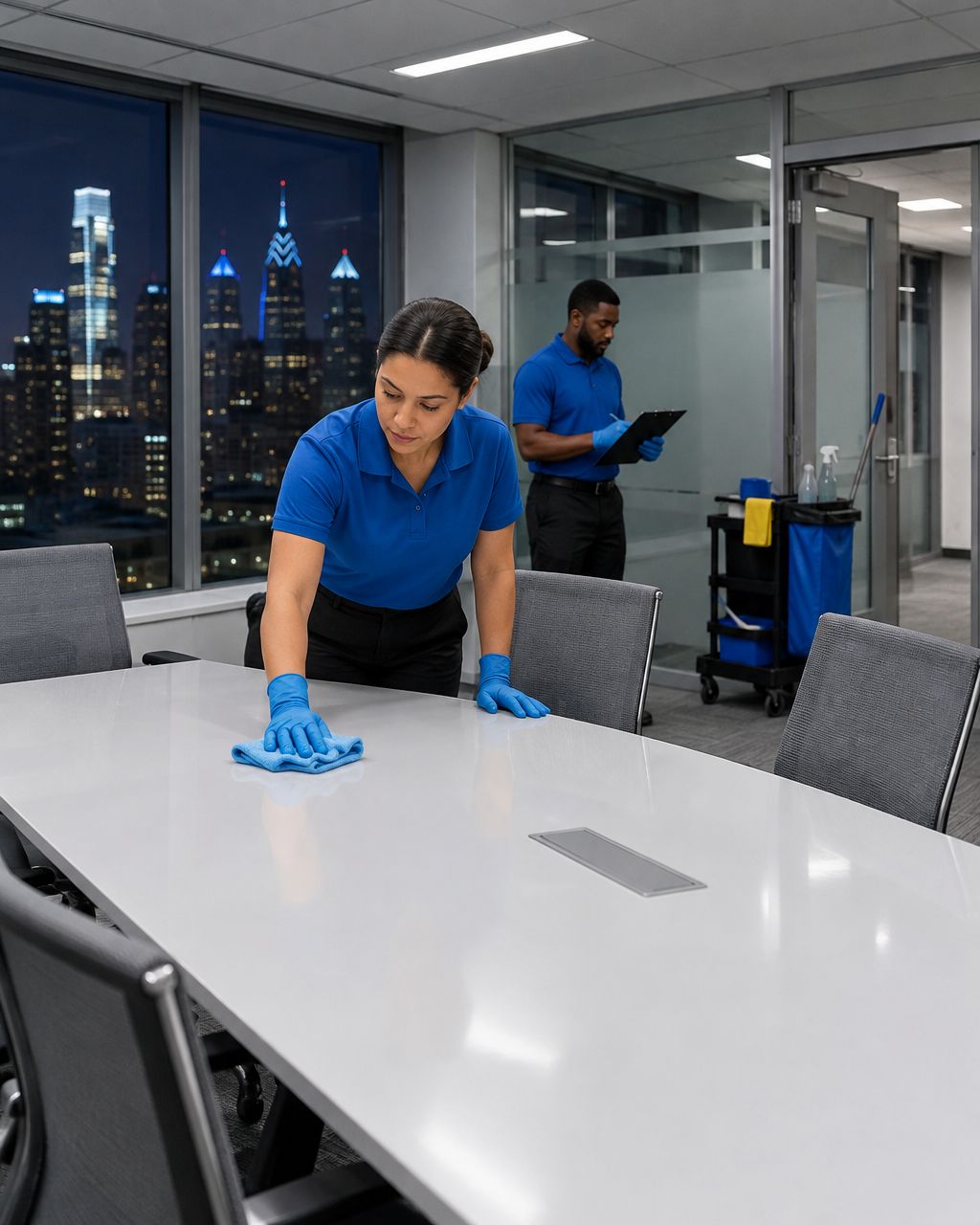
Philadelphia office night cleaning services are after-hours cleaning assignments defined by approved rooms, tasks, access and closing responsibilities. This 2026 guide shows you how to turn those requirements into a written scope that your facility manager, cleaning team and security contact can use without guessing.
Key takeaways
- Philadelphia office night cleaning services need written tasks, service windows, access rules and lock-up responsibilities.
- Define approved surfaces and exclusions before work starts; an unlocked room does not authorize every task.
- Separate crew attendance from task completion, blocked work and supervisor checks.
- Hi Shine provides dedicated commercial cleaning teams and facility-specific HI-Q™ checklists across Greater Philadelphia.
- Request a facility assessment with your room list, access restrictions and unresolved cleaning issues ready.
Why Philadelphia offices need an after-hours scope
After hours, cleaning involves more than the room list. Someone must authorize entry, identify occupied spaces, protect restricted areas and confirm how the building closes. Leaving those duties implicit makes an ordinary service question difficult to resolve the next morning.
Your commercial office cleaning requirements should distinguish the night assignment from daytime upkeep. Restroom restocking, meeting-room resets and trash removal need clear ownership when more than one shift handles the building. A task should not disappear because each shift assumes the other completed it.
A useful scope tells you what should happen and what happens when it cannot. You need a task list, but you also need a route for occupied rooms, missing supplies, denied access and unfinished work. The following steps keep those decisions in the agreement rather than in late-night phone calls.
Build your 2026 night cleaning scope
Set the service window and covered days
Start with your actual building schedule. Identify when cleaning staff can enter, when occupied areas become available and when work must end. Define covered days separately from hours; an after-hours assignment does not automatically mean service every night.
Account for security-desk coverage, elevator access, late meetings and the morning opening routine. Floor work must follow the approved method and its drying requirements. Do not promise a universal completion time before the room list and access conditions are known.
Write down:
- Covered service days and approved arrival and departure times.
- The contact who authorizes schedule changes or extended access.
- Rooms that remain occupied during part of the window.
- Work that requires an empty area or a separate appointment.
- The process for a late meeting, holiday or building closure.
Reconcile the task list with the available window. Record occupied rooms as deferred rather than leaving their status unexplained.
Map rooms, surfaces and task boundaries
Use a floor plan or a simple room list. Walk the building with the service supervisor and identify each included zone, its approved surfaces and the work expected there. A phrase such as “clean all offices” does not establish permission to move documents, handle equipment or open storage.
The table below is a planning aid, not a promise that every task belongs in every nightly visit. Assign the actual interval and method in your agreement.
| Office zone | Tasks to define | Boundary to confirm |
|---|---|---|
| Reception and lobby | Approved counters, ordinary trash, floor maintenance and glass touch-ups | Reception equipment and display items |
| Work areas | Accessible approved surfaces, ordinary trash and floors | Papers, personal items and devices |
| Conference rooms | Tables, floors, trash and approved touchpoints | Occupied rooms, whiteboards and meeting materials |
| Restrooms | Fixtures, mirrors, floors and agreed restocking | Product instructions and supply ownership |
| Kitchens and breakrooms | Counters, sinks, appliance exteriors, trash and floors | Food, dishes and appliance interiors |
| Corridors and stairs | Floor maintenance and approved handrails or touchpoints | Access routes and restricted doors |
For each room, record:
- The room name or identifier used by your staff.
- Included tasks and approved cleaning methods.
- The interval or condition that triggers each task.
- Surfaces and materials that must remain untouched.
- How blocked access or unfinished work is reported.
Keep nightly maintenance separate from periodic work. Carpet cleaning, high dusting and restorative floor care require their own approved scope and schedule. Adding them to a general duty list does not establish when they will happen.
Assign access, keys, badges and alarm duties
Your building controls who can enter and where they can work. Agree on authorized personnel, credential handling and check-in requirements before the first shift. Include the same process for backup personnel; knowing the regular crew is not enough.
Keep sensitive access information in the building's approved system, not in an openly shared cleaning checklist. If a badge fails or a restricted door is unlocked, the crew needs a named contact and an instruction that does not require improvising.
Specify:
- Who approves regular and substitute personnel for access.
- Who issues, stores, returns or deactivates credentials.
- The check-in and check-out process required by the building.
- Restricted areas and the rule for unexpected access problems.
- Who operates alarms and verifies doors at departure.
An open door is not authorization to enter a restricted room. Likewise, an access record establishes presence, not completed cleaning. Preserve both distinctions when reviewing the night assignment.
Confirm staffing, backups and supervision
Identify the assigned team, service supervisor and building contact. Ask how absences are covered and how a replacement worker receives current room instructions. Dedicated staffing still needs a backup plan that respects your access requirements.
Hi Shine provides dedicated commercial cleaning teams across Greater Philadelphia. Hi Shine's commercial office cleaning service also includes 24/7 owner access. Confirm the proposed service window, backup arrangements and issue-handling expectations for your specific building rather than assuming a particular staffing level or response commitment.
Document:
- The service supervisor responsible for the assignment.
- The contact who approves personnel or access changes.
- How backup staff receive the current scope.
- How your building is notified of a staffing change.
- Who receives a service issue when the local contact is unavailable.
Keep service issues separate from building emergencies. Direct owner access does not replace your security or facilities decision-maker.
Allocate supplies, products and equipment
Separate purchasing from stocking and restocking. The organization buying restroom consumables is not automatically the one checking storage or filling dispensers. Assign each responsibility and define how a shortage reaches someone authorized to resolve it.
Use approved products and methods for the surfaces in scope. Equipment availability does not authorize an unapproved floor treatment, and a substitute product should follow your approval process. Workers should follow manufacturer instructions and the building's relevant procedures.
Include:
- Who buys, stores and replenishes agreed consumables.
- Who checks stock and receives shortage notifications.
- Approved products, surface restrictions and substitution rules.
- Where equipment is stored and who maintains it.
- How unavailable supplies or equipment affect the task record.
Record supply shortages as exceptions and assign the correction to a named contact.
Define completion checks and exception handling
Start with a written task list and a simple exception record. You do not need to assume a customer dashboard, photographs or an automatic report after every visit. Agree on the information your building receives and the format the service can actually provide.
Hi Shine's HI-Q™ Quality System configures tasks to your facility's specifications. The dedicated team works through the checklist at each visit, and the team lead confirms completion before wrapping up. Unfinished work is flagged for follow-up; confirm how relevant exceptions will reach your building contact.
For your 2026 review, agree on:
- How included tasks are confirmed as complete.
- How occupied rooms, access problems and shortages are recorded.
- Who reviews unresolved exceptions and assigns the next action.
- The supervisor inspection schedule and areas checked.
- How a reported omission is corrected and closed.
Attendance, completion and inspection answer different questions. Arrival tells you someone entered. A task record tells you what was done or blocked. An inspection checks the condition against the agreed scope; none should be treated as a substitute for the others.
Write the lock-up and morning handoff
Assign closing responsibilities to named roles. Confirm whether cleaning staff, security or another building representative checks doors and operates alarms. Do not make cleaning staff responsible for a closing duty they lack permission or access to perform.
The handoff should explain what remains unresolved and who owns it. A door that will not latch needs a different response from a missed wastebasket. Follow the building's incident procedures rather than treating every condition as routine service work.
Require the agreed handoff to identify:
- The responsible closing role and departure confirmation.
- Door or alarm exceptions that require notification.
- Where ordinary waste is placed for the building's removal process.
- Unfinished cleaning, the reason and the next responsible person.
- Conditions requiring your facilities or security contact's decision.
Define acknowledgment and backup contacts for important notices; sending a message alone does not establish receipt.
Control special nights and scope changes
Late meetings, tenant moves and events change room availability. Use written notice and acknowledgment to identify affected rooms, tasks and access. Keep the rest of the assignment unchanged unless your authorized contact approves a revision.
Review recurring exceptions in the 2026 scope. Repeatedly blocked rooms can indicate that the window needs adjusting; recurring added tasks can indicate that the written assignment no longer matches building use. Decide on the change rather than silently adding expectations.
Record:
- Who can request and approve a temporary change.
- Which rooms, tasks or dates are affected.
- Whether the change needs additional authorization or resources.
- How regular and backup staff receive the revised instructions.
- When the normal assignment resumes.
Common gaps in an office night cleaning agreement
Treating every accessible surface as included
Define the work, not just the room. Papers, devices, food and stored materials need explicit boundaries so cleaning does not become unauthorized handling.
Confusing presence with finished work
A check-in does not establish that restrooms were restocked or the conference room was available. Review completed tasks and exceptions separately from attendance.
Leaving shared duties between shifts
Assign ordinary trash, supplies and meeting-room responsibilities by service window. A daytime and nighttime handoff needs an owner for unresolved work.
Assuming reporting or response promises
Confirm what records are available and how issues are handled. Do not infer photographs, inspection scores, response times or customer access to an internal system from a general checklist description.
Prepare for a Philadelphia facility assessment
Bring your room list, operating hours, access restrictions and unresolved cleaning concerns. Hi Shine's commercial night cleaning scope should be confirmed through a facility assessment, with the proposed tasks and service window matched to your building.
Hi Shine offers a 90-day risk-free trial. Confirm its terms and how it applies to your proposed assignment; a trial still needs a defined scope. Use actual task completion, exception handling and closing responsibilities to evaluate the arrangement during your 2026 service review.
Get a free facility assessment to discuss the commercial cleaning assignment your office needs. Identify restricted rooms and existing daytime responsibilities before the walkthrough so those boundaries enter the proposal from the start.
FAQ
What should night cleaning services include for Philadelphia offices?
Night cleaning services should include a building-specific task list, covered days, service window, access rules and agreed closing responsibilities. Define supplies, exceptions and completion checks in the same scope.
Does night cleaning mean service every night?
No. The agreement should state covered days separately from after-hours access. Set the assignment around your office's approved tasks and operating requirements.
Can cleaners move papers or clean computer equipment?
Only when those tasks and methods are explicitly authorized. Define document, device and personal-item boundaries instead of treating an accessible desk as permission to handle everything on it.
Who should hold keys and set the alarm?
Only personnel authorized by your building should hold credentials or operate alarms. Name the responsible roles, including backups, and document the procedure for access or closing problems.
How can I verify that office cleaning was completed?
Agree on task confirmation, exception records and supervisor checks against the written scope. Attendance alone does not prove that the assigned work was completed.
Who supplies restroom consumables and cleaning products?
The agreement should identify purchasing, storage, stock checks and restocking responsibilities. It should also define approved products and how shortages or substitutions are handled.
Does Hi Shine provide night cleaning services in Greater Philadelphia?
Hi Shine provides dedicated commercial cleaning teams across Greater Philadelphia. Request a facility assessment to confirm the night service window, room-level tasks and access requirements for your office.
One last thing
Ask who receives the unfinished task when the crew leaves. If the answer is unclear, the scope has a handoff gap. Name the recipient and next decision before service starts, so a recorded exception becomes an action rather than another morning complaint.