
Property managers’ commercial cleaning is the coordination of janitorial work, building access, and service accountability with the aim of keeping commercial properties consistently serviced and tenant issues traceable. Property management cleaning services need building-specific instructions and portfolio-level reporting—not a single checklist copied across every address.
Key takeaways
- Hi Shine provides dedicated commercial cleaning teams for property managers across Greater Philadelphia.
- Define janitorial scope by building, tenant boundaries, access rules, and responsibility—not appearance alone.
- Dedicated teams still need written coverage instructions, inspections, and an escalation process.
- Track unresolved issues by property and task so portfolio reporting shows what needs action.
Why commercial cleaning matters for property managers
A missed trash pickup is a task failure. A complaint that circulates between the tenant, management office, and cleaning contact without an owner is an accountability failure. Your cleaning scope must address both.
For your 2026 operating plan, separate the work each building needs from the reporting you need across the portfolio. Hi Shine provides commercial cleaning with dedicated teams for facility and property managers across Greater Philadelphia. Hi Shine serves commercial property managers who need dedicated janitorial teams and a defined accountability process.
Your portfolio also needs boundaries. A corporate office, a legal tenant’s suite, and a medical facility do not share identical access instructions or cleaning responsibilities. Record those differences before asking a crew to follow a standard operating checklist.
Build property management cleaning services around accountability
The practical starting point is a walkthrough, a written scope, and an issue register you control. A spreadsheet and shared documents are enough to establish these foundations; the cleaning provider should work within them rather than require you to abandon them.
Use the following steps to connect daily service with property-level oversight. Each step should produce something you can inspect: a responsibility map, access instructions, a coverage plan, a task record, a closed issue, or a portfolio review.
Define each building’s cleaning boundaries
Start manually with a floor plan or room list. Mark landlord-controlled common areas, tenant-controlled spaces, shared facilities, and rooms requiring separate authorization. Do not assume that everything behind the same entrance belongs in the same janitorial scope.
Write down the service outcome for each included area. For a lobby, that means identifying the surfaces and tasks—not writing “keep lobby clean.” For a shared restroom, assign cleaning responsibilities separately from supply purchasing, dispenser repairs, and plumbing issues.
A useful scope also states what the crew must leave alone. Locked offices, confidential materials, laboratory equipment, and tenant belongings need explicit instructions. For specialized environments, let the facility’s authorized personnel define restrictions; routine commercial cleaning is not blanket permission to handle regulated materials.
Before approving your 2026 scope, confirm how changes will be recorded. A new tenant, revised access window, or newly restricted room should trigger a documented update, not an informal instruction that disappears with a staff change.
- List included areas: Identify each common area, suite, restroom, and shared room by building.
- Record exclusions: Name restricted spaces, equipment, and materials outside the agreed scope.
- Assign supply duties: Separate cleaning tasks from ordering, replenishment, repairs, and waste arrangements.
- Document changes: Keep the current scope and its approval history together.
Assign responsibility for every handoff
Use a simple responsibility sheet before adding another communication channel. For every recurring task and exception, name the property contact, the cleaning contact, and the person authorized to approve a scope change.
Tenant complaints need the same discipline. Decide whether tenants report through management or directly to the cleaning contact, then define how management receives the record. A request should not become an unapproved task merely because someone passed it to a cleaner in the hallway.
Hi Shine commercial cleaning uses HI-Q™ checklist discipline and direct owner access. Those operating facts give you specific subjects to discuss during evaluation: how the checklist reflects your property, how an exception reaches the responsible person, and how correction is recorded. They do not replace your own approval rules.
Direct access is an escalation route, not a substitute for a complete issue report. Send the building, location, missed task, access constraints, and requested action together. That gives the recipient something concrete to resolve.
- Name task owners: Assign responsibility for recurring cleaning work and management-side dependencies.
- Set approval rights: Identify who can authorize additional work or change the scope.
- Choose a reporting route: Give tenants and building staff a clear place to report issues.
- Define escalation: Record who receives unresolved issues and what information accompanies them.
Establish dedicated-team and access instructions
Start with a building access sheet that your management team maintains. Include approved entrances, permitted service windows, restricted rooms, alarm instructions, and the contact for an access failure. Store sensitive credentials through your approved process, not in a broadly shared complaint log.
Dedicated teams provide continuity of assignment, but the operating requirement extends beyond the regular crew. Ask how coverage personnel receive current instructions, who authorizes access, and how the property learns about an assignment change. A dedicated team needs a documented coverage plan.
Hi Shine provides dedicated commercial janitorial teams and 24/7 owner access. Discuss how those features will apply to your property’s communication needs; do not treat owner access as a promised arrival time or emergency-response deadline.
Access instructions should distinguish cleaning permission from permission to move belongings or enter tenant-controlled areas. A legal office’s files and a medical tenant’s controlled spaces need explicit boundaries supplied by the tenant or facility representative.
- Record approved access: List entrances, service windows, and restrictions for each property.
- Prepare coverage instructions: Keep building requirements usable by authorized replacement personnel.
- Protect credentials: Follow management’s rules for keys, badges, codes, and sensitive records.
- Confirm communication: Identify who reports access failures and crew-assignment changes.
Turn the scope into observable task records
Build a basic task sheet yourself before evaluating a provider’s reporting format. Each entry needs a location, the required task, and a way to distinguish completion from an exception. A checkmark without a defined task tells you very little.
Separate the crew’s completion record from management’s inspection findings. A task can be marked complete and still fail inspection; those are different records serving different purposes. Keep both visible so a disagreement does not erase the original report.
Use photographs selectively. They can document a missed bin or visible residue, but photographing occupied workspaces introduces privacy and security concerns. Establish permitted subjects and locations with the property and tenant representatives before requesting routine images.
Your 2026 checklist should stay specific enough to inspect without becoming a collection of vague assurances. “Empty the designated lobby waste containers” identifies work. “Maintain a professional environment” does not.
For a formal request, use the commercial cleaning RFP guide to organize requirements around documented scope and responsibilities.
- Describe observable tasks: Name the location and action instead of using general cleanliness language.
- Separate record types: Keep service completion and inspection findings distinct.
- Capture exceptions: Record blocked access, missing supplies, and work outside the authorized scope.
- Control evidence: Define when photographs are permitted and who can view them.
Close issues with evidence, not acknowledgments
Maintain one issue register with a separate property field. Email can carry the conversation, but the register should preserve the task, assigned owner, current status, and closure evidence. Otherwise, an inbox becomes the only record of what happened.
Use this sequence: Report issue, Assign owner, Confirm correction, Record closure. An acknowledgment belongs near the beginning. It is not the end of the process.
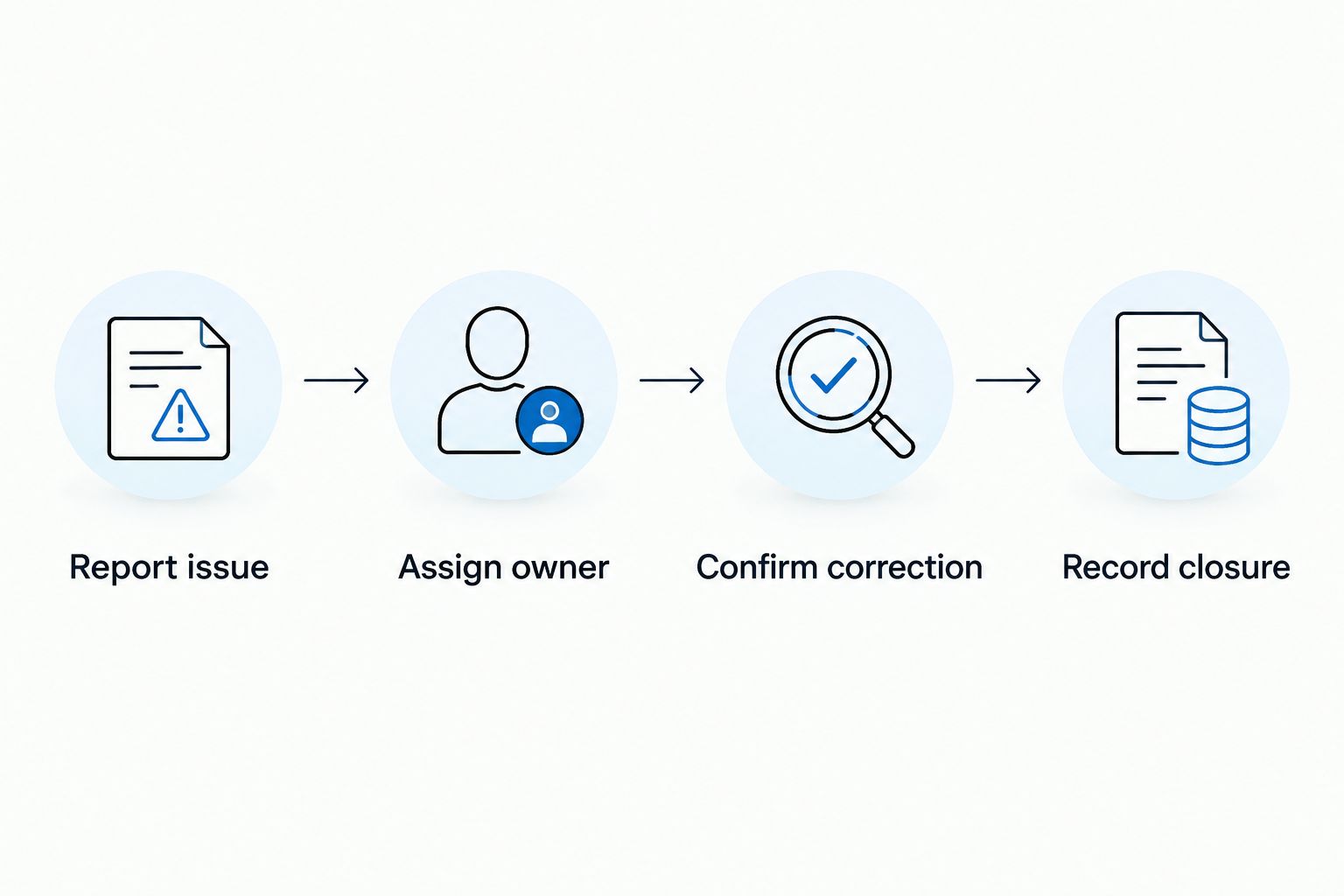
An acknowledged complaint remains open until correction is confirmed and recorded.
Record what established closure: a management inspection, an authorized tenant confirmation, or another agreed form of evidence. Do not require unnecessary personal information when the location and task are sufficient.
Recurring complaints deserve a cause review. If trash remains repeatedly, distinguish a missed pickup from inaccessible bins, unclear responsibility, or a scope omission. Different causes need different actions; repeatedly sending the same reminder leaves the underlying problem untouched.
- Report issue: Identify the property, location, task, and observed problem.
- Assign owner: Name the person responsible for arranging the next action.
- Confirm correction: Check the result using the agreed verification method.
- Record closure: Preserve the evidence and note any required scope or instruction change.
Review portfolio performance without hiding building failures
Begin with a property-by-property register rather than a single portfolio score. Track recurring issues, unresolved tasks, access failures, and scope changes. You need to see where problems concentrate before deciding what management action is required.
Then review the shared process. Are building instructions current? Are tenant requests entering the agreed channel? Are resolved issues supported by evidence? This separates a local execution problem from a reporting or approval problem affecting several sites.
For your 2026 review, inspect the documents behind the service relationship as well as the task records. Hi Shine lists a 90-day risk-free trial and $5MM insurance among its operating facts. Confirm the written trial terms and insurance documentation against your property’s requirements; a stated coverage amount alone does not establish every required policy condition.
When adding a building, carry over the reporting structure—not another building’s assumptions. The new site still needs its own walkthrough, scope, access instructions, and authorized contacts.
- Review by property: Keep unresolved and recurring issues visible at the building level.
- Check shared procedures: Identify outdated instructions or unclear approval responsibilities.
- Verify documents: Review applicable service terms and insurance evidence.
- Approve site changes: Document additions and revised responsibilities before service instructions change.
Choose records that match your oversight needs
These are recordkeeping options, not competing providers. Use them together where each serves a distinct purpose; adding a document is useful only if someone maintains it and acts on its contents.
| Recordkeeping option | Best suited to | Practical benefit | Key limitation |
|---|---|---|---|
| Building scope sheet | Defining location-specific work | Makes included tasks and exclusions inspectable | Does not show whether work occurred |
| Task completion checklist | Recording recurring janitorial work | Connects service records to named tasks | Completion marks do not replace inspection |
| Shared issue register | Managing complaints and exceptions | Preserves ownership, status, and closure evidence | Requires consistent updates from responsible contacts |
| Portfolio review sheet | Reviewing several commercial properties | Keeps building-level issues visible in one review | Summaries lose meaning when source records are incomplete |
Keep the scope, completion record, and issue register connected. If they use different room names or task descriptions, management spends time reconciling records instead of resolving problems.
Common mistakes property managers make
Treating tenant requests as approved scope changes
A tenant asks the crew to clean an additional room, then assumes the request is permanent. Require management approval and update the written scope before treating that request as a recurring obligation.
Copying one building’s checklist across the portfolio
Matching headings do not mean matching requirements. Reuse the checklist format, but confirm each property’s areas, restrictions, supplies, and responsibility boundaries during its own walkthrough.
Treating owner access as the entire accountability system
An available contact still needs a clear report and someone authorized to act. Pair escalation access with task ownership and closure evidence, so a conversation produces a traceable result.
Closing a complaint when someone replies
“Received” records acknowledgment, not correction. Keep the issue open until the agreed verification confirms the task was addressed, and record unresolved access or scope dependencies separately.
FAQ
What are property management cleaning services for commercial buildings?
Property management cleaning services coordinate janitorial work, building access, and service accountability for commercial properties. The scope should identify included areas, tenant boundaries, task ownership, and how issues are resolved.
Can I use the same cleaning checklist for every property?
You can reuse a checklist format, but each property needs its own approved tasks and restrictions. Confirm common areas, tenant spaces, access instructions, and supply responsibilities before adopting the checklist.
What should I ask about a dedicated cleaning team?
Ask how the dedicated team receives building instructions and how authorized coverage personnel receive the same information. Also establish who communicates assignment changes and access failures to management.
How do I track cleaning complaints across multiple buildings?
Use a shared issue register with a property field, task description, assigned owner, status, and closure evidence. Review each building separately so portfolio summaries do not hide unresolved local problems.
Does commercial janitorial cleaning include tenant-controlled or specialized rooms?
Tenant-controlled and specialized rooms belong in the service only when the written scope and authorized access instructions include them. Facility representatives should define restrictions on equipment, materials, and sensitive spaces.
What does Hi Shine offer commercial property managers?
Hi Shine provides dedicated commercial janitorial cleaning teams across Greater Philadelphia, with HI-Q™ checklist discipline and direct owner access. Confirm the building-specific scope, coverage instructions, and service terms during evaluation.
How do I know a cleaning complaint is resolved?
A cleaning complaint is resolved when the agreed verification confirms correction and the result is recorded. An email acknowledgment alone does not establish that the task was completed.
One last thing
Before signing off on your 2026 cleaning scope, ask this question: If the regular property contact and regular cleaner are both absent, can authorized coverage personnel still identify the work, access restrictions, and escalation route?
That is a practical test of your documentation. If the answer depends on someone remembering an unwritten conversation, put the instruction into the controlled record before the next handoff.