
Switch Cleaning Vendors Without a Service Gap (2026)
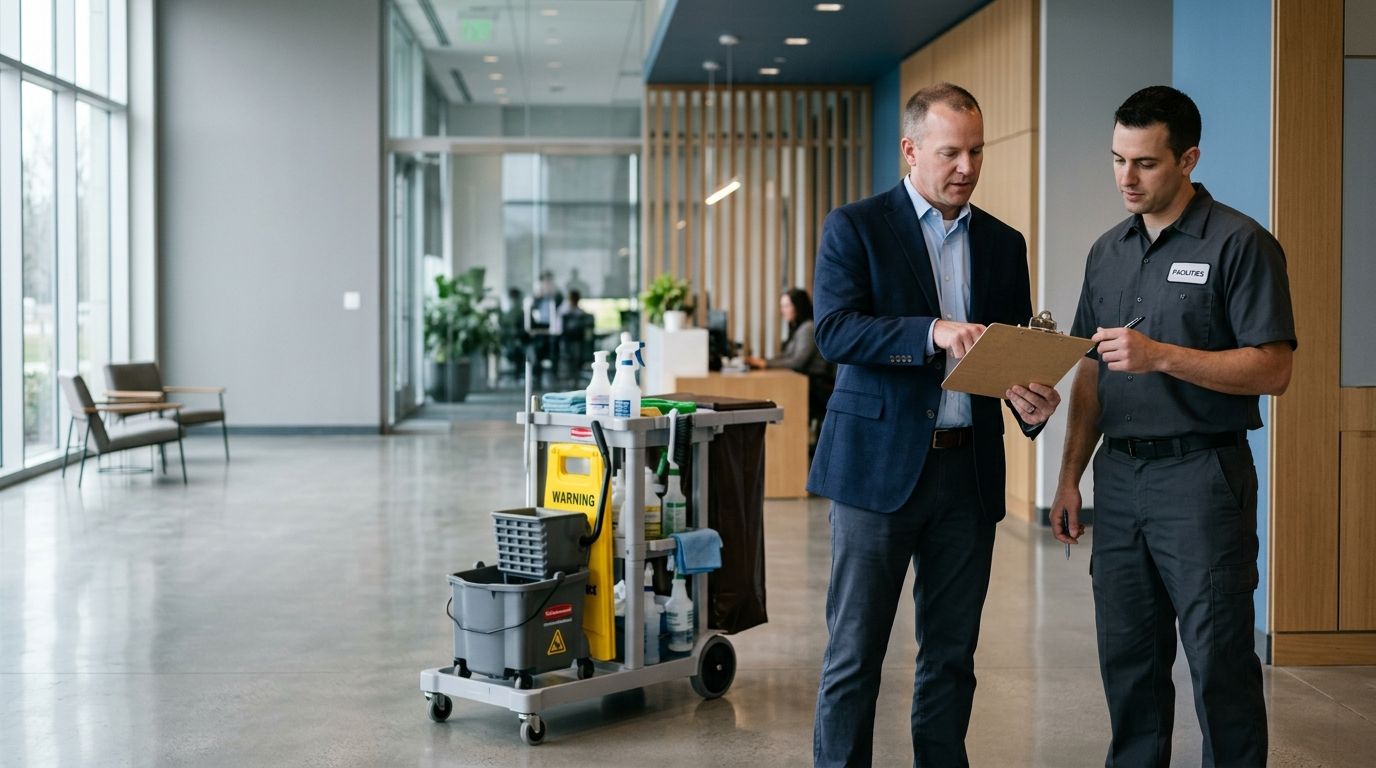
Switch commercial cleaning vendors without a service gap by running the change as a controlled facility handoff, not a simple contract swap. Lock the scope, access, supplies, staffing, and escalation process before the outgoing team leaves, then verify the new team’s work from the first shift.
- Use one written scope for the outgoing vendor, incoming vendor, and facility team.
- Confirm keys, badges, alarms, supplies, and waste routes before the first shift.
- Overlap management coverage even when cleaning crews cannot overlap.
- Judge the transition by completed tasks and corrected misses, not promises.
A 90-day risk-free trial can reduce the operational risk of a change, but the trial only works when success is defined before service begins. In 2026, the safest transition is one where every room, task, frequency, access rule, and correction owner is written down.
Why this matters
A cleaning change fails when knowledge disappears between vendors. The outgoing crew knows which loading door sticks, which conference room stays occupied late, which restroom runs out of supplies first, and which alarm instructions are easy to misread. If that information lives only in people’s heads, the new vendor starts blind.
For facility managers, the immediate risk is visible: missed trash, locked rooms left untouched, empty dispensers, tenant complaints, and no clear owner for the fix. The deeper risk is that a rough first week becomes the new normal because nobody separated transition problems from ongoing performance problems.
The 2026 standard should be simple: transfer the operating details before the contract changes, then inspect against the same written requirements from day one.
How do you switch commercial cleaning vendors without a service gap?
Use a seven-part transition plan:
- Set the final service date and first service date.
- Freeze the room-by-room cleaning scope.
- Transfer facility access without sharing old credentials.
- Assign supply and equipment ownership.
- Approve the incoming team and backup coverage.
- Run a documented first-night inspection.
- Track misses through a named correction process.
Each part needs one owner and one due date. A group email is not ownership. Name the facility contact, outgoing vendor contact, incoming vendor contact, and final approver for each handoff item.
1. Control the contract dates
Start with the notice terms in the current agreement. Confirm the required notice date, final billable service, equipment-removal deadline, key-return process, and responsibility for periodic work already scheduled.
Then set the incoming vendor’s first shift. Avoid leaving an unassigned night between the two contracts. If the outgoing vendor ends Friday and the incoming vendor starts Monday, decide who handles weekend trash, restrooms, events, deliveries, and emergency calls.
Your date sheet for a 2026 transition should include:
- Written notice date
- Final routine service date
- Final periodic-service date
- Equipment and supply removal date
- Key, badge, and credential return date
- Incoming kickoff date
- First inspection date
- First performance review date
Do not rely on the contract end date alone. A vendor can stop routine work while still needing access to remove equipment or complete a final floor-care task.
2. Freeze one room-by-room scope
The incoming vendor should not build its program from the outgoing vendor’s habits. Build it from your requirements.
List every service area, the tasks performed there, and the required frequency. Separate daily work from weekly, monthly, quarterly, and request-only work. Identify exclusions so specialized, clinical, research, IT, or tenant-controlled spaces do not become assumptions.
A useful scope includes:
- Room or zone name
- Task description
- Frequency
- Approved service window
- Surface or equipment restrictions
- Supply responsibility
- Completion evidence
- Exception process
The facility manager cleaning guide explains why this detail matters: a vendor relationship becomes easier to manage when routine work is controlled by a documented system instead of repeated reminders.
Ask both vendors to acknowledge the final scope. The outgoing vendor uses it to close service correctly. The incoming vendor uses it to staff, train, and verify the first shifts.
3. Transfer access without creating a security gap
Never hand the incoming crew the outgoing crew’s shared codes or untracked keys. Issue access through your current security process and close the old access separately.
Build an access register with:
- Approved worker name
- Vendor and supervisor
- Building and zone permissions
- Badge or key identifier
- Allowed days and hours
- Alarm instructions
- Check-in requirement
- Expiration or removal date
Test access before the first cleaning shift. The test should cover the actual entry door, elevators, restricted floors, janitorial closets, service corridors, loading areas, and lock-up sequence.
Access problems cause false performance failures. A locked suite looks like missed cleaning unless the crew records that access was blocked. Require the incoming team to report blocked work during the shift, not the next morning after complaints begin.
4. Assign supplies, closets, and equipment
Cleaning closets often become the most confusing part of a vendor transition. Inventory what belongs to the facility, what belongs to the outgoing vendor, and what the incoming vendor must provide.
Record:
- Consumable supplies and current counts
- Dispensers and compatible refills
- Vacuums, carts, mop systems, and floor equipment
- Product labels and safety documents
- Closet keys and storage rules
- Damaged or abandoned items
- Removal and delivery deadlines
Photograph the closet condition at handoff. The goal is not to create a dispute file; it is to give everyone the same starting point.
Do not let the outgoing vendor remove facility-owned supplies by mistake. Do not let the incoming vendor assume that unlabeled chemicals or equipment are approved for use. In 2026, every item used on-site should have a clear owner and approved purpose.
5. Approve the incoming team and backup plan
Get the roster before the first shift. Confirm the assigned supervisor, regular team members, replacement process, and emergency contact. If your facility requires screening, confidentiality rules, training, or site-specific orientation, complete those steps before access is activated.
Hi Shine uses dedicated teams because facility familiarity affects consistency. The operating principle is broader than any one vendor: the same people learn the layout, priority zones, access rules, and recurring exceptions faster than a rotating roster.
Ask four direct questions:
- Who is permanently assigned to this building?
- Who covers an absence?
- Who confirms the work is complete?
- Who can authorize a same-day correction?
The answers should name people or roles, not a generic service desk.
6. Run the first shift as a controlled launch
The first shift should not be treated like an ordinary cleaning night. Hold a site walk before work begins, confirm the scope and access route, and identify any last-minute occupancy or event changes.
Use the HI-Q Quality System as a model for the control you want: facility-specific tasks, a consistent completion sequence, confirmation before departure, and escalation when something cannot be completed.
Inspect the first shift against the written scope. Check a sample across high-visibility, high-use, and easily missed areas:
- Main entrances and lobbies
- Restrooms and dispensers
- Breakrooms
- Conference rooms
- Interior glass
- Trash and recycling points
- Priority offices or tenant areas
- Janitorial closets
Record what passed, what was blocked, what was missed, and who owns each correction. A first-night miss is not automatically a failed vendor. An undocumented miss with no correction owner is the warning sign.
7. Separate transition issues from performance issues
Expect a small number of setup corrections. A badge permission may be wrong. A supply location may be unclear. A task may need a better description. Fix those quickly and update the operating documents.
Performance issues are different. Repeatedly missed tasks, rotating unapproved workers, unreported access failures, and slow corrections indicate that the operating system is not working.
Track the first 2026 review period with a short scorecard:
| Measure | What to record | Warning sign |
|---|---|---|
| Scope completion | Required tasks completed | The same task is repeatedly missed |
| Access exceptions | Blocked zones reported during service | Problems appear only after complaints |
| Staffing continuity | Assigned and backup staff used | Unannounced roster changes |
| Supply readiness | Required items available | Repeated stockouts |
| Correction response | Misses assigned and closed | No named owner or closure record |
The scorecard should drive decisions. General impressions like “better” or “about the same” are too vague to manage.
What should the outgoing vendor provide?
Request the return of facility property and a clean closeout record. That includes keys, badges, alarm devices, facility-owned equipment, current task schedules, open issue notes, and confirmation that vendor-owned materials have been removed.
Do not request proprietary employee information or internal vendor documents. You need the facility’s operating information, not the outgoing company’s private records.
Use the Philadelphia commercial cleaning vendor checklist to compare the closeout and startup requirements against one consistent standard.
What should you tell tenants and staff?
Send one short notice with the change date, what remains the same, and where to report cleaning issues. Do not make broad promises about immediate improvement. Tell people how the new process works.
Include:
- New service start date
- Any temporary access or timing changes
- Request and complaint channel
- Emergency contact path
- Expected response owner
Ask staff not to give direct side instructions to cleaners. Untracked requests pull the crew away from the approved scope and make completion harder to verify.
FAQ
How far ahead should a facility plan a cleaning vendor switch?
Start as soon as the current contract’s notice terms are known. The plan must leave enough time for scope approval, staffing, access, supplies, orientation, and a first-shift inspection.
Should the old and new cleaning vendors overlap?
The crews do not always need to work at the same time, but management coverage should overlap. Facility information, property, access, and open issues must have a confirmed handoff owner.
Who should own the cleaning vendor transition?
One facility-side manager should own the transition. That person coordinates procurement, security, occupants, the outgoing vendor, and the incoming vendor against one written plan.
How do you prevent missed cleaning on the first night?
Freeze the room-by-room scope, test access, confirm supplies, walk the site, and inspect before the building reopens. Require blocked tasks and misses to be reported during the shift.
What happens to keys and badges when a cleaning contract ends?
Deactivate and recover outgoing credentials through the facility’s security process. Issue separately tracked access to approved incoming workers rather than transferring shared codes.
How do you judge a new cleaning vendor during a trial?
Judge the vendor against documented task completion, staffing continuity, exception reporting, supply readiness, and correction response. Promises and general impressions are not performance records.
Can Hi Shine help plan a vendor transition in Philadelphia?
Hi Shine can scope commercial cleaning around the facility’s rooms, schedules, access rules, and accountability needs. A facility assessment is the right starting point for a Philadelphia transition.
One last thing
Do not schedule the first performance meeting and then wait for it. Review the first shift, the first week, and every repeated miss as it happens. In 2026, fast correction is part of the service, not an extra favor.
When the scope, access, staff, supplies, and escalation path are ready, request a facility assessment to build the transition around your building instead of a generic checklist.