Industrial cleaning in Chester County should start with approved service zones, written tasks and a schedule that respects production. This 2026 guide helps facility managers define commercial janitorial work without assuming that machinery, process areas or restricted waste belong in the same scope as offices and restrooms.
Key takeaways
- Industrial cleaning in Chester County needs an approved task list for each service zone.
- Separate ordinary janitorial work from machinery, process areas, restricted waste and specialist procedures.
- Set service windows around actual shifts, access restrictions and production downtime.
- Require assigned personnel, approved backups, completion confirmation and a named exception contact.
- Hi Shine provides dedicated commercial cleaning teams; confirm the proposed scope for your Chester County facility.
Why zone-level scope matters
An industrial building can contain offices, breakrooms, locker rooms, loading areas and production-adjacent corridors. Those areas do not share the same permissions or tasks. A broad instruction to clean the building leaves workers guessing where routine janitorial responsibility ends.
Hi Shine's industrial and manufacturing cleaning scope includes administrative cleaning, breakroom and locker room sanitation, restroom service, floor care and scheduling around shifts and downtime. Discuss the actual areas included before treating a service description as authorization for production work.
Write the boundary before writing the route. Facility operations and safety personnel should identify restricted areas, approved surfaces and conditions that stop a task. The cleaning team then follows that approved assignment rather than deciding what looks safe or accessible.
Build the 2026 scope from the actual facility
Map the included and excluded zones
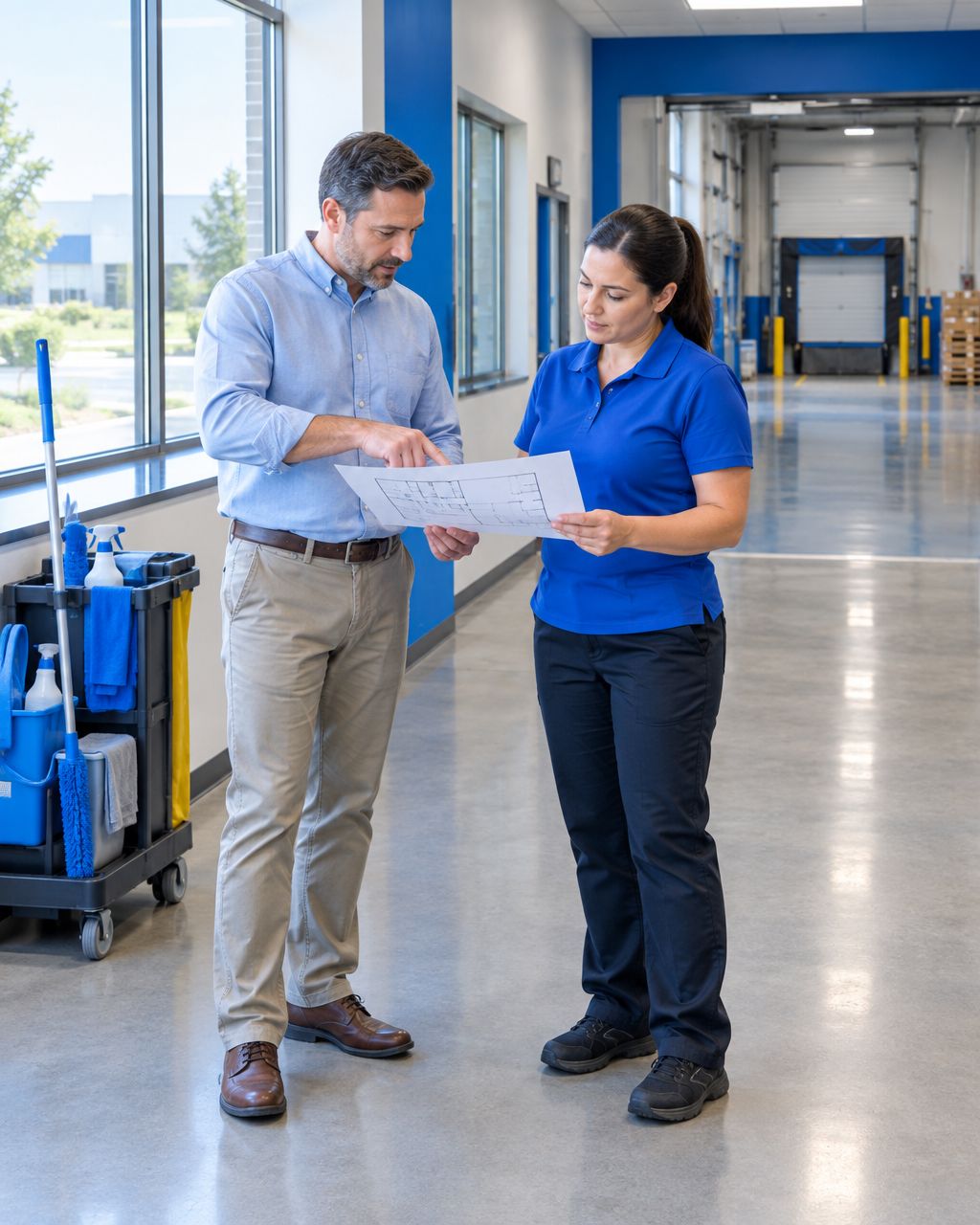
Use a current floor plan and room list. Walk the service areas with someone who can authorize the work, and identify which rooms belong in ordinary janitorial service. Mark conditional areas separately from spaces the crew must not enter.
Record these fields for each zone:
- Room or area name that workers can recognize.
- Included tasks and accessible surfaces.
- Equipment, materials and spaces excluded from the task.
- Person who approves entry or answers boundary questions.
- Available service window and movement route.
A route should not require a worker to cross an excluded space simply because it is the shortest path. Check the access to storage, water, ordinary waste collection and the exit as well as the rooms being serviced.
Keep unresolved questions visible. If the facility has not authorized a surface or decided who owns a waste stream, record the work as unresolved or excluded. Do not turn an unanswered question into a cleaning instruction to keep the walkthrough moving.
Write tasks that can be checked
Replace broad labels with observable work. For a breakroom, specify the approved counters, sink, tables, appliance exteriors, floors and ordinary trash points. For a restroom, identify fixtures, floor care and dispenser responsibilities.
Your task sheet should distinguish:
- Routine work completed at an agreed service visit.
- Periodic work that needs a separate schedule.
- Work performed only after facility approval.
- Facility-owned maintenance and specialist procedures.
- Tasks blocked by occupancy, access or an unresolved hazard.
An instruction to sweep an approved floor does not include moving machinery, disconnecting equipment or cleaning inside a production system. Those are different assignments. State the limit next to the task so it travels with the instruction.
Set frequency from use and operating requirements
There is no building-wide frequency that fits every industrial site. Review actual occupancy, shift patterns, visible soil, restroom demand and available access with the facility owner. Define which tasks occur at each service visit and which follow a separate calendar.
For your 2026 schedule, document the agreed frequency, the service window and the trigger for reviewing it. An additional shift, a changed route or a newly occupied area can alter the assignment without changing the building's total size.
Do not assume every production floor needs daily janitorial service or that every warehouse can wait longer. The approved task and operating conditions determine the requirement. Specialized procedures remain under the facility's applicable instructions rather than a general janitorial calendar.
Plan around shifts and production movement
Walk the proposed route under representative conditions when permitted. Identify shift-change traffic, occupied breakrooms, loading activity and times when cleaning equipment would block movement. Choose windows with the operations team rather than relying on an empty-building tour.
Confirm:
- Entry and departure times for the assigned crew.
- Areas that remain available during each window.
- Routes that avoid active vehicle or production movement.
- Where tools and supplies can be staged.
- What happens when production runs beyond the planned window.
Keep emergency access and required movement routes clear. If a task cannot be completed without crossing a restricted route or creating an unsafe obstruction, stop and notify the facility contact. Rescheduling is a decision to document, not a reason to improvise.
Define products, tools and storage
Identify the facility-approved products and surface restrictions for the included work. Record who supplies consumables, who maintains tools and where items are stored. Where the facility requires separation by zone, put that requirement in the instructions.
Check product substitutions before they happen. A product suitable for one surface is not automatically suitable for every finish or operating environment. Workers need the approved method and applicable manufacturer instructions, not permission to choose whichever bottle is available.
Give low stock an owner. The crew should know whom to notify when supplies are unavailable and how that affects the scheduled work. A shortage belongs in the exception record rather than disappearing behind a completed checklist line.
Make staffing and backup approval explicit
Ask for the assigned personnel, supervisor and absence procedure. Dedicated staffing provides continuity, but illness, leave and personnel changes still require a plan. A backup needs the facility's required authorization and instructions before taking over.
Hi Shine uses dedicated commercial cleaning teams. Connect that staffing model to your building's requirements: approved access, no-touch boundaries, route training and a named contact when a task cannot proceed.
Document who maintains the roster and who removes credentials when an assignment ends. Do not assume an old badge is valid indefinitely or that a familiar worker is exempt from revised facility instructions.
Separate responsibilities before the first visit
A responsibility table helps you locate gaps without ranking service providers or assuming technical capabilities.
| Work or decision | Responsibility to define |
|---|---|
| Ordinary janitorial tasks | Assigned service team, approved rooms and completion process |
| Machinery and process equipment | Facility owner or separately authorized specialist |
| Unknown spills or containers | Stop-work and notification to the facility's responsible contact |
| Ordinary trash and recycling | Approved collection points, containers and handoff |
| Restricted waste streams | Facility-controlled ownership and authorization |
| Access and procedure changes | Facility approver and service-side communication owner |
| Periodic floor care | Approved method, schedule, available area and review owner |
Review the table with operations before contract launch. A blank responsibility field is an open decision, not shared ownership. If several teams use the same corridor or waste area, identify where each assignment begins and ends.
Make completion and exceptions visible
Hi Shine's HI-Q™ Quality System configures tasks to facility specifications, uses a checklist at each visit and requires team-lead confirmation. Unfinished work is flagged for follow-up. The system supports commercial janitorial accountability; it does not replace an industrial facility's safety program or regulated records.
Agree on the information your facility receives. Internal checklist use does not automatically include a customer dashboard, photographs, signatures or a specific inspection report. Ask which records are available and put the agreed format in the service requirements.
A practical exception record identifies the area, task, reason work stopped, person notified and follow-up decision. Distinguish a missed task from a task correctly stopped at an access or safety boundary. Both need follow-up, but they are not the same operating failure.
Agree on escalation and correction
Name the facility contact for safety and authorization questions and the service contact for incomplete work. Workers should not have to decide which department owns an unfamiliar condition while standing beside it.
Hi Shine provides 24/7 owner access. Agree on acknowledgment, correction expectations and how closure is confirmed in the service agreement; a communication route and a completed correction are different commitments.
For the 2026 agreement, specify how recurring problems are reviewed. Repeated blocked tasks can indicate an unavailable service window or an incomplete scope. Repeated misses can indicate execution problems. Investigate the documented reason before changing staffing or the schedule.
Verify insurance and evaluate the trial
Hi Shine identifies $5MM insurance coverage and a 90-day risk-free trial. Request current insurance documentation and confirm the proposed coverage meets your facility's requirements. Insurance does not establish machinery-cleaning qualifications or authorize restricted tasks.
Confirm the trial's written terms and included work. Set review points with operations and evaluate the assignment under normal shifts, not only the presentation on the first day.
Use the same checks throughout the trial:
- Approved personnel attend and follow the entry process.
- Included work receives accurate completion confirmation.
- Equipment and restricted-area boundaries remain intact.
- Blocked tasks reach the designated contact.
- Corrections are assigned and checked.
- Schedule changes reflect actual operating conditions.
A trial cannot test a periodic task that was never scheduled during it. Identify what the trial will demonstrate and what still needs separate approval or a later review.
Common industrial scope mistakes
Treating the whole building as one zone
Offices, loading areas and production-adjacent spaces require distinct instructions. Keep their tasks and permissions separate even when they share a contract.
Carrying old shifts into a new agreement
Review the 2026 operating pattern before renewal. Changes in occupancy, production and access can make an old route unsuitable without anyone deliberately changing the contract.
Assuming ordinary trash includes every container
Unknown or restricted containers require facility direction. Define approved waste points and handoffs; do not infer ownership from a container's location.
Marking blocked work complete
A locked room or unsafe route needs an exception and follow-up decision. A completed checkbox cannot substitute for work that did not happen.
FAQ
What should industrial cleaning in Chester County include?
Include approved rooms, surfaces, tasks, frequencies, service windows, staffing, access instructions and exception handling. Keep machinery, process areas and restricted waste separate unless specifically authorized.
How often should an industrial facility be cleaned?
Set frequency by approved task, occupancy, soil conditions, shifts and facility requirements. There is no universal janitorial schedule for every production floor or warehouse.
Can janitorial workers clean production equipment?
Ordinary janitorial scope does not authorize production-equipment cleaning. The facility must define any separate work, qualifications, methods and permissions before it is assigned.
What happens when a task is unsafe or inaccessible?
Stop the affected task and notify the named facility contact under the approved procedure. Record the blocked work and the decision for rescheduling or resolving it.
How should backup cleaners get access?
Backups need the facility's required approval and site instructions before entry. Define roster changes, credentials and notice in the staffing plan.
What records should the facility request?
Agree on task completion, blocked-work reasons, notification and correction records. Confirm the available reporting format rather than assuming a dashboard or regulated record is included.
What industrial commercial cleaning can be discussed for Chester County facilities?
Hi Shine publishes an industrial and manufacturing scope with dedicated teams, shift-aware scheduling and HI-Q™ checklist discipline. Confirm coverage, the included tasks and exclusions for the particular address before service starts.
One last thing
Walk the proposed route, not just the rooms. Storage access, loading activity and restricted corridors can stop an otherwise clear task list from working. For your Chester County facility, request a free facility assessment with the current room list and operating restrictions ready.