
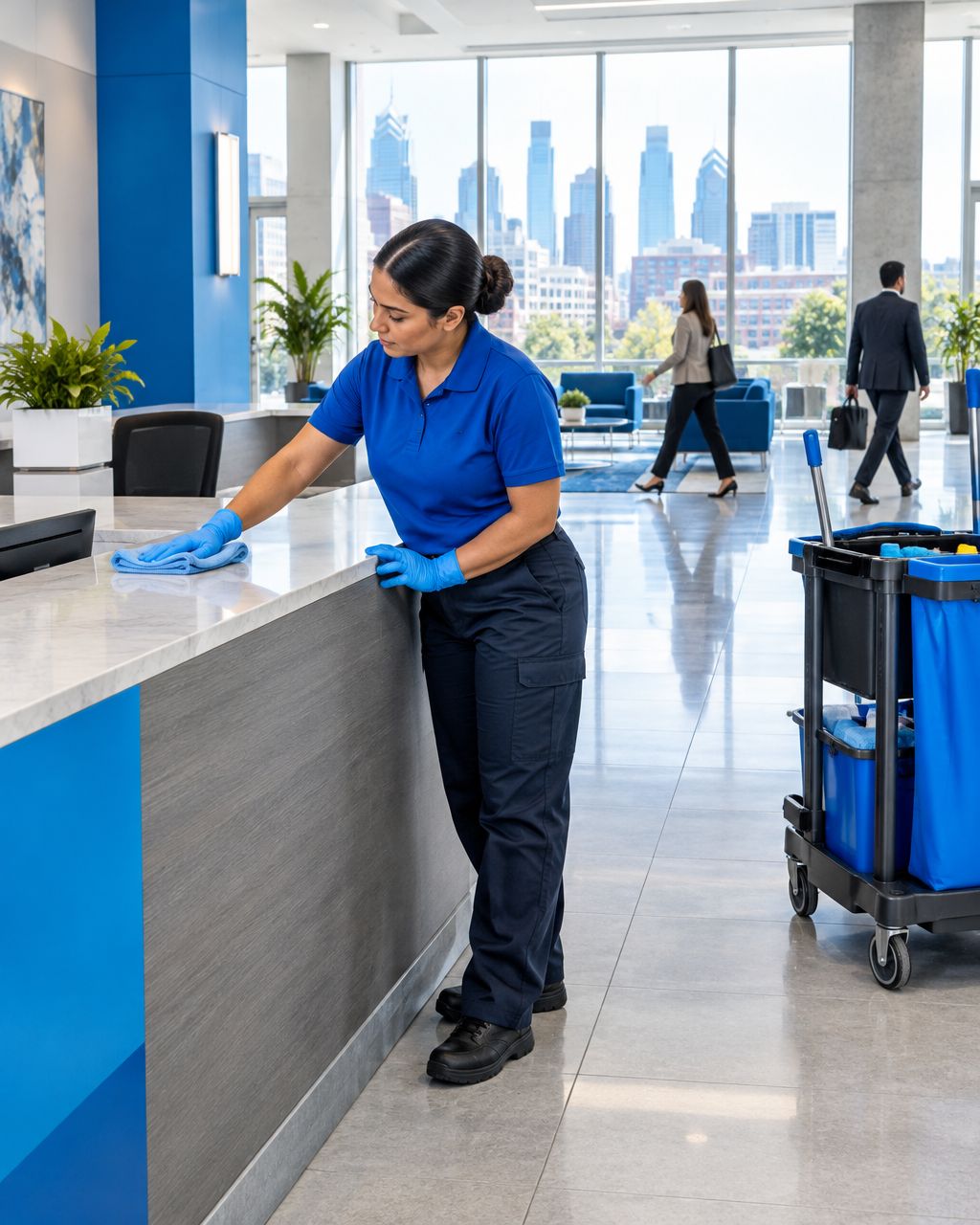
Day porter services in Philadelphia are occupied-hours cleaning assignments defined by staffed windows, approved tasks and request handling. A useful 2026 scope identifies what the porter maintains during the day, what belongs to another assignment and how blocked work, supply shortages and additional requests reach the building manager.
Key takeaways
- Philadelphia day porter services need defined staffed hours, tasks and supervision.
- Separate scheduled rounds, approved requests and work that requires additional authorization.
- Assign responsibility for purchasing, storing and restocking supplies.
- Document completion, blocked tasks and the handoff to the next service shift.
- Hi Shine provides dedicated commercial cleaning teams; confirm any proposed daytime assignment during the facility assessment.
Why daytime coverage needs a written assignment
A building changes after it opens. Occupants use restrooms, meetings leave rooms needing attention and deliveries can affect common areas. A daytime role should address agreed conditions without becoming an unlimited invitation to perform any task someone requests.
The property manager's commercial cleaning requirements should connect daytime coverage to the actual building. Identify who manages the assignment, which occupants can submit requests and who approves extra work. The role needs the same clarity as any other service in the contract.
A job title does not establish a task boundary. Staffed hours tell you when someone is available; the duty list tells you what they are authorized to do. Keep both visible to the porter, local contacts and service supervisor.
Define the 2026 daytime scope
Set the staffed window
Start with the building's occupied periods and recurring demand. Agree on covered days, arrival and departure times, breaks and the expected process for an absence. Do not assume daytime availability means uninterrupted coverage of every occupied hour.
Record:
- Normal staffed days and hours.
- Areas covered during that window.
- Approval process for schedule changes.
- Backup arrangements and notice of unavailable coverage.
- Event or extended-hours work requiring separate agreement.
Ask what happens when a meeting ends after the staffed period or a building opens early. The answer might be a revised schedule, an authorized request or a handoff to another assignment. Put the decision in the scope rather than relying on the porter to stay informally.
Write scheduled rounds as tasks
Identify the rooms and conditions the porter checks on a routine round. Restroom checks, common-area touch-ups and breakroom upkeep are examples to discuss, not a universal duty list for every building. Define each included task and its agreed interval or trigger.
A task line should identify:
- Room or service area.
- Included surface, supply or condition.
- Approved method and products.
- Check interval or response trigger.
- Completion or exception record.
Keep inspection separate from correction where appropriate. A porter can check a condition but still need authorization, materials or a different responsible team to resolve it. The task list should show when to stop and notify rather than treating every observed issue as ordinary cleaning.
Separate daytime and other service responsibilities
The overnight assignment is not automatically responsible for all deep cleaning, and the porter is not automatically responsible for every occupied-hours request. Divide work according to the actual contract, safety constraints and available windows.
| Task or decision | What the scope should establish |
|---|---|
| Restroom checks | Included fixtures, supply responsibilities and check interval |
| Common-area touch-ups | Approved surfaces, products and operating restrictions |
| Meeting-room requests | Request route, authorized work and room availability |
| Ordinary trash | Collection points, handoff and assignment by service window |
| Periodic floor care | Separate approval, method, schedule and available area |
| Unknown spills | Stop-work and notification to the responsible building contact |
| End-of-shift exceptions | Recipient and follow-up decision for the next assignment |
Review shared items with both service supervisors. Ordinary trash, supplies and recurring exceptions can be missed if each assignment assumes the other owns them. A handoff should identify the unfinished task, not merely say the area needs attention.
Give requests a clear route
Daytime occupants often see the worker directly, but a casual request is not necessarily authorized work. Define how requests are submitted, what the porter can accept within scope and what requires a supervisor or building manager's approval.
Use an agreed request record to capture the area, request, urgency, requester and decision. If a task is declined or deferred, make the reason visible. A record helps distinguish a blocked assignment from a request that was never approved.
For your 2026 scope, identify who resolves competing priorities. A meeting-room reset and a restroom check can need attention at the same time. The building needs an agreed priority process rather than leaving the porter to negotiate with whoever asks most insistently.
Assign supplies and storage
Consumables need ownership. State who buys them, who maintains stock, who restocks dispensers and who receives a low-stock notification. Define the storage location and access so the worker can reach approved supplies during the staffed window.
Include:
- Approved products and surface restrictions.
- Purchasing and inventory responsibility.
- Restocking thresholds or agreed check process.
- Notice when stock or access is unavailable.
- Approval before product substitutions.
Keep cleaning products and occupant supplies under the building's applicable storage rules. Workers should follow approved methods and manufacturer instructions. Availability of a product in storage does not establish permission to use it on every surface.
Define occupied-area precautions
Occupied work requires attention to movement, privacy, wet surfaces and noise. Identify when a room must be closed or a task deferred. Preserve required access routes and follow the building's procedures for signs or barriers.
Ordinary daytime cleaning does not authorize entering restricted offices, moving personal materials or handling unfamiliar spills. Give the worker a named contact and a way to record why the task stopped. An open room is not automatic approval for every surface inside it.
Discuss events and deliveries before they create exceptions. Some work can be planned around predictable activity; other conditions need a same-day decision. The scope should tell the porter which process applies without promising unrestricted emergency response.
Make staffing and supervision practical
Ask who is assigned, who supervises the role and who covers an absence. Dedicated workers can retain familiarity with the building, but backups still need authorized access and current task instructions. Document the notice process for personnel changes.
Hi Shine provides dedicated commercial cleaning teams across Greater Philadelphia. Confirm whether the proposed daytime assignment is available for your building and how its staffing and supervision would work. Do not infer a specific porter package, staffed-hour commitment or response guarantee from a general service description.
The building's local contact should know whom to reach without supervising every task personally. Identify the service owner for work questions and the facility owner for access or safety decisions. A worker should not be left to obtain permissions from whichever occupant is nearby.
Confirm completion without inventing a reporting package
Hi Shine's HI-Q™ Quality System configures cleaning tasks to facility specifications and requires team-lead confirmation at each visit. Unfinished work is flagged for follow-up. Confirm how that process would apply to an agreed daytime assignment.
Ask what records your building receives. A checklist system does not automatically include a time-stamped customer dashboard, photographs or a report after every round. Agree on the available format and the information needed to manage the actual scope.
For a 2026 review, separate attendance, completed tasks, requests and exceptions. Presence in the building does not establish completion of the duty list. Likewise, a deferred request outside scope is not evidence that an included task was missed.
Plan the handoff before departure
A daytime assignment should leave the next responsible person enough information to act. Identify which unresolved requests reach the evening service supervisor, which go to the building manager and which remain with a specialist or facilities team.
The handoff should identify:
- Area and task affected.
- What was completed and what remains.
- Reason for a blocked or deferred item.
- Person notified and approval needed.
- Follow-up owner and agreed next step.
Hi Shine provides 24/7 owner access for service issues. Agree separately on response expectations and correction procedures for your assignment. Direct access does not replace the building's own decision-maker for safety, access or specialist work.
Review scope changes instead of absorbing them
Repeated extra requests can indicate that the original duty list no longer matches the building. Review the records with the service owner and decide whether to change tasks, staffed hours, priorities or another service assignment.
Use the 2026 agreement's approval process. A permanent change should appear in the written scope and reach regular and backup workers. If approved work affects charges, confirm that before it becomes routine rather than leaving the worker to negotiate it.
A fuller duty list can exceed the available window. Reconcile tasks with staffed coverage instead of adding expectations without time or authorization. The goal is a workable assignment, not a longer list of obligations nobody can complete.
Evaluate the assignment in normal conditions
Hi Shine offers a 90-day risk-free trial for commercial service. Confirm the terms and whether they apply to the proposed daytime assignment before relying on them. Verify relevant insurance documentation; Hi Shine identifies $5MM coverage, which should be checked against the property's requirements.
Test the scope during representative occupied hours. Review staffed coverage, routine rounds, requests, supply handling and the end-of-shift handoff. A presentable lobby at arrival does not establish how the assignment performs later in the window.
Use specific records and observations. When a task is missed, investigate whether the work was unclear, supplies were unavailable, a room was occupied or execution failed. Agree on the correction that addresses the documented cause.
Common day porter scope gaps
Buying hours without naming tasks
Availability needs an approved duty list and priorities. Otherwise neither the worker nor building manager can establish what the window was intended to deliver.
Accepting every request verbally
Keep an agreed intake and approval route. Informal requests should not silently become recurring responsibilities.
Leaving supplies outside the agreement
Define purchasing, storage and restocking together. Each part needs an owner for the duty to work.
Letting unfinished work disappear at departure
Record the exception and next responsible person. A service shift ending is not the same as the task being resolved.
FAQ
What are day porter services in Philadelphia?
Day porter services are approved cleaning assignments performed during occupied building hours. The scope should define staffed windows, tasks, requests, supplies and supervision.
Does a day porter replace the night cleaning assignment?
Not automatically. Divide tasks and service windows in the actual agreement, including shared responsibilities and the handoff between assignments.
What hours should a day porter cover?
Choose hours from the building's occupied periods and agreed demand. Document covered days, breaks, backup arrangements and separately authorized extensions.
How should tenant requests be handled?
Use an agreed request route with clear in-scope duties and approval for added work. Record deferred or blocked requests and who owns the next decision.
Who provides supplies?
The agreement should identify who purchases, stores, tracks and restocks supplies. Define low-stock notification and approval for substitutions.
Can a porter handle an unidentified spill?
An unknown condition should follow the building's stop-work and notification procedure. Ordinary cleaning scope does not establish hazardous-material response capabilities.
How should daytime work be verified?
Agree on attendance, task completion, requests and exception records appropriate to the scope. Confirm the available reporting format rather than assuming a dashboard or photographs.
One last thing
Ask what the next shift receives when the porter leaves. If unfinished work has no recipient or decision owner, the gap is in the handoff. Request a free facility assessment with your staffed-hour and request requirements ready.