
Day Porter for a Multi-Tenant Office Building: 2026 Guide
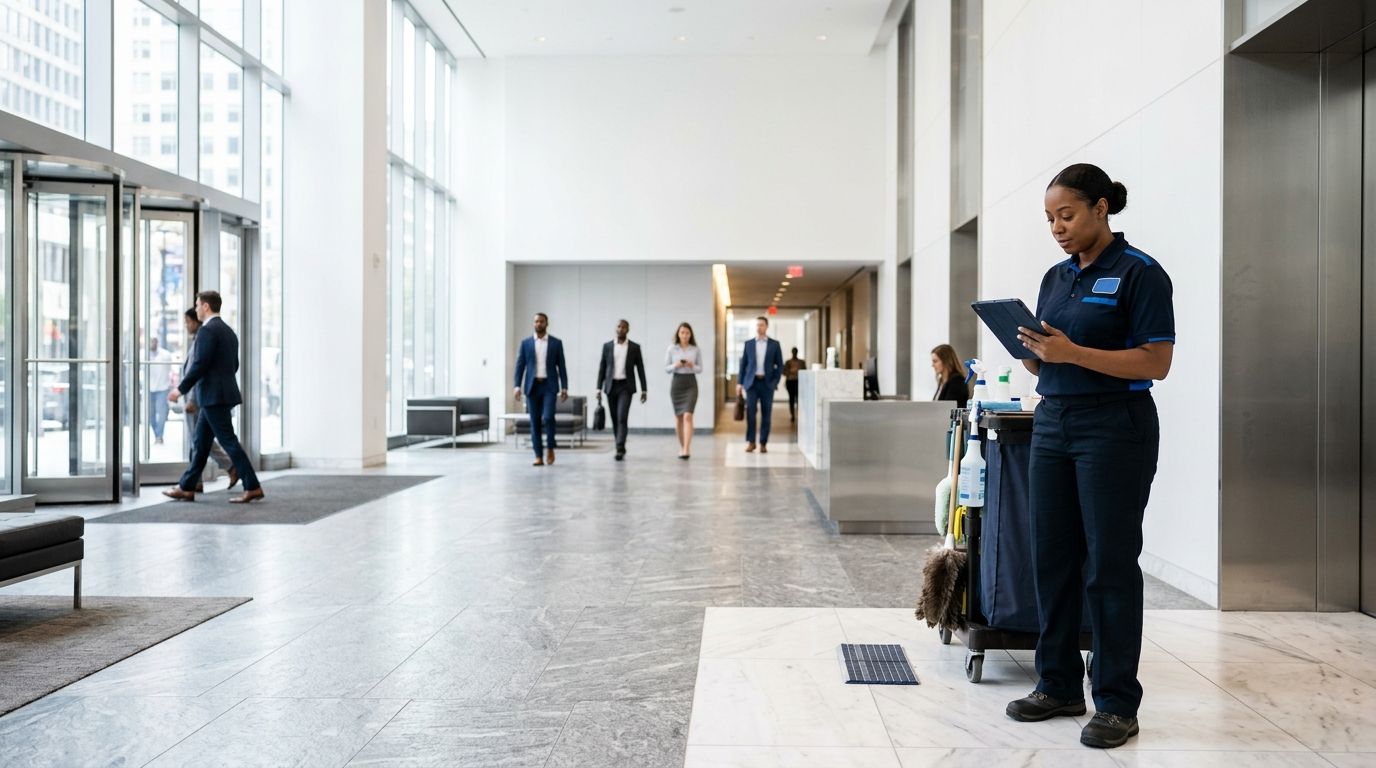
A day porter is worth it for a multi-tenant office building when occupied-hour demand repeatedly exceeds what the nightly crew can prevent or correct. In 2026, the decision should be based on documented restroom checks, lobby traffic, tenant requests, deliveries, spills, supplies, and response gaps—not on a vague desire for a cleaner-looking building.
Hi Shine commercial cleaning teams work with facility managers across Greater Philadelphia who need clear ownership during occupied hours.
- Use a day porter for a multi-tenant office building when occupied-hour demand is predictable.
- Track daytime demand before choosing staffed hours and duties.
- Keep porter tasks separate from nightly janitorial and building maintenance.
- Give tenants one approved request path through property management.
- Measure completed routes, response tasks, blocked work, supplies, and repeat problems.
Why this matters
Nightly cleaning resets the building after occupancy. It does not stop a morning restroom shortage, a wet lobby during bad weather, an overflowing common-area bin after lunch, or a conference event that ends midafternoon.
A day porter can own those visible daytime conditions. The role fails when every tenant treats the porter as personal staff, the scope includes unapproved maintenance, or scheduled routes are constantly abandoned for hallway requests.
Is a day porter worth it for a multi-tenant office building?
In 2026, the answer is yes when three conditions are true:
- Daytime demand is frequent enough to plan.
- The tasks fit a defined porter role.
- The building will control requests, priorities, access, and proof of work.
If daytime issues are rare, improve the nightly scope, supply process, or property-management response first. Do not add a staffed shift to solve one poorly defined complaint.
Track daytime demand before deciding
Use a short observation period that includes normal days, heavy-traffic days, events, deliveries, and weather conditions. Record demand by time and location.
Track these categories
- Restroom inspection and replenishment needs
- Lobby and entrance conditions
- Elevator and common-corridor issues
- Ordinary waste and recycling overflow
- Spills within the approved scope
- Breakroom or shared-amenity needs
- Tenant meeting and event support
- Deliveries affecting common areas
- Supply shortages
- Property-management requests
- Conditions requiring maintenance or another specialist
Do not count the same recurring problem as a reason for unlimited staffing. If one dispenser fails every day, repair may be the right solution.
Separate the porter role from nightly cleaning
The porter should have a daytime route and response list. The nightly crew should retain the deeper reset work that is disruptive or inefficient during occupancy.
| Day porter work | Nightly janitorial work |
|---|---|
| Inspect and replenish common restrooms | Complete assigned restroom cleaning |
| Maintain entrances during occupied hours | Perform full entrance and lobby reset |
| Address approved small spills | Complete scheduled floor work |
| Remove approved common-area overflow | Service recurring waste routes |
| Support scheduled events within scope | Reset event areas after approved windows |
| Report damage, leaks, or hazards | Report after-hours exceptions and lock-up issues |
The building decides the actual assignment. A Hi Shine commercial cleaning scope should name which shift owns final completion for every recurring task.
Define the occupied-hour route
A porter should not wait at a desk for complaints. Build a route around the spaces where conditions change during the day.
Route fields
- Building, floor, and zone
- Check time or route order
- Task to inspect or perform
- Supply threshold
- Condition requiring immediate response
- Condition requiring maintenance escalation
- Completion record
- Exception or blocked-access record
A route may change by day. Monday occupancy, tenant events, seasonal weather, or building deliveries can create different patterns. Version the route rather than relying on memory.
Set request priorities
The porter needs a clear rule for what interrupts a scheduled route. Without it, the loudest tenant controls the day.
Practical priority order
- Immediate safety condition within the porter's reporting or response scope
- Restroom or access condition affecting many occupants
- Active spill or common-area issue within approved capability
- Scheduled building event
- Approved property-management request
- Routine tenant request
- Work outside scope, routed to the correct owner
The final order should reflect the building's policies. The key is to set it before requests conflict. Hi Shine provides 24/7 owner access when an occupied-hour issue needs escalation beyond the assigned team.
Give tenants one request path
Tenants should not add work by directing the porter in hallways. Use a property-management channel that records the requester, suite, task, authority, and due time.
Request form fields
- Tenant and suite
- Requester name
- Exact location
- Task requested
- Time needed
- Whether the area is common or tenant-controlled
- Billing approval when required
- Access details
- Property-management authorization
- Closure contact
The porter can acknowledge the person politely while still routing the request for approval. This protects the porter from conflicting instructions and protects the building from unauthorized extras.
Draw a line around maintenance work
A day porter is not automatically a maintenance technician, security officer, mover, waste specialist, or emergency responder. List excluded work and the handoff path.
Common boundary questions include:
- Who handles plumbing leaks?
- Who changes lamps or performs electrical work?
- Who moves heavy furniture?
- Who handles snow or exterior hazards?
- Who manages pest conditions?
- Who responds to blood, body fluids, sharps, or unknown materials?
- Who enters mechanical, roof, or restricted rooms?
- Who handles confidential materials?
The porter should secure or report a condition only as trained and authorized. Fast improvisation is not accountability.
Control supplies
A porter cannot replenish supplies that are unavailable or locked away. Assign purchasing, storage, inventory checks, delivery, and substitution approval.
Track:
- Soap and paper products
- Liners
- Approved cleaning products
- Personal protective equipment
- Wet-floor signs and response tools
- Event supplies included in scope
- Tenant-specific items excluded from common service
Set a reporting threshold for each critical item. The owner should receive notice early enough to act before stock reaches zero.
Manage access and tenant privacy
The porter works while people are present. That creates different access and privacy conditions from a nightly shift.
Define:
- Approved common and tenant areas
- Escort-required rooms
- Occupied conference-room rules
- Confidential-document boundaries
- Photo and device restrictions
- Keys and badge permissions
- Personal-property rules
- Lost-item handling
- Visitor and delivery handoffs
- Incident escalation
A dedicated porter becomes familiar with the building and tenants, but familiarity does not expand authority. Access stays tied to the written role.
Measure the role
Do not judge the porter only by how busy the person appears. Measure completion, demand, exceptions, and recurring causes.
Useful operating measures
- Scheduled route checks completed
- Approved response tasks completed
- Blocked or inaccessible locations
- Restroom or supply exceptions
- Requests routed outside scope
- Repeat issues by room or condition
- Open corrections at shift end
- Handoffs to nightly cleaning
- Handoffs to property management or maintenance
Hi Shine's HI-Q quality system can support visible task and exception records. The property manager still defines the route, standards, priorities, and response ownership.
Decide staffed hours from demand
Do not assume the porter must cover every occupied hour. Match the shift to the periods when demand clusters.
Review:
- Arrival and departure peaks
- Lunch and shared-space peaks
- Restroom-demand patterns
- Delivery windows
- Event schedules
- Weather exposure at entrances
- Tenant service hours
- Nightly crew start time
The building may need a continuous shift, split coverage, event-only support, or no permanent porter. The 2026 decision belongs in the service design, not in a generic formula.
Compare alternatives before adding the role
A day porter solves daytime ownership. Other fixes may solve narrower causes with less operational complexity.
Check these alternatives
- Add a targeted restroom check
- Change the nightly route or finish time
- Improve supply storage and alerts
- Repair recurring dispensers, leaks, or door issues
- Schedule event coverage separately
- Move waste pickups to a better time
- Clarify tenant responsibilities
- Add entrance service only during bad-weather periods
If several daytime needs remain across multiple zones after these fixes, a porter becomes easier to justify.
Build the 2026 day porter scope
A complete scope should include:
- Building and approved zones
- Staffed days and hours
- Scheduled route and check frequency
- Response-task list
- Priority rules
- Tenant-request process
- Supply responsibilities
- Access and privacy rules
- Explicit exclusions
- Completion and exception records
- Shift-end handoff
- Supervisor and property-manager contacts
- Change-control process
The related multi-tenant office building cleaning guide covers the broader common-area and tenant-service framework. The porter scope should fit inside it rather than compete with it.
Test the role before treating it as permanent
Start with defined hours, routes, and success criteria. Review whether the porter is solving real demand or absorbing unmanaged requests.
Review questions
- Did occupied-hour issues decrease?
- Were scheduled routes completed?
- Which requests interrupted the route?
- How many requests were outside scope?
- Did supplies remain available?
- Did repeat issues point to maintenance instead?
- Were tenants using the approved request path?
- Was the shift aligned with demand peaks?
- What should move to nightly cleaning?
- What should leave the porter scope?
A Hi Shine facility assessment can map these demands before staffing is proposed.
FAQ
What does a day porter do in an office building?
A day porter follows an occupied-hour route for assigned common areas, restrooms, supplies, approved spills, events, and property-management requests while reporting work outside scope.
Is a day porter the same as a night cleaner?
No. A porter maintains defined daytime conditions and responds to approved requests, while the nightly crew usually performs the deeper scheduled reset.
When is a day porter worth the cost?
A porter is worth considering when documented daytime demand is frequent, predictable, within scope, and not solved by schedule, supply, repair, or targeted-coverage changes.
Can tenants give the day porter extra tasks?
Tenant requests should use the building's approved channel so authority, scope, access, timing, and billing responsibility are clear before work changes.
Should a day porter handle maintenance?
Only tasks expressly assigned within the person's training and authority. Plumbing, electrical, security, hazardous materials, and specialist work need clear owners.
How should day porter performance be measured?
Measure route completion, approved responses, blocked work, supply exceptions, repeat issues, handoffs, and open corrections rather than visible busyness.
How should a building test a day porter service?
Use defined hours, routes, priorities, records, and review questions during a limited trial, then adjust the role from observed demand.
One last thing
A good day porter does not become the building's catch-all. For Hi Shine commercial cleaning clients, the 2026 role works when predictable occupied-hour tasks have one trained owner, one request path, one record, and one escalation process.