
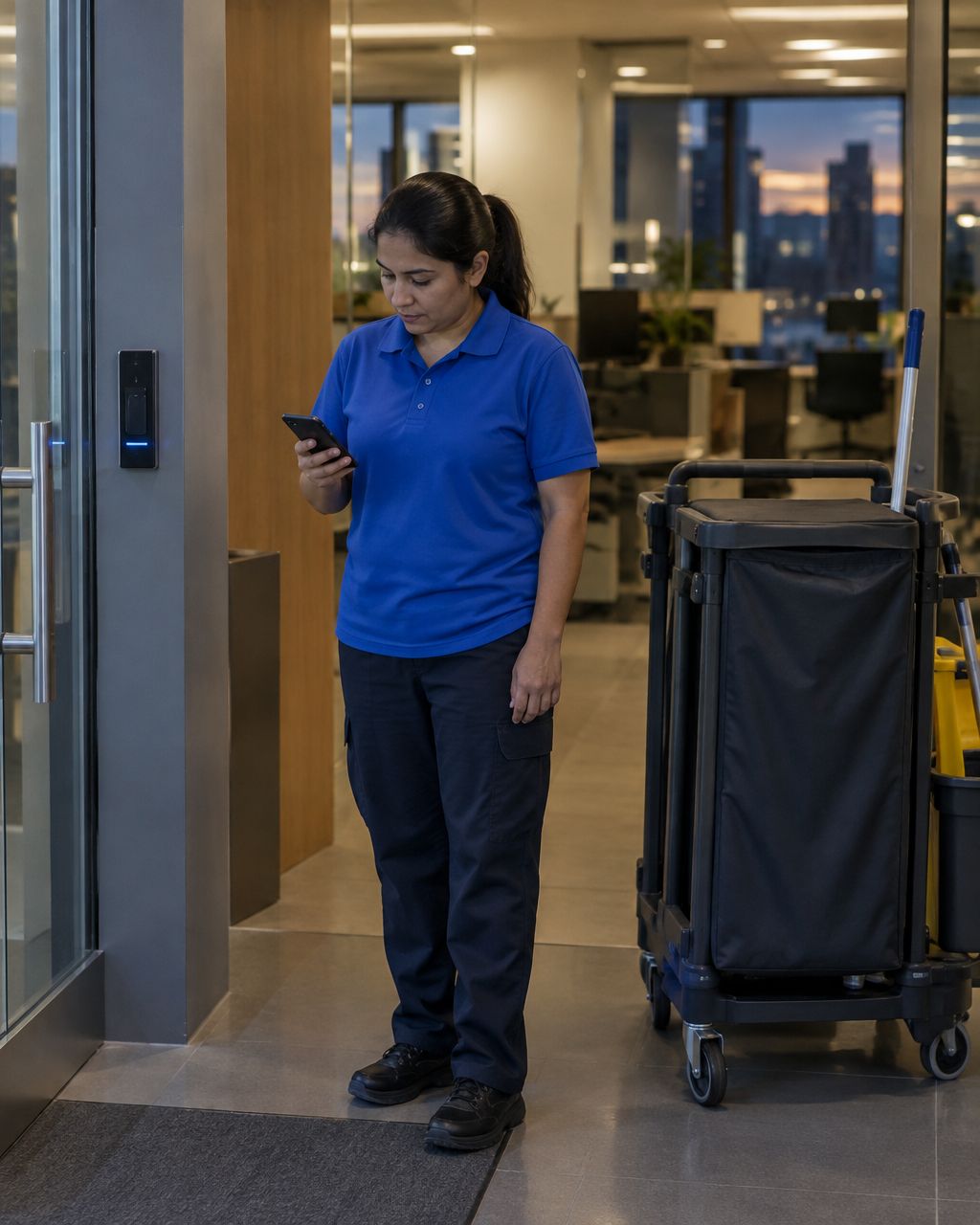
Instead of treating a cleaning crew's arrival as proof the office was cleaned, use cleaning crew GPS check-in verification as attendance evidence alongside task records and inspection. A location check-in can support the visit record; it does not establish that trash, restrooms, floors or any other assigned task was completed.
Key takeaways
- Cleaning crew GPS check-in verification supports attendance, not task-completion claims.
- Connect the visit to the correct property, personnel and approved service window.
- Reconcile check-ins with task exceptions and supervisor confirmation.
- Hi Shine's HI-Q™ process does not establish that a GPS tracking feature is included.
For Greater Philadelphia facility managers, the question is not merely whether someone reached the building. It is whether the approved work happened and unfinished tasks remained visible.
Why this matters
A building can have an arrival record and still have unemptied bins. Attendance and completion answer different questions. Combining them into a single complete status prevents the facility from seeing where the service failed.
Your 2026 review should use location information only for the purpose it can support. A task-level record, a supervisor's confirmation and the facility's agreed inspection are separate evidence about the actual work.
This guide describes an operating workflow for a location-enabled attendance tool if your organization uses one. It does not claim that Hi Shine provides a GPS product, that every tool reports identical information or that collecting worker location is automatically permitted.
Before you start
- Confirm the organization's approved attendance tool, privacy requirements and authorized access to records.
- Obtain the correct property identifiers, assigned personnel and approved service windows.
- Agree how task completion and blocked work will be reported separately from attendance.
The non-obvious issue is permission. Before collecting or using worker location, have the employer and facility's appropriate advisers approve the policy, purpose, access and retention arrangement. Do not turn an operational checklist into a legal conclusion.
A manual attendance register remains useful where location collection is unavailable or not approved. The method changes the evidence source, not the need to inspect assigned tasks.
Define what a check-in is allowed to prove
Separate the evidence questions
Start with a written description of the purpose of the check-in. If the purpose is supporting attendance, keep that scope clear in the facility's service review and in any report label.
The record should distinguish the following questions:
| Evidence | Question it supports | What it does not establish alone |
|---|---|---|
| Approved check-in record | Was a visit recorded for this property and time? | Completion of every assigned task |
| Personnel assignment | Who was scheduled to perform the approved work? | Actual attendance or task completion |
| Task record | What was reported complete or blocked? | Independent acceptance of the condition |
| Supervisor confirmation | Was the reported visit reviewed by the team lead? | A specialist or regulatory approval |
| Facility inspection | Did the agreed condition meet the reviewed task standard? | Unobserved tasks or unrelated areas |
Do not label a check-in event “cleaning complete.” That wording creates a false connection between presence and finished work even if the underlying tool works as configured.
For a 2026 review, record evidence discrepancies as questions to resolve. A missing event does not by itself establish that no service occurred, and an event present does not by itself establish that service was complete.
Expected result: the facility knows what each evidence source can support without over-reading a single record.
Keep worker-location use bounded
Use the organization's approved purpose and scope for collection. Do not assume ongoing location monitoring is needed to establish a scheduled building visit.
Have the responsible owner decide the retention period, authorized viewers and reporting detail. The cleaning supervisor and property manager may need different views, but neither should improvise access to personal location records.
Confirm:
- The approved collection purpose.
- The people authorized to view records.
- The information included in service reports.
- The retention and correction process.
- The permitted fallback for failed collection.
If those decisions are unresolved, keep the workflow manual. Better task accountability does not require collecting information the employer has not authorized.
Expected result: attendance evidence remains within the approved operating and information-control arrangement.
Match attendance to the actual visit
Reconcile property and personnel identifiers
Use stable property identifiers so a visit cannot be confused with another office in the same portfolio. Keep the street address and the relevant building or suite information in the authorized assignment record.
Reconcile the assigned personnel with the actual reported visit. Where a replacement is approved, record that approval through the facility's process rather than quietly treating the original assignment as accurate.
Suggested register fields are:
- Property identifier: the site the visit concerns.
- Assigned personnel: the authorized team or supervisor.
- Approved service window: the planned working arrangement.
- Recorded attendance: the available check-in evidence.
- Attendance exception: the discrepancy or collection issue.
- Review owner: the person responsible for resolving it.
These are template labels, not button names for a particular tool. Confirm actual fields with your administrator before setting up any software mapping.
Expected result: attendance records refer to the correct site and authorized assignment rather than a vague portfolio-level visit.
Resolve discrepancies before making a service claim
If attendance evidence is missing or inconsistent, ask the supervisor to review the available records and permitted fallback. Preserve the original event and document any correction or explanation.
Do not backdate a manual entry to make it look like an original system event. A reviewed correction should be identifiable as a correction, with the reason and person responsible.
For your 2026 review, separate missing collection, incorrect property mapping and a visit that did not occur. The next action differs, and a generic failed label hides the cause.
Hi Shine uses dedicated teams for commercial facilities. Familiar staffing helps maintain site continuity, but the attendance review should still remain attributable when approved replacements cover a visit.
Expected result: the facility reaches a supported attendance conclusion without changing the record to fit an assumption.
Reconcile attendance with task outcomes
Keep the task list independent
The approved task list identifies the room, surface, action and relevant schedule. Attendance evidence should attach to that visit context, not automatically mark every task complete.
Start with the existing checklist or manual task register. Each task should show reported completion or an exception. If a room remains occupied, record the blocked task rather than converting the visit arrival into a success label.
Your task review should identify:
- The tasks assigned to that visit.
- The tasks reported complete.
- The tasks blocked or excluded.
- The reasons for unfinished work.
- The person responsible for correction or access.
Hi Shine commercial cleaning uses the HI-Q™ Quality System, configured to the facility's specifications. Its task discipline and team-lead confirmation are the relevant operating facts; no GPS capability is established by this guide.
Expected result: the visit can show attendance while still exposing unfinished work accurately.
Ask the supervisor to confirm the exception record
The supervisor checks that reported task status reflects the actual visit. An exception needs a next owner and a decision, not a note that remains unread until the next complaint.
A record of “room locked” should identify the affected approved task and the facility contact who can arrange access. A record of “materials unavailable” should identify the task and the authorized product or supply decision required.
Hi Shine provides 24/7 owner access for service escalation. That direct route supports an unresolved service issue, but it does not replace a task record or establish independent attendance verification.
For a 2026 visit review, make sure supervisor confirmation does not overwrite blocked tasks. The confirmation should acknowledge the exception and its follow-up rather than conceal it inside a complete visit label.
Expected result: the supervisor's review adds accountability without claiming every task was performed.
Inspect completion separately
Review the relevant room and task
Use the facility's agreed inspection approach to evaluate actual assigned work. A property manager does not need to inspect every surface at every visit to understand the distinction between attendance evidence and task acceptance.
Define the inspection arrangement with the service owner. State which tasks and conditions are reviewed, who records findings and how corrections are verified. Avoid claiming that a visual check establishes invisible cleanliness or a regulated standard.
The review record should contain:
- The task and zone inspected.
- The observation time.
- The relevant condition seen.
- Any difference from the reported completion.
- The correction owner and verification outcome.
Photographs require facility permission. Do not expose confidential documents, screens, faces or badge details merely to make a work record more convincing. Written observations can be enough for an ordinary task review.
Expected result: a completion decision is based on the agreed task condition rather than the presence of a location event.
Track repeat mismatches without guessing the cause
When check-ins and completion reports look normal but the same task remains unfinished, investigate the scope, access and supervisor review. Do not conclude that the location tool is the cause simply because it is part of the record.
Hi Shine commercial cleaning is built around dedicated-team accountability. The facility should assess the relevant task and correction process, not a software feature that has not been confirmed as part of the service.
For your 2026 review, keep repeated misses separate from discretionary extra-work requests. That distinction lets the owner address ordinary contract performance without confusing it with changes the facility requested later.
Apply the same reconciliation to a multi-site portfolio
A related workflow groups visit records by property while preserving each site's task exceptions. A combined attendance total can be useful, but it should not conceal a building with missing or blocked tasks.
Keep the common property identifiers, assignment references and evidence labels consistent. Then record site-specific access restrictions and the person who owns the local decision.
Hi Shine offers a 90-day risk-free trial. Where applicable, use that period to inspect task consistency, exception handling and supervisor follow-through. A set of recorded arrivals is not proof that the trial's service expectations were met.
Troubleshooting
The check-in report says complete before tasks are reviewed
Change the report label through the authorized system owner so it describes attendance accurately. Do not let a location event stand in for a task-completion decision.
An event points to the wrong property record
Resolve the mapping with the administrator and preserve the original evidence. Review other affected records before relying on the same mapping again.
A crew reports work but the attendance event is missing
Use the approved fallback and supervisor review to investigate. Keep any correction attributable rather than manufacturing an original system event after the visit.
Attendance is recorded but recurring tasks remain unfinished
Inspect the task definition, access window and completion evidence. The problem needs a task-level correction even if attendance collection itself worked.
Customize the workflow before adding a connection
Confirm your 2026 tool's actual fields, permissions and approved collection behavior with its owner. Test the manual reconciliation first: attendance, task report, exception and inspection outcome.
Do not assume a commercial cleaner supplies an attendance application, automated data connection or particular tracking capability. Confirm any requested feature separately and keep it out of service claims until it is established.
A facility assessment can discuss the commercial cleaning assignment and evidence expectations. The goal is work you can hold accountable, not a dashboard that mistakes arrival for completion.
FAQ
What does cleaning crew GPS check-in verification prove?
Cleaning crew GPS check-in verification can support the attendance record when collected and reviewed under the approved arrangement. It does not prove assigned cleaning tasks were completed.
Can a check-in automatically mark a checklist complete?
A check-in should not automatically establish task completion. Review reported tasks, exceptions and the agreed inspection separately.
What if a check-in is missing?
A missing check-in needs review using the approved fallback and other available evidence. Do not assume the visit failed or create an unattributable replacement event.
Who approves location collection for cleaning staff?
The responsible employer and appropriate facility advisers should approve the collection purpose and controls. This guide does not establish legal permission to collect worker location.
Does Hi Shine include GPS tracking?
GPS tracking is not established as an included Hi Shine feature by this guide. Confirm any requested attendance tool or connection separately.
How do I verify the actual cleaning?
Verify the actual cleaning through the approved task record, exception review and agreed inspection. Attendance is one part of the visit evidence, not the completion verdict.
One last thing
A reliable arrival record can still sit beside an unreliable cleaning record. Keep the two questions separate and the facility can see whether it needs an attendance correction, a task correction or an access decision.