
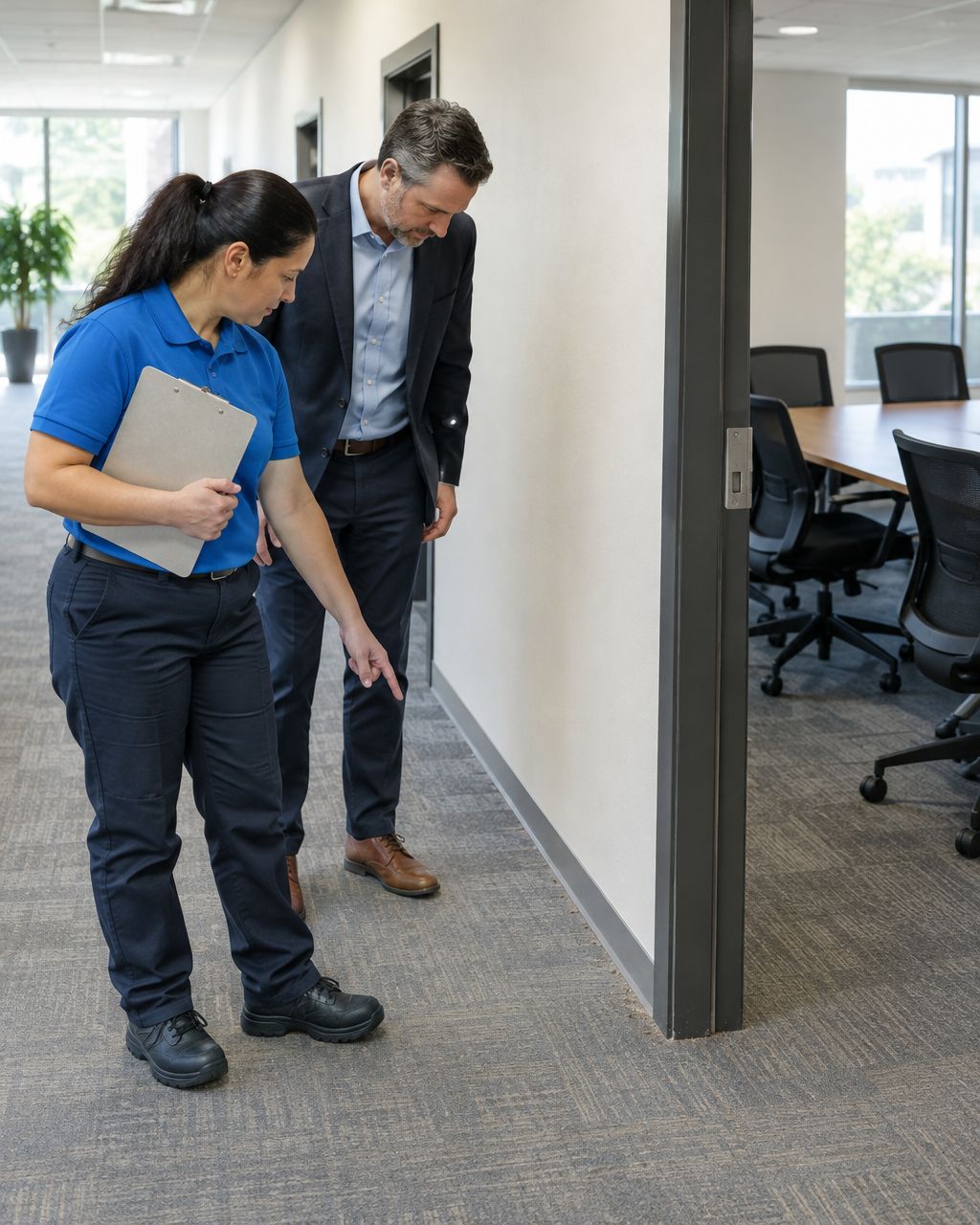
Instead of discovering unfinished cleaning when an inspection begins, use a missed cleaning zone compliance inspection workflow to reconcile the room map, approved task list and actual condition. Flag each omission, assign its correction and have the authorized facility reviewer verify closure; a janitorial check does not certify regulatory compliance.
Key takeaways
- Missed cleaning zone compliance inspection checks start with the approved room and task inventory.
- Separate omitted tasks from inaccessible areas and work outside the cleaning scope.
- A signed checklist does not replace observing the relevant condition.
- Hi Shine's HI-Q™ process supports repeatable cleaning, not a compliance certification.
Greater Philadelphia facility managers need an exception list they can act on, not a last-minute declaration that every room looks acceptable.
Why this matters
An inspection preparation walk can uncover a mismatch between what the facility expects and what the cleaning team was instructed to do. A storage room omitted from the task list is a scope problem; an included room left unfinished is a completion problem.
Your 2026 review should preserve that distinction. Adding an unapproved task to the crew's route does not resolve ownership, training, access or method requirements. The facility must decide what work belongs in the janitorial assignment.
This guide covers cleaning task reconciliation. Clinical procedures, controlled-area release, equipment decontamination and regulatory interpretation remain with the facility's authorized specialists. Never present an ordinary cleaning walkthrough as a substitute for those decisions.
Before you start
- Obtain the current room map, approved cleaning scope and facility inspection instructions relevant to the review.
- Identify the cleaning supervisor, access owner and designated facility reviewer.
- Confirm which evidence is permitted and which rooms, surfaces or equipment require specialist authorization.
The non-obvious problem is an obsolete room map. A renamed suite or repurposed storage area can disappear from the operating list even when the crew follows its instructions exactly. Reconcile names before judging task performance.
Do not photograph restricted information or enter a controlled room simply to complete the review. The inspection route follows the facility's existing access and evidence policies.
Reconcile the rooms and tasks
Build a zone register from approved information
Start with a paper map and a shared register. This manual method lets the facility contact and cleaning supervisor identify omissions without assuming a particular inspection app exists.
Use suggested fields that fit your building:
- Zone identifier: building, floor and room.
- Approved task: the work actually assigned to the janitorial team.
- Service window: when the room can be entered.
- Observed condition: the relevant condition at the review.
- Exception reason: missed, blocked, omitted from scope or outside scope.
- Next owner: the person who can resolve that exception.
Give each zone a stable identifier. A descriptive room name can remain alongside it, but the same room should not appear under several names in different records. Duplicate names make unfinished work harder to trace.
Compare the register with the current approved scope. If a room is not assigned, ask the facility owner whether it should be added or handled separately. Do not label every unassigned surface a cleaning failure.
Expected result: every reviewed zone has an identifiable approved task or a visible scope question.
Keep restricted and excluded work visible
A review can include the boundary of a restricted area without authorizing entry or cleaning inside it. Mark the restriction and identify the specialist owner when ordinary janitorial work does not apply.
| Review finding | What it means | Next decision |
|---|---|---|
| Assigned task was not completed | Completion exception | Supervisor arranges the approved correction |
| Assigned room was inaccessible | Access exception | Facility access owner establishes the next window |
| Expected room is absent from scope | Scope question | Facility owner decides the assignment |
| Surface belongs to specialist work | Outside janitorial scope | Authorized specialist defines the procedure |
| Record and observation disagree | Evidence question | Reviewer investigates before accepting closure |
Your 2026 register should not hide excluded work by deleting the zone. Visibility helps the facility understand who owns it. An excluded task still needs a responsible owner if it matters to the facility's inspection plan.
Do not use a generic “complete” status for a room that was never assigned. The record should say which approved tasks were assessed and which matters were referred elsewhere.
Expected result: the review identifies responsibilities instead of expanding the cleaning contract by implication.
Inspect the agreed condition
Check the task, not the room's overall appearance
A tidy room can still have an unemptied bin or an unfinished baseboard task. Review the surfaces and actions named in the approved instruction, rather than judging whether the room creates a favorable impression.
Use an observable standard. The record might note visible debris at an assigned floor edge, a contracted trash task not completed or a supply item missing where replenishment is part of the agreement.
The walkthrough should capture:
- The relevant approved task.
- The location of the observation.
- The condition seen at the review.
- Any access or occupancy limitation.
- The person responsible for the next action.
Do not claim invisible cleanliness, microbial results or compliance from visual inspection. A visual task check has a limited scope. If the facility needs a different test, its authorized specialist defines it.
Expected result: the review produces specific, bounded observations that the assigned supervisor can understand without guessing.
Compare the observation with the visit record
Check the task record for the relevant visit, including any blocked-work note. A completion entry is evidence to examine, not a reason to ignore a contrary observation.
If the condition could have changed after cleaning, record the review time and ask the facility owner to consider occupancy or subsequent activity. Do not automatically accuse the crew or dismiss the finding. Preserve the facts needed for a fair decision.
Hi Shine commercial cleaning uses the HI-Q™ Quality System, configured to a facility's exact specifications. Its team-lead confirmation and exception reporting give the facility a structured routine to inspect.
For a 2026 review, ask how an unfinished task was recorded and followed up. The important question is whether the exception led to an accountable correction, not whether the checklist has an attractive format.
Expected result: the reviewer can distinguish a missing record, an unresolved exception and a condition that arose after the visit.
Assign correction and acceptance
Give each exception a next action
A missed-zone list is useful only when someone owns the next decision. Assign the cleaning supervisor to contracted corrections and the facility representative to access or scope questions.
Keep the original observation when arranging the correction. Do not overwrite it with a new completion note; the history should show what was seen, what was done and who accepted the result.
Use this sequence:
- State the approved correction or unresolved question.
- Name the action owner.
- Confirm the authorized access window.
- Record completion or the remaining barrier.
- Obtain the designated reviewer's acceptance.
A last-minute inspection deadline does not authorize untrained work or entry into a restricted area. Where the planned correction cannot be performed under approved conditions, the facility owner must decide the next step.
Hi Shine provides 24/7 owner access for service escalation. That contact route supports an ordinary missed-task correction; it is not authority to override laboratory, clinical or security restrictions.
Expected result: every open finding has a decision owner and an appropriate correction route.
Verify closure against the original finding
Inspect the same task and location after correction. A photo of another section of the corridor does not verify the finding, and a message saying “handled” does not explain the condition restored.
The facility reviewer should record the acceptance and any residual limitation. If part of the task remains blocked, keep that portion open with its own next owner. Closing the whole room hides unfinished work.
Hi Shine commercial cleaning uses dedicated teams, which supports consistent familiarity with the approved facility assignment. Even with a familiar team, the review record should remain clear enough for an authorized replacement to understand.
Expected result: closure answers the original observation and preserves unfinished items instead of hiding them inside a general completion label.
Review layout changes before the next inspection
A related workflow checks the cleaning assignment whenever rooms are repurposed, tenants move or an access arrangement changes. The trigger is the facility change, not a complaint that arrives later.
Your 2026 change review should ask whether the zone identifier, task owner, approved method and service window still match actual use. A room that becomes a storage area can need a different assignment without changing its floor area.
Notify the cleaning supervisor through the approved route. If the facility changes the task scope, record the authorization and update the working instructions. Do not rely on a verbal comment made during a walkthrough.
Hi Shine offers a 90-day risk-free trial. Where applicable, use that period to inspect how the approved task list reflects the building and how exceptions are followed through. A successful service review is not a regulatory certification.
Troubleshooting
A room is on the map but absent from the checklist
Ask the facility owner to decide whether the work belongs in the contract or a separate assignment. Record the scope decision before adding a task to the crew's route.
The checklist says complete but the condition disagrees
Compare the visit time, exception notes and subsequent use. Keep the observation visible and investigate the difference before accepting a correction or assigning a cause.
A restricted zone cannot be inspected
Record the access limitation and refer it to the authorized owner. Do not borrow credentials or broaden entry permissions to finish the review.
Findings reappear after repeated corrections
Examine the task definition, access window and completion evidence. Repeated correction without a cause review leaves the underlying operating failure unresolved.
Make the review part of ordinary service management
Use the same zone register between inspections so preparation does not become a rushed cosmetic cleanup. The facility should be able to see open exceptions throughout the service period, not only when an external visitor is expected.
For your 2026 review, separate scope changes from missed tasks and access barriers. Each requires a different action. A single complaint total cannot tell the supervisor what to fix.
Hi Shine serves Greater Philadelphia commercial facilities that need repeatable checklist discipline. A facility assessment can clarify the ordinary janitorial assignment and its boundaries; specialist procedures require their own qualified review.
FAQ
What is a missed cleaning zone compliance inspection check?
A missed cleaning zone compliance inspection check reconciles approved room-level tasks, visit records and observed conditions before a facility review. It does not certify regulatory compliance.
Should every uncleaned area be called a missed task?
An uncleaned area is not automatically a missed task. Determine whether it was assigned, accessible and within the janitorial scope before classifying the finding.
Does a signed checklist prove an area is acceptable?
A signed checklist does not replace the designated reviewer's observation. Compare the record with the approved task and the relevant condition.
Who decides whether an omitted room joins the cleaning scope?
The authorized facility owner decides whether an omitted room joins the cleaning scope. Confirm task boundaries, access and any specialist requirements before assigning work.
Can ordinary cleaners inspect a restricted laboratory area?
Ordinary cleaners should not enter or inspect a restricted area without the required facility authorization. Record the limitation and route the review to the appropriate owner.
How should a corrected finding be closed?
A corrected finding should close after the original task and location are verified by the designated reviewer. Keep remaining blocked work visible with a named next owner.
One last thing
An omitted room and a missed task need different fixes. Before asking for another cleanup, determine whether the instruction existed and whether the team had authorized access to carry it out.