

Financial office cleaning in Philadelphia is commercial janitorial service organized around client-facing spaces, confidential work areas, and controlled building access, with the aim of keeping your office ready for business without disrupting financial operations. Your scope needs to distinguish ordinary cleaning from document handling, restricted-room access, and responsibilities that remain with your staff.
Key takeaways
- Financial office cleaning Philadelphia requirements should define access, document boundaries, room-level tasks, and correction ownership.
- Hi Shine provides commercial cleaning with dedicated teams for Greater Philadelphia corporate facility managers.
- Keep confidential papers, secure disposal, and restricted equipment outside ordinary janitorial duties unless explicitly authorized.
- Use a written scope and inspection record to make missed work visible and correctable.
Why financial office cleaning matters for Philadelphia managers
A financial office combines public-facing areas with workspaces that can contain sensitive client information. A conference room needs to be ready for the next meeting; a workstation needs clear instructions about what cleaners must leave untouched. Treating both as unrestricted cleaning areas creates avoidable ambiguity.
For your 2026 scope, define the work before discussing a service start. The commercial cleaning RFP guide provides a place to organize requirements into a document your internal stakeholders can review.
Hi Shine commercial cleaning serves Greater Philadelphia corporate facility managers who need dedicated teams and accountable service. A dedicated team still needs your office’s access rules, exclusions, and escalation contacts. Familiarity does not replace written authorization.
The practical requirement is straightforward: someone must own each task, each boundary, and each correction. If a cleaner finds confidential papers covering a desk, the instruction should already exist. Leaving that decision to the person standing in the room is not an operating plan.
Build your financial office cleaning requirements
Map rooms and assign responsibility
Start with a floor plan or a simple spreadsheet. Walk the office with the person responsible for facilities and identify every room, shared area, and boundary between tenant responsibility and building management.
Do not assume the landlord’s cleaning arrangement includes your reception area, internal restrooms, or meeting rooms. Equally, do not assign your janitorial team work that building management already controls. Write down who does what and where responsibility changes.
For a financial office, include client interview rooms, records storage, employee kitchens, and equipment areas in the walkthrough. A room can appear on the plan without being approved for routine entry. Mark exclusions as clearly as included work.
- List each room or cleaning zone by its actual office name.
- Assign responsibility to your staff, building management, or cleaning team.
- Mark restricted rooms and spaces requiring an escort.
- Identify surfaces that require manufacturer-specific care.
- Record the person authorized to approve scope changes.
Set access and confidentiality boundaries
Create written entry and exit instructions before handing over access credentials. Your procedure should cover authorized personnel, alarm responsibilities, restricted doors, and what happens when someone arrives without approval.
Keep confidentiality instructions operational. A cleaner needs to know whether to leave papers untouched, whether desk drawers are excluded, and whom to contact after finding an exposed file. A broad confidentiality statement does not answer those questions.
Use your own security and legal teams to approve the requirements. Do not describe a cleaning agreement as proof of financial-sector compliance. Cleaning access is one part of your office’s controls, not a substitute for them.
- Name the role that approves cleaning personnel for entry.
- Document credential issue, return, and removal procedures.
- Prohibit opening drawers or moving client documents without authorization.
- Define the response to an unsecured room or exposed record.
- Establish an approved method for reporting sensitive incidents.
Translate expectations into observable tasks
Write the manual checklist first. Replace phrases such as clean thoroughly with a location, task, and visible acceptance condition. For example, specify that designated waste bins are emptied and relined, rather than leaving waste handling inside a general office-cleaning description.
Hi Shine uses HI-Q™ checklist discipline as part of its commercial cleaning approach. Bring your room inventory and exclusions into the scope discussion so the checklist reflects your office rather than replacing its requirements.
For your 2026 service review, distinguish routine tasks from work requiring separate approval. Carpet extraction, elevated surfaces, and specialized equipment care should not become assumed obligations because the agreement says general cleaning.
- Specify waste collection points and excluded containers.
- Identify accessible desk surfaces that staff must clear first.
- Describe restroom fixtures, dispensers, and floor tasks separately.
- List reception and conference-room reset expectations.
- Separate routine floor care from separately authorized work.
Match cleaning access to office operations
Mark working hours, client appointments, and building access restrictions on a shared schedule. This is an access plan, not a generic cleaning-frequency formula. Your office’s actual use determines where cleaning can happen without interrupting staff or visitors.
Identify the rooms that remain occupied after normal hours. A late client meeting should trigger a known response: defer the room, contact the designated person, or return within an approved access window. Do not expect cleaners to infer whether entry is appropriate.
Also document how your office communicates closures and schedule changes. A message sent only to reception does not help a cleaning team arriving after reception has closed.
- Identify approved entry and departure windows.
- Flag meeting rooms with variable evening use.
- Define what happens when a scheduled room remains occupied.
- Assign responsibility for communicating closures and changes.
- Record any building loading, elevator, or security-desk procedures.
Separate waste streams and protected materials
Label the waste streams your office actually uses. Ordinary trash, recycling, and confidential destruction containers need separate instructions, even when they sit beside one another. Location alone should never determine how a container is handled.
Document the handoff between your employees, cleaning personnel, and any authorized document-destruction service. Janitorial waste collection does not automatically include opening locked consoles, transporting records, or deciding whether a document is disposable.
Your cleaning scope should also address accidental discoveries. If papers are left beside a bin rather than inside it, the crew needs an instruction that does not require interpreting their business value.
- Identify ordinary trash and recycling containers by location.
- Mark confidential destruction containers as excluded unless authorized.
- Assign responsibility for moving or servicing secure containers.
- Tell cleaners to leave ambiguous papers in place and report them.
- Specify how to report leaks, sharp objects, or unidentified materials.
Inspect results and close the correction loop
Begin with a shared issue log that records the room, missed task, report date, responsible contact, and confirmed resolution. Keep sensitive client information out of the record. A useful cleaning report identifies the problem without reproducing confidential material.
Use consistent inspection criteria in 2026 so the record shows whether the same task keeps failing. A missed trash pickup and an inaccessible meeting room are different events. Record the reason instead of counting both as identical failures.
Hi Shine provides direct owner access, including 24/7 owner access, and offers a 90-day risk-free trial. Document the applicable terms and escalation process before service starts; those features do not replace an agreed scope or establish a particular response deadline.
- Record the exact room and task requiring correction.
- Separate missed work from denied access or changed instructions.
- Name the person responsible for acknowledging each issue.
- Agree on correction timing for different types of problems.
- Confirm completion instead of closing issues after acknowledgment alone.
A correction process has distinct stages. Reporting a missed task is not the same as confirming that the task was completed. Keep the handoff visible so neither your staff nor the cleaning team has to reconstruct it from scattered messages.
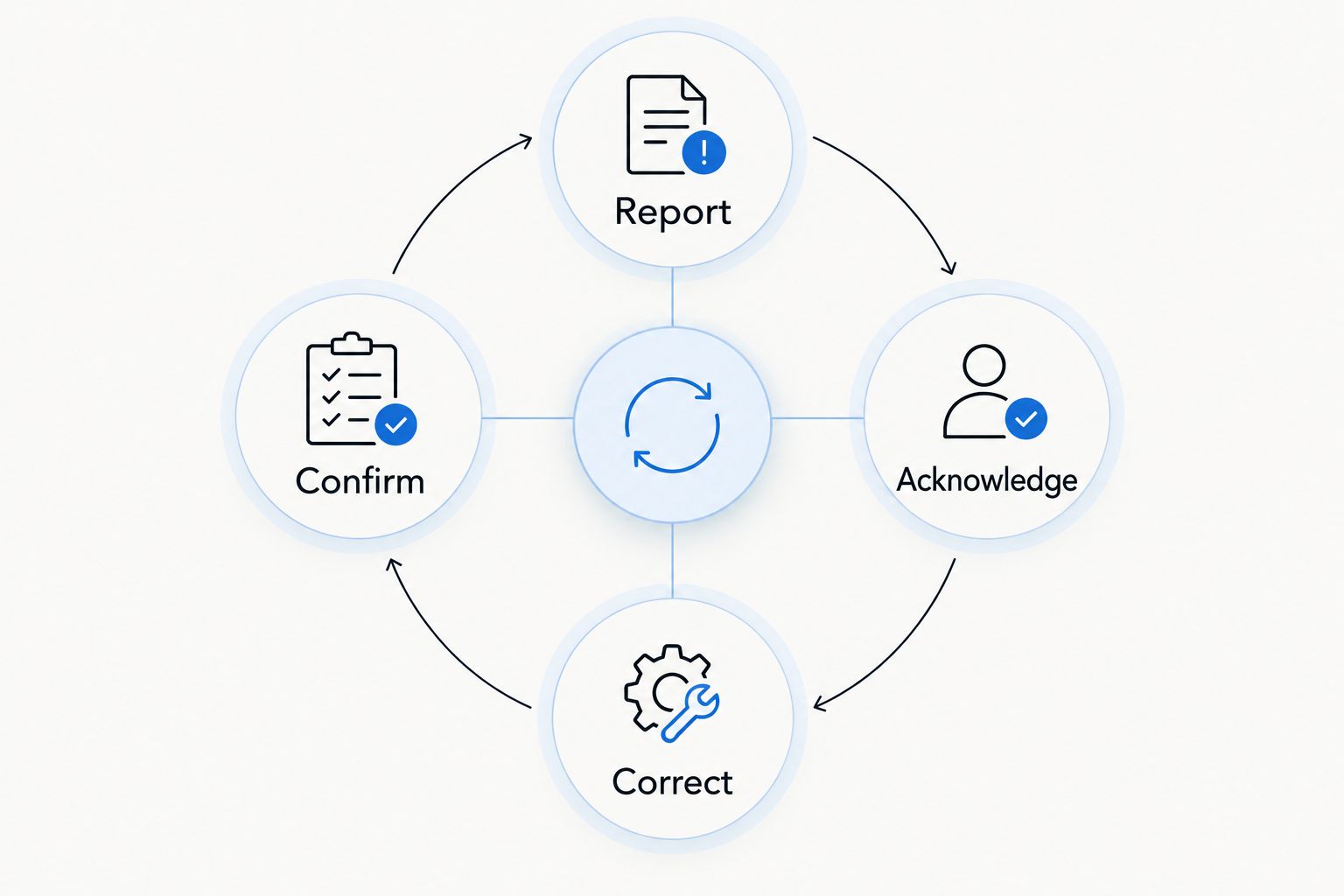
An issue stays open until the correction is confirmed.
Verify documents and rehearse the handoff
Collect the agreement, scope, insurance documentation, contact list, and access instructions in a shared location controlled by your office. Check that the business named in the agreement matches the supporting documents. Let your risk adviser determine the coverage your premises and contract require.
Hi Shine’s stated insurance amount is $5 million. Review the current certificate and applicable coverage rather than treating that amount alone as proof that every contractual requirement is satisfied.
Before your 2026 start date, walk through arrival, restricted-room handling, a missed task, and departure. A short rehearsal exposes unanswered questions while you can still resolve them without interrupting a live cleaning visit.
- Confirm the approved scope and exclusions are attached to the agreement.
- Review current insurance documents with the appropriate internal owner.
- Verify primary and backup operational contacts.
- Rehearse access, alarm, and departure instructions.
- Confirm how your office authorizes changes after service begins.
Use a room-by-room responsibility table
A scope table is more useful than a broad promise to clean the office. Use the following requirements as a starting point, then replace general room names with your actual locations. The table assigns boundaries; it does not establish regulatory requirements or authorize access.
| Area | Cleaning requirement to document | Office responsibility | Boundary to state |
|---|---|---|---|
| Reception | Floors, designated waste bins, accessible surfaces | Secure visitor records and loose papers | Do not move documents or operate reception equipment |
| Client meeting rooms | Table surfaces, floors, approved reset tasks | Remove confidential meeting materials | Do not discard notes or rearrange files |
| Employee workstations | Accessible surfaces and designated waste collection | Clear approved surfaces before service | Leave papers, drawers, and devices untouched unless authorized |
| Restrooms | Fixtures, floors, waste, and assigned dispenser checks | Assign supply purchasing and replenishment responsibility | Do not assume consumables are included |
| Records storage | Only explicitly authorized tasks | Control entry and record handling | No routine access without approval |
| Shared building areas | Tasks allocated under the building arrangement | Confirm landlord and tenant responsibilities | Do not duplicate or assume building-management duties |
Review this table when rooms change use, not just when the agreement renews. A former meeting room converted into records storage needs a revised access instruction before the next cleaning visit.
Define your facility cleaning scope
Discuss your Philadelphia office’s room list, access boundaries, and accountability requirements.
Common mistakes financial office managers make
Treating confidentiality as a catch-all instruction
A signed confidentiality provision does not tell a cleaner whether to move papers to wipe a desk. Define the permitted action at the surface level. Staff should know what they must clear, and cleaners should know what stays untouched.
Mixing confidential disposal with ordinary trash
A locked destruction console and a wastebasket serve different purposes. Keep their handling instructions separate, and identify the authorized owner of each handoff. Never make the cleaning team decide which loose documents are ready for disposal.
Leaving landlord boundaries unresolved
Shared lobbies, elevators, and restrooms can fall under different agreements. Confirm responsibility before service starts. Otherwise, your internal team can end up reporting a missed task to someone who was never assigned to perform it.
Accepting an escalation contact without a process
A phone number is not a correction procedure. State who receives a report, how it is acknowledged, who assigns the corrective work, and who verifies completion. Your 2026 review should examine closed corrections, not just the number of messages exchanged.
FAQ
What should financial office cleaning in Philadelphia include?
Financial office cleaning in Philadelphia should include a written room-level scope, access instructions, confidentiality boundaries, waste-handling rules, and a correction process. Assign responsibility for shared building areas and exclude restricted rooms unless entry is expressly approved.
Can cleaners move confidential papers to clean a desk?
Cleaners should leave confidential papers untouched unless your office has explicitly authorized a different procedure. Have employees clear approved surfaces and give the cleaning team a defined way to report obstructed work.
Does a financial office cleaning agreement prove regulatory compliance?
A cleaning agreement does not establish regulatory compliance. Have your legal, security, and risk teams approve the access and confidentiality requirements relevant to your organization.
Can a cleaning team empty confidential document containers?
A cleaning team should service confidential document containers only when the task and authorization are explicitly documented. Ordinary trash collection does not automatically include secure document handling or destruction.
How should we document missed cleaning tasks?
Document the room, missed task, report date, responsible contact, and confirmed correction. Exclude client information and distinguish missed work from rooms the team could not access.
What should we check before giving a cleaning team building access?
Check personnel authorization, credential handling, restricted-room rules, alarm responsibilities, and departure instructions. Rehearse the process with the designated office contact before the first service visit.
How do we request a financial office cleaning quote?
Prepare a room list, operating schedule, access restrictions, and proposed cleaning tasks before requesting a quote. A facility walkthrough should clarify exclusions, building-management responsibilities, and how corrections will be handled.
One last thing
Inspect one deliberately uncleared workstation during your walkthrough. Ask what the cleaning team should do when papers block the surface. The useful answer is not a promise to clean around everything; it is a clear instruction to respect the boundary, record the obstruction, and notify the right person.
Carry that instruction into your 2026 scope. A documented exclusion is more accountable than an unwritten expectation.