
Office cleaning for law firms needs a room-level scope that protects document boundaries, controls access and confirms the work before client-facing spaces reopen. This 2026 Philadelphia guide helps office managers turn confidentiality expectations, approved surfaces, staffing and corrections into written instructions rather than assumptions.
Key takeaways
- Law firm office cleaning needs room-specific tasks and explicit confidential-material boundaries.
- Do not move, read, photograph or discard documents outside the firm's approved instructions.
- Define assigned personnel, approved backups, access and credential removal.
- Agree on completion records, blocked-work reporting and who verifies corrections.
- Hi Shine provides dedicated commercial cleaning teams for Philadelphia law firms with HI-Q™ checklist discipline.
Why law firm offices need specific instructions
Reception and meeting rooms need approved routine cleaning, while records rooms, documents and occupied offices need boundaries that workers can follow. These decisions should not be left to the person arriving after hours. The firm owns its access and information-handling requirements.
Hi Shine's commercial cleaning scope for law firms includes reception, conference rooms, glasswork, common workstation areas, restrooms, breakrooms and after-hours scheduling. Its published scope identifies dedicated teams familiar with file-room and confidentiality boundaries. Confirm the actual assignment for your suite before service begins.
Discretion needs an instruction. Tell workers what they may clean, what they must leave untouched and whom to contact when materials block a task. A general promise to respect confidentiality does not answer those operating questions.
Write the firm's 2026 room-level scope
Identify included rooms and surfaces
Start with a current room list. Include reception, meeting rooms, offices, restrooms, kitchens and any approved common areas. Mark records rooms, technology spaces and restricted suites separately rather than assuming all areas share the same access.
For each room, record:
- Included surfaces and tasks.
- Agreed task frequency and service window.
- Materials and equipment that remain untouched.
- Contact who can approve access or changes.
- Completion or exception process.
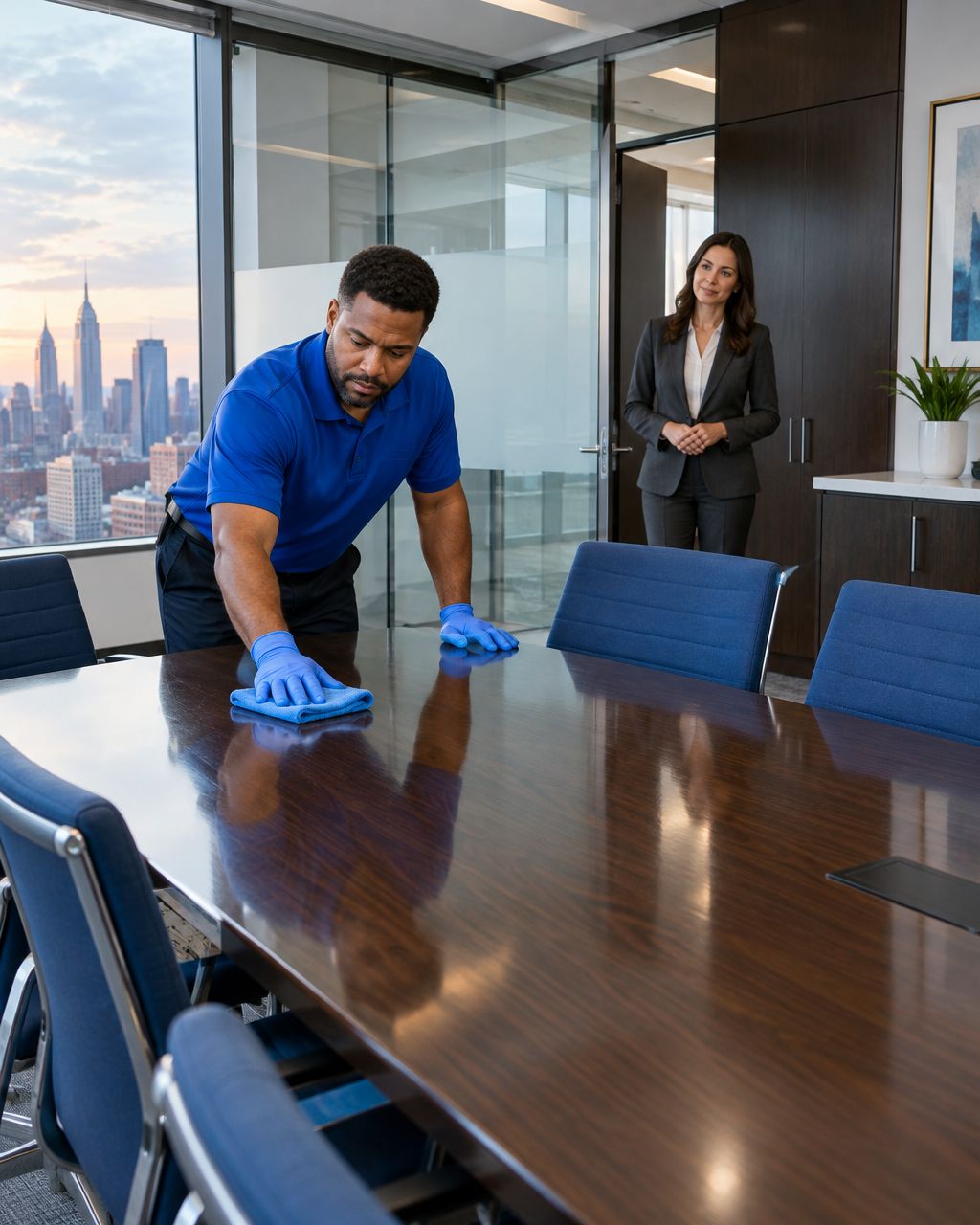
A conference-room instruction should distinguish the table surface from papers, devices and personal items left on it. If the surface is blocked, the worker needs an approved decision route. Do not ask the crew to infer whether materials are confidential or disposable.
Establish document and personal-item boundaries
The firm should define handling rules before a worker enters. Identify what stays in place, what ordinary waste points can be emptied and what confidential disposal remains with authorized personnel. An item near a bin is not necessarily approved for disposal.
Document:
- No-touch areas and materials.
- Approved ordinary trash and recycling collection points.
- Confidential waste and records ownership.
- Rules for photography, devices and information exposure.
- Notification when materials prevent an included task.
Use a current instruction that applies to regular and backup personnel. Do not depend on a worker recognizing privileged material by appearance. The boundary should be clear enough to follow without reading or examining the contents.
Agree on access and lock-up
Write the allowed entry route and service window. Identify who issues credentials, who recognizes expected personnel and whether an escort or sign-in is required. Tenant-suite access can differ from access to the building's common areas.
Include the process for lost credentials, an unsecured door and the end of an assignment. Access removal should follow the firm's and building's approved procedure. Avoid sharing codes or personal information outside that process.
For the 2026 agreement, confirm occupied-suite instructions. Late preparation, a private meeting or an unavailable room can change the route. Workers should report blocked work and seek an approved alternative rather than entering because the ordinary schedule says the room is due.
Identify assigned staffing and backups
Ask who regularly services the firm, who supervises the assignment and how an absence is covered. Specify the firm's screening and authorization requirements in writing. Dedicated staffing does not replace approval or establish a universal screening standard.
Hi Shine provides dedicated commercial cleaning teams for law firms. Connect that model to the actual suite by confirming the assigned roster, notice of changes and how authorized replacements receive instructions. Do not assume the same individual attends every visit indefinitely.
Keep document boundaries, access and room tasks recorded. A backup needs the current assignment before arriving, not a verbal summary after reaching reception. Define who confirms that the instructions have been communicated.
Set frequency from use and requirements
Review how the firm uses reception, conference rooms, individual offices, restrooms and kitchen areas. Agree on tasks and intervals that fit the actual use and available windows. Do not prescribe the same weekly or nightly schedule for every law office.
The published law-firm scope describes a daily checklist for conference rooms and lobbies. Confirm how that applies to the proposed service and which additional rooms or periodic tasks are included. A website description is not the complete agreement for your suite.
Use your 2026 review to check changes in occupancy, meeting patterns and operating hours. Update the task list when a room's use changes. A larger service window alone does not establish a different document-handling permission.
Make completion and exceptions visible
Hi Shine's HI-Q™ Quality System configures tasks to facility specifications, guides each visit and requires team-lead confirmation. Unfinished work is flagged for follow-up. Confirm what information the office manager receives under the agreed reporting arrangement.
Records should distinguish completed, blocked, missed and excluded tasks. A table covered with materials is a different situation from an accessible table that was skipped. Both need an accurate record and follow-up decision, not the same automatic correction.
Agree on the available format before expecting signatures, photographs, a customer dashboard or a report after every room. Documentation also needs privacy limits; proof of cleaning should not expose firm information.
Check responsibility at each boundary
A table can reveal gaps without ranking providers or assuming qualifications from a service label.
| Area or task | Decision the firm should document |
|---|---|
| Reception | Approved floors, seating, glass and surfaces |
| Conference rooms | Surface cleaning, occupancy and document boundaries |
| Individual offices | Included work and personal-item restrictions |
| Records rooms | Entry permission and excluded materials |
| Ordinary waste | Authorized collection points and handoff |
| Confidential waste | Firm-controlled owner and procedure |
| Shared building areas | Landlord, tenant and service responsibilities |
| Credentials | Issuance, loss reporting and removal process |
Review the table with building management where responsibilities overlap. A suite agreement does not automatically authorize work in landlord-controlled corridors or shared spaces. Identify those assignments before the first service visit.
Define correction and escalation terms
Name the service contact for missed work and the firm contact for access or information-boundary decisions. Agree on how issues are submitted, what constitutes acknowledgment and how a completed correction is verified.
Hi Shine provides 24/7 owner access. That establishes a communication route, not a universal service deadline. Set the response expectations and any agreed remedies in the actual contract rather than assuming a particular correction window or credit.
Review repeated issues with the task record. A recurring blocked room can require revised access or scheduling, while a repeated missed task can require an execution correction. Identify the cause before expanding service or changing personnel.
Verify insurance without assuming technical permissions
Request current insurance documentation and match the legal entity to the agreement. Compare coverage types, limits and dates with the firm's and building's requirements. Ask the appropriate risk contact about any additional documentation or endorsements.
Hi Shine identifies $5MM insurance coverage. Confirm that documentation for your assignment; it does not establish legal confidentiality compliance or authorize handling of sensitive material. Coverage and work permissions are separate checks.
Give renewal checks a named owner. A certificate stored at launch does not establish that ongoing requirements are being reviewed. Document who requests updates and where the current records are kept.
Walk the route and supply arrangements
Walk from the approved entrance through supply storage, included rooms, ordinary waste handoff and the exit. The route can reveal permissions or timing questions that a room list misses. Keep restricted suites and private materials outside the tour unless the firm authorizes access.
Identify product restrictions for floors, furniture and glass. Use applicable manufacturer or property instructions rather than choosing methods based on appearance. Agree on substitutions before they occur.
Consumables need ownership. Record who purchases, stores and restocks supplies and whom workers notify about shortages. A supply problem should appear in the exception record so the firm can distinguish it from a missed task.
Evaluate the actual assignment during a trial
Hi Shine offers a 90-day risk-free trial. Confirm written terms and the included service before starting. A trial does not prove every periodic task unless that task is actually scheduled and authorized during the period.
Review:
- Approved personnel and service windows.
- Document and access boundary adherence.
- Completion against the room-level task list.
- Accurate notification of blocked work.
- Reachable contacts and recorded follow-up.
- Confirmed corrections and any untested work.
For the 2026 trial review, use observations tied to rooms and service visits. A clean reception area does not establish that a blocked office was handled correctly. Check records and actual conditions together.
Keep acceptance criteria focused on the assignment rather than broad labels. Record any revised instructions and confirm regular and backup workers receive them. The ongoing agreement should preserve the process that was actually tested.
Common law firm scope gaps
Treating every paper as ordinary waste
Document confidential disposal ownership and no-touch rules. Workers should not infer permission from where an item is left.
Defining access only for the regular worker
Apply the firm's authorization process to replacements too. An absence is not an exemption from suite security.
Asking for photographic proof without privacy instructions
Agree on documentation that does not expose confidential information. A record format should respect the same boundaries as the service itself.
Accepting a correction without checking it
Identify who verifies closure. A message acknowledging the problem does not establish that the task was completed.
FAQ
What should office cleaning for law firms include?
Include approved rooms and surfaces, task frequencies, document boundaries, staffing, access, supplies and correction procedures. Keep confidential disposal and restricted spaces explicitly assigned.
Should cleaning workers move papers to reach a table?
Only a firm-approved procedure can authorize handling materials. Otherwise leave them untouched, record the blocked task and notify the firm's designated contact.
Does a dedicated crew replace screening requirements?
No. Assigned and backup workers still need the firm's required screening, clearance and access authorization. State those requirements in the agreement.
Should cleaning happen after hours?
Choose the service windows with the firm and building manager. Define occupied-room rules and alternatives for late meetings instead of assuming every law firm has the same schedule.
Who handles confidential waste?
The firm should name the authorized owner and procedure. Ordinary janitorial waste collection does not establish permission to handle confidential disposal.
What proof of work should we request?
Agree on task completion, exceptions and corrections in a format that respects information boundaries. Do not assume photographs, signatures or a dashboard are included.
How should the trial be evaluated?
Check approved staffing, access and document discipline, completed tasks, exceptions and verified corrections against the written scope. Identify periodic or excluded work the trial did not test.
One last thing
Test the instructions with a blocked conference table. If nobody can explain what the worker must leave untouched and whom to notify, the confidentiality boundary is not yet operational. Request a free facility assessment with the room list and access rules ready.
Related guides
Define your law firm's approved cleaning scope
Discuss room-level tasks, document boundaries, assigned personnel and HI-Q™ checklist discipline before service starts.