
Corporate Office Cleaning Philadelphia Checklist 2026
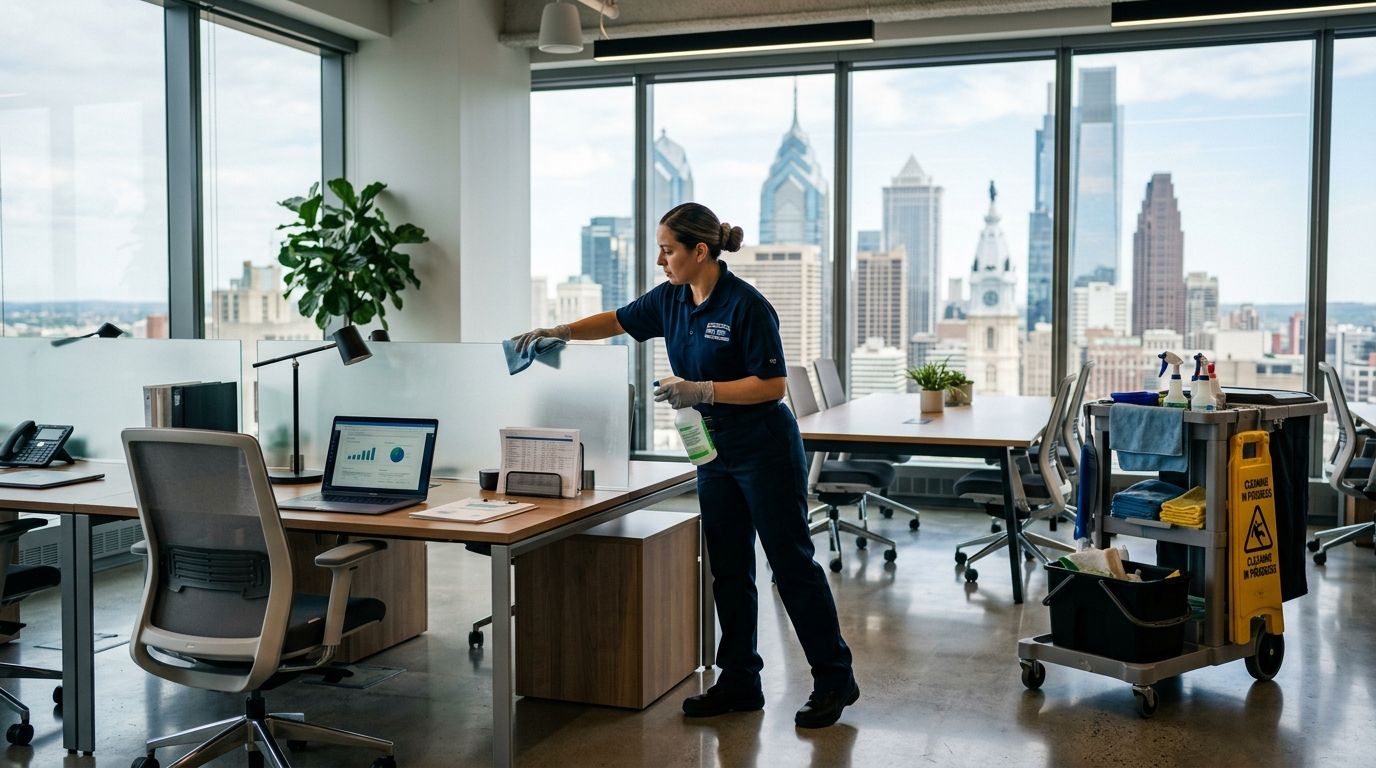
Corporate office cleaning in Philadelphia is a documented, room-by-room service designed to keep shared workspaces consistent without forcing the facility manager to supervise the cleaning company. In 2026, the strongest requirements define the scope, the assigned team, the proof of completed work, and the person responsible when something is missed.
- Corporate office cleaning Philadelphia requirements should define every room, task, frequency, and exception.
- A dedicated team gives the building consistent staffing and a clear access list.
- The 2026 standard is documented completion, not verbal promises or vague quality claims.
- Escalation terms should name the responsible person, response expectation, and correction process.
- Test the full operating system during a 90-day risk-free trial before making a long commitment.
Why cleaning requirements matter for corporate offices
Corporate offices create recurring pressure points: reception areas shape the first impression, restrooms affect every employee, conference rooms must be ready for scheduled meetings, and kitchens can fall behind within one workday. A vague promise to provide general cleaning does not tell you what happens in any of those spaces.
The useful 2026 standard is accountability you can verify. Hi Shine uses its HI-Q™ Quality System to configure tasks around the facility, guide the dedicated team through each visit, confirm completion, and flag work that could not be finished. That structure turns a complaint from a debate into a specific task with an owner and a correction path.
Hi Shine is built for Greater Philadelphia corporate offices that need a dedicated cleaning team and documented follow-through, not another vendor the facility manager has to chase.
Build your 2026 corporate office cleaning requirements
Define every room and task
Start with the building, not a generic service package. Walk the office and write the scope at room level so every bidder or cleaning team is working from the same document. The scope should separate routine work from periodic work and state what is outside the cleaning team's responsibility.
Include at least these areas when they exist in your office:
- Lobby, reception desk, entry glass, mats, and visitor seating
- Restrooms, including fixtures, partitions, floors, trash, and supply levels
- Kitchens and breakrooms, including counters, sinks, appliance exteriors, trash, and recycling
- Conference rooms, executive areas, private offices, and open workspaces
- Corridors, elevators, stairwells, copy rooms, and storage areas
- Periodic floor care, high dusting, and detail work on a written schedule
For each room, state the task, method, frequency, and completion standard. In 2026, general office cleaning is not a usable scope because it leaves the most important decisions to whoever happens to be working that night.
Set frequencies by zone
Do not apply one frequency to the entire building. A reception area, occupied restroom, executive office, and storage room do not receive the same traffic. Set the service schedule by how each space is used, then document who can approve a change.
For every zone, record:
- Which tasks happen at every scheduled visit
- Which tasks follow a weekly, monthly, or periodic schedule
- Which spaces need attention before opening or after a scheduled event
- Who reports a temporary change in occupancy or room use
- How schedule changes are added to the written scope
This prevents a common failure: adding work informally until the crew cannot finish the original scope. If the office changes, update the document and confirm the staffing and service window still support it.
Assign a dedicated team and control access
The staffing requirement should state whether the same cleaning team is assigned to the office. A dedicated team learns the building's room sequence, access points, recurring events, and exceptions. It also gives the facility manager a stable list of people who should be inside the building after hours.
Put these controls in writing:
- The assigned team members and team lead
- Notice required before a staffing change
- Approval and orientation steps for a replacement
- The current key, badge, alarm, and access-code inventory
- The return process when a team member leaves the assignment
- The contact responsible for keeping the access list current
Do not accept rotating staffing as an unspoken operating model. If substitutions are allowed, define when they can happen and what the replacement must complete before entering the facility.
Make completed work auditable
A checklist is useful only when it matches the contract and someone reviews it. Ask to see how the cleaning company defines a completed task, records a blocked task, and confirms the visit before the team leaves.
The 2026 documentation requirement should answer:
- What record is created for each visit
- Which person confirms the checklist is complete
- How a missed, blocked, or skipped task is labeled
- Who receives the exception notice
- When the task will be corrected
- How recurring misses are reviewed and prevented
Hi Shine configures HI-Q™ around each facility's cleaning specifications. The on-site team follows the task list, the team lead confirms completion, and work that cannot be finished is flagged rather than left silent. That is the difference between a checklist used for accountability and a form that exists only during the sales process.
Name the escalation owner and correction process
Your agreement should name a real person responsible for service failures. A portal or general inbox can record a complaint, but it does not tell you who owns the correction or when the office will be back to standard.
Define the escalation path in plain language:
- Where routine questions are sent
- Who handles a missed task
- What requires an urgent phone call
- The response expectation for each category
- The correction deadline for each category
- Who confirms that the correction is complete
Hi Shine provides 24/7 owner access so urgent issues go directly to ownership. The important requirement is not the phrase 24/7 support; it is the named person, the direct path, and the agreed next step when something goes wrong.
Verify insurance and operating documents
Insurance and access control belong in the screening process, before service begins. Hi Shine carries $5MM in insurance coverage. Whatever requirements your organization sets, verify the current certificate and confirm that the coverage matches the work and property involved.
Collect and maintain:
- The current certificate of insurance
- The approved personnel and access list
- The key and badge inventory
- Site instructions and restricted-area boundaries
- Emergency and after-hours contacts
- The process for updating every document after a staffing or facility change
Do not rely on a document that was collected once and never reviewed again. Assign one person to confirm that the records remain current at renewal and whenever the team changes.
Run a controlled trial with acceptance criteria
A trial should test the full operating system, not just whether the office looks good during the first week. Hi Shine starts engagements with a 90-day risk-free trial, giving the facility team time to evaluate ordinary service, exceptions, communication, and corrections before a long commitment.
Write the trial terms around observable requirements:
- The rooms and tasks included from day one
- The assigned team and access list
- The completion record expected after each visit
- The response and correction process for missed work
- The review points during the 90-day period
- The exit terms and responsibilities for returning access materials
Use the same requirements after the trial. A successful first 90 days should prove that the system works under normal operating conditions, not create a separate standard that disappears once the agreement continues.
Compare accountability methods before signing
| Accountability method | Best used for | Key limitation |
|---|---|---|
| Room-level contract scope | Defining exactly what the cleaning company owes | Must be updated when rooms or usage change |
| Visit checklist matched to the scope | Confirming routine work and documenting exceptions | Weak if nobody reviews completion |
| Named escalation path | Assigning ownership when work is missed | Does not replace a clear scope |
| Verbal instructions | Handling a temporary, same-day exception | Easy to forget and difficult to verify later |
The strongest 2026 setup uses the first three together: the scope defines the work, the checklist records the visit, and the escalation path assigns the correction. Verbal instructions should handle a temporary exception, never the permanent operating standard.
Common mistakes corporate office managers should avoid
Accepting a vague proposal
A proposal that says general cleaning without a room list cannot be measured. Require the cleaning company to attach the full scope before you compare terms or approve service.
Leaving supplies undefined
Write down who orders, pays for, stores, and restocks restroom and breakroom consumables. Also define how low supply levels are reported so an empty dispenser does not become a repeated argument about responsibility.
Treating staffing as the vendor's private decision
The people entering the office after hours affect security and consistency. Require a current access list, notice of changes, and a documented process for approving and orienting replacements.
Measuring only appearance
A quick morning walkthrough can miss work in low-traffic rooms and cannot explain why a task was skipped. Review the completion record, open exceptions, correction times, and repeat failures alongside the physical condition of the office.
Waiting for a serious miss to test escalation
Confirm the escalation path during onboarding. Send a routine question, verify the named contact, and confirm how a correction will be recorded before an urgent issue puts the process under pressure.
Use the walkthrough to create your requirements document
Walk the office with no vendor present. For every room, record the required task, frequency, approved access window, supply responsibility, and person who can approve an exception. Then add the staffing, documentation, insurance, and escalation requirements from this guide.
That document becomes the basis for the facility walkthrough and proposal. If you want Hi Shine to scope the office line by line, request a free facility assessment. The goal is a written operating plan you can verify after service begins, not a sales promise you have to interpret later.
FAQ
What should corporate office cleaning requirements include?
Corporate office cleaning requirements should include a room-level scope, task frequencies, dedicated staffing expectations, access controls, proof of completed work, supply responsibilities, insurance, and a named escalation path.
How do I compare corporate office cleaning proposals in Philadelphia?
Compare every proposal against the same room list, tasks, frequencies, staffing requirements, documentation, insurance, and correction process. Do not compare terms until the scope is identical.
Why is a dedicated cleaning team important for an office?
A dedicated cleaning team gives the office a consistent group that learns the building and maintains a stable access list. Any substitution process should still require notice, approval, and site orientation.
How can I verify that scheduled office cleaning happened?
Require a visit record tied to the written scope, with completed tasks, blocked tasks, exceptions, and the person who confirmed the work. A checklist without review or correction ownership is not enough.
What insurance does Hi Shine carry?
Hi Shine carries $5MM in insurance coverage. Your organization should verify the current certificate and confirm that its own vendor requirements are met before service starts.
What is included in Hi Shine's 90-day risk-free trial?
The 90-day risk-free trial lets the facility evaluate the assigned team, room-level service, documentation, communication, and correction process under normal operating conditions. The exact scope should be written before the trial begins.
Does Hi Shine provide corporate office cleaning in Philadelphia?
Yes. Hi Shine provides commercial-only cleaning across Greater Philadelphia with dedicated teams, HI-Q™ checklist discipline, 24/7 owner access, and a 90-day risk-free trial.
One last thing
The real test of a cleaning company is not whether a task is ever missed. It is whether the miss is documented, corrected, and prevented from repeating without making the facility manager chase five people for an answer. Put that requirement in writing before day one.