
Law Firm Office Cleaning: A Security and Scope Checklist
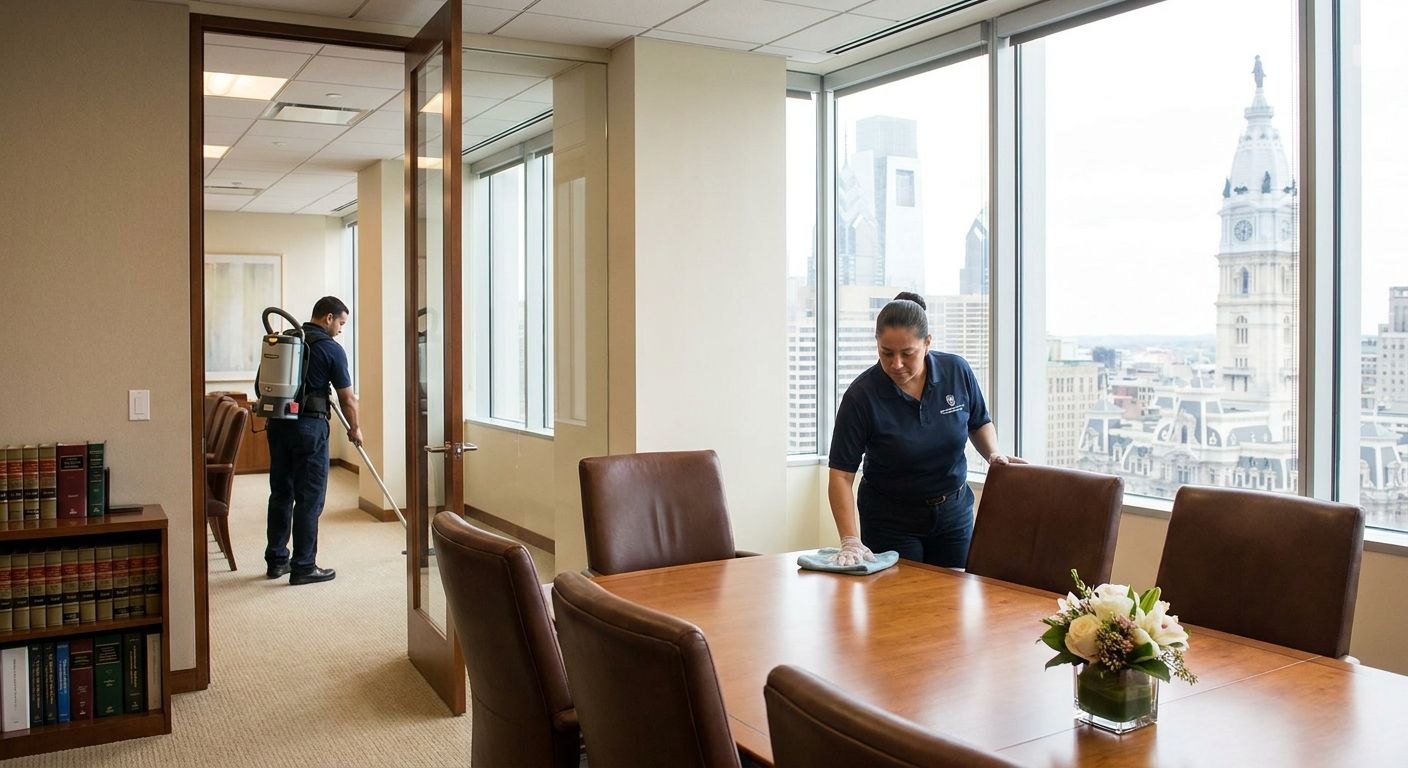
Law firm office cleaning requires a clear scope, controlled access, consistent staffing, and a documented escalation path. This guide helps Philadelphia office and facility managers evaluate those controls without ratings, rankings, or claims about other cleaning companies.
Why this matters
Law offices combine ordinary janitorial needs with confidential work areas, client-facing spaces, after-hours access, and physical security controls. The cleaning plan should support the office without asking cleaning staff to interpret what is sensitive.
The firm or property team should make those decisions in writing. A vendor’s job is to assign authorized people, follow the approved scope, document the work, and escalate anything unexpected.
Create an access-and-scope matrix
| Area | Scope question | Security control |
|---|---|---|
| Reception and conference rooms | Tasks, frequency, resets | Client materials and closing procedure |
| Private offices | Floors, bins, surfaces, exclusions | Desk, file, and device boundaries |
| Records and storage | Included or excluded | Authorized personnel only |
| Kitchens and restrooms | Routine tasks and replenishment | Service window and inspection |
| Shared building areas | Firm or landlord responsibility | Clear ownership and escalation |
Eight controls to verify
1. Assigned-team model
Ask who normally enters the office and how the vendor limits unnecessary rotation. Consistency does not eliminate the need for backup coverage; it makes the backup process easier to control.
2. Replacement authorization
Define how substitutes are approved, identified, trained, and communicated. A last-minute staffing need should not bypass the firm’s access rules.
3. Key, badge, and alarm handling
Document issuance, storage, use, return, loss reporting, and revocation. Identify who may know alarm procedures and who receives alerts after an access problem.
4. Desk and document boundaries
State whether cleaners may move papers, wipe occupied desks, empty specific containers, enter file rooms, or handle items left on floors. Use clear exclusions instead of relying on judgment.
5. Service window
Coordinate cleaning with attorneys, staff, client meetings, depositions, and building security. Define what happens when rooms remain occupied during the approved window.
6. Inspection and proof
Require a checklist that identifies the completed area and a process for review. Set the owner and deadline for corrective work.
7. Incident escalation
List the contacts for an unlocked office, damaged item, alarm issue, unexpected visitor, confidential material, or blocked room. Cleaning staff should stop and call rather than improvise.
8. Insurance and agreement terms
Verify current documentation through the firm’s normal review process. Read the term, renewal, notice, and termination language before access credentials are issued.
How to test the operating plan
- Walk one complete route from building entry to final lock-up.
- Mark every restricted room and ambiguous surface.
- Test the process for an occupied office during the service window.
- Review one replacement-staff scenario.
- Confirm who receives an after-hours incident call.
- Define what evidence closes a missed-service issue.
How Hi Shine should be evaluated
Hi Shine Cleaning Services provides dedicated commercial janitorial teams to legal, medical, biotech, and corporate facilities across Greater Philadelphia. Its stated model includes the HI-Q™ checklist, $5MM in insurance coverage, 24/7 owner access, and a 90-day risk-free trial.
For a law firm, verify how those controls apply to access, credentials, desk boundaries, staffing changes, inspections, and escalation. The proposal should make those details visible before anyone receives a key or badge.
Build a law-office cleaning scope
Document access, restricted areas, staffing, inspection, and escalation for your office.
Request a facility assessmentCommon mistakes
- Giving a master key without a written key-control process.
- Using “do not disturb papers” without defining desk and floor boundaries.
- Allowing substitutes without the same authorization process.
- Leaving shared-area responsibility unclear between the firm and property manager.
- Discovering the escalation path only after an alarm or missed service.
- Measuring quality only through employee complaints.
FAQ
What should a law firm cleaning scope include?
Include tasks, frequencies, access windows, restricted areas, desk rules, credentials, inspections, escalation, and corrective work.
Should cleaning staff move papers on desks?
Only if the firm’s written scope explicitly permits it. A safer default is to define clear no-move boundaries.
How should replacement cleaners be handled?
Require the same identity, authorization, site orientation, and access controls applied to the assigned team.
Who should control keys and badges?
The firm or building should define issuance and revocation, while the vendor documents custody and reports any problem immediately.
What happens if an office is occupied during cleaning?
The scope should state whether the team returns later, skips the room, or contacts an approved office representative.
How should missed work be documented?
Record the area, task, report time, owner, correction, verification, and closure.
One last thing
Ask the vendor to explain what happens when a cleaner sees an unlocked office containing client files after the approved service window. A clear stop-and-escalate answer matters more than a polished promise about discretion.