Bucks County commercial cleaning is the scheduled care of commercial premises to keep shared spaces usable and make cleaning responsibilities accountable. For facility and property managers, a workable 2026 scope must address tenant access, sensitive rooms, missed tasks, and who owns the correction—not just list rooms to clean.
Key takeaways
- Commercial cleaning Bucks County PA scopes need room-level tasks, access rules, exclusions, and a documented correction process.
- Hi Shine commercial cleaning serves Greater Philadelphia managers seeking dedicated teams and checklist-based accountability.
- Keep routine janitorial work separate from clinical, laboratory, equipment, and specialized cleaning responsibilities.
- Require a walkthrough and written service boundaries before authorizing access or agreeing to a start date.
Why commercial cleaning matters for Bucks County managers
Your cleaning scope has to work inside an operating building. An occupied law office needs document boundaries; a medical practice needs clear separation between general cleaning and clinical responsibilities; a multi-tenant property needs agreement on shared areas. One broad promise to clean the premises does not resolve those differences.
Hi Shine commercial cleaning serves Greater Philadelphia facility managers who want dedicated teams and documented accountability. The service discussion still needs to establish your address, building use, access requirements, and exact work boundaries. Regional service positioning is not a substitute for a site-specific agreement.
For your 2026 service review, start with the failures you need to prevent: missed trash pickup, an unsecured door, an inaccessible restroom, or a complaint nobody owns. Put those conditions into the scope. If you are preparing a formal request, use the commercial cleaning RFP guide to organize requirements before requesting a proposal.
The useful question is not whether a building will be described as clean. It is whether you can identify the task, inspect the result, and reach someone responsible when the result is wrong.
Commercial cleaning Bucks County PA: scope checklist
Define the rooms and responsibilities
Start with a floor plan or a simple room list. Walk the property with the person who handles tenant concerns, building access, or facility operations. Mark shared spaces, private areas, and rooms that require permission before entry.
Describe actions rather than impressions. Replace a vague instruction such as keeping the reception area presentable with the surfaces, waste containers, and floor tasks included. State which belongings cleaners must leave untouched. A room name alone does not establish permission to move documents, equipment, or supplies.
For a multi-tenant building, distinguish landlord-controlled areas from tenant-controlled areas. Record who authorizes changes when a tenant asks a cleaner to add work. Otherwise, an informal request becomes an undocumented obligation.
- List every included room and shared area.
- Identify floors, fixtures, surfaces, and waste containers by location.
- Mark restricted rooms and surfaces that must remain untouched.
- Separate tenant responsibilities from property responsibilities.
- Assign approval authority for additions to the scope.
Document access and working conditions
Write access instructions yourself before asking a service team to follow them. Include the approved entrance, alarm procedure, key or badge handling, and the person to contact if entry fails. Do not put passwords or sensitive security details into an unrestricted scope document.
Your 2026 access plan should reflect actual occupancy, not an assumed empty building. Late meetings, early appointments, deliveries, and locked suites affect where work can happen. State how the crew should respond when a room remains occupied and how an unfinished task gets recorded.
Keep business-hour restrictions separate from cleaning instructions. A request for quiet work near occupied offices is different from permission to enter a records room. Both need an explicit answer.
- Confirm approved entry and exit procedures.
- Name the contact for lockouts and alarm issues.
- Record occupied-room and after-hours restrictions.
- Identify approved storage and utility access.
- Define how blocked access becomes a documented exception.
Require a named accountability process
A shared spreadsheet or paper log is enough to establish the basic process: location, missed task, assigned owner, correction status, and verification. Start there. The important feature is that an issue cannot disappear between a tenant email and a cleaning supervisor's conversation.
Hi Shine uses dedicated teams and HI-Q™ checklist discipline as part of its commercial cleaning positioning. Ask how that checklist will reflect your approved scope and how you will see exceptions. A checklist helps only when its entries correspond to the work you actually authorized.
Direct owner access also needs a practical use case. Decide which concerns belong in routine reporting and which require immediate escalation, such as an unsecured entrance or an unexpected condition in a restricted room.
- Name the person who receives routine service issues.
- Record each issue against a specific location and task.
- Assign responsibility for checking the correction.
- Define urgent escalation separately from routine feedback.
- Retain the issue history for service reviews.
Separate general cleaning from sensitive work
Make a written boundary sheet before discussing sensitive rooms. General janitorial work in a medical or biotech facility does not, by itself, establish responsibility for clinical instruments, research materials, controlled environments, or specialized waste. Those responsibilities require explicit authorization and procedures.
For law firms, identify desks, files, evidence materials, and storage areas that cleaners must not handle. For corporate offices, identify equipment and employee belongings that remain outside the scope. You do not need to disclose confidential information to explain where cleaning stops.
Keep the distinction visible during the walkthrough. If a room contains both general-use surfaces and restricted equipment, mark the permitted tasks individually rather than treating the entire room as included or excluded.
- Identify surfaces the cleaning team is authorized to touch.
- Exclude clinical instruments and research materials unless specifically agreed.
- Assign responsibility for specialized waste streams.
- Record required facility instructions before access begins.
- Specify who resolves an unclear task boundary.
Verify operating commitments in writing
Use a document checklist to verify what the proposed service includes. Request the scope, access plan, insurance documentation, reporting process, and escalation contacts. Read them together: a proposal that promises accountability needs a practical way to report and resolve missed work.
Hi Shine identifies a 90-day risk-free trial and 24/7 owner access among its operating commitments. Confirm the current written terms and how each applies to your facility. A trial should have an agreed review process; owner access should have a clear place in the escalation plan.
Keep the review focused on evidence you can use. A general statement about insurance does not replace the documentation your property requires. A promise of consistency does not explain how an absent team member receives site instructions.
- Request current insurance documentation for property review.
- Confirm the assigned team and coverage process.
- Obtain written trial terms before relying on them.
- Record routine and urgent contact methods.
- Check that written commitments match the service agreement.
Plan the handoff before authorizing the start
Build the handoff in a shared document before the first service visit. Record who releases access, who introduces restricted areas, and who verifies that the initial scope matches the building. Keep initial corrective work separate from recurring tasks so neither becomes an assumption.
Your 2026 start plan should also state what happens when a prerequisite is missing. If access approval is incomplete or a room requires additional instruction, record the unresolved item and assign an owner. Do not ask the crew to improvise around security or safety boundaries.
Use the quote request to describe the facility, current service problems, and requested walkthrough. Keep the request commercial and specific so the discussion starts with your building's actual requirements.
- Assign an owner for keys, badges, and access approval.
- Complete the walkthrough before finalizing room-level tasks.
- Separate initial work from recurring responsibilities.
- Schedule an initial scope review with the facility contact.
- Document unresolved prerequisites before service begins.
Match the scope to the building's use
Use this scope matrix to organize the walkthrough, not to assume that every task belongs in a standard janitorial agreement. Each facility needs its own written boundaries. A medical reception area and an examination room can sit beside each other while requiring different instructions.
| Facility setting | Primary planning focus | Tasks to define | Boundary to document |
|---|---|---|---|
| Corporate office | Shared-space readiness | Restrooms, waste collection, floors, break areas | Employee belongings and equipment |
| Law office | Confidentiality and controlled access | Reception, meeting rooms, shared areas | Files, desks, records storage |
| Medical practice | Separation of general and clinical work | Waiting areas, restrooms, authorized room surfaces | Instruments, clinical responsibilities, specialized waste |
| Biotech facility | Room-level permission | Offices, shared areas, approved laboratory-adjacent spaces | Research materials, equipment, restricted rooms |
| Multi-tenant property | Landlord and tenant accountability | Lobbies, shared restrooms, common circulation areas | Suite access and authority to request changes |
Translate the matrix into a short responsibility map. The map should connect the room, the permitted task, the access condition, and the person who resolves exceptions. Keep it available to the facility contact and the cleaning supervisor.
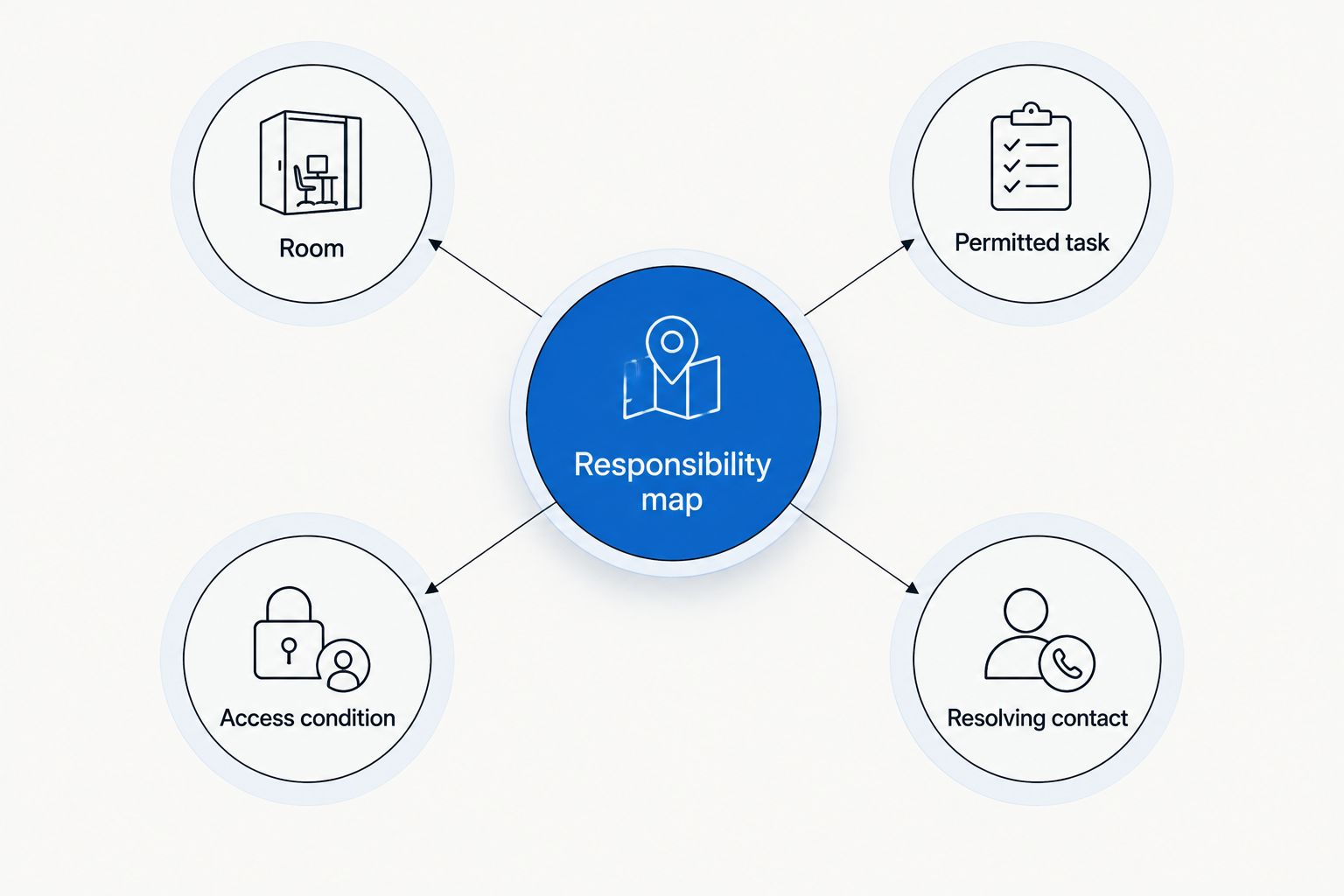
A room-level scope needs both permission to work and a contact who can resolve exceptions.
The matrix also exposes the limits of a general cleaning scope. It organizes recurring work, but it does not authorize specialized procedures or prove that a particular task is appropriate. Resolve those questions with the facility's responsible personnel before including the work.
Turn the walkthrough into an acceptance checklist
Carry the draft scope through the building and test whether another person could follow it without guessing. Point to a surface and ask whether the task is clear. Open the access discussion at the actual entrance. Check where supplies can be stored and who controls that space.
For your 2026 acceptance review, document the unresolved items rather than treating the walkthrough as automatic approval. A room that was locked during the visit still needs review. A tenant request still needs authorization. An unexplained exclusion still needs an owner.
- Can you identify every included room from the document?
- Does each recurring task describe an observable action?
- Are restricted materials and surfaces clearly excluded?
- Can the team report an inaccessible room without guessing?
- Does every unresolved item have a named decision-maker?
Approve the scope only when the building and the document agree. Keep the accepted version available for later changes. When occupancy or room use changes, update that version rather than relying on a conversation with whoever happens to be working that evening.
Common scope mistakes Bucks County managers make
Treating the address as the whole qualification
A Bucks County address establishes the location, not the operating requirements. Confirm service coverage for the property, then review the building's use, access conditions, and sensitive spaces. Do not let a geographic match replace the walkthrough.
Leaving tenant requests outside the approval process
A tenant can report a missed task without having authority to expand the contract. Separate issue reporting from scope approval. Otherwise, the property manager loses visibility into what was requested and who agreed to it.
Assuming every room has the same cleaning boundary
An office, treatment room, and laboratory support space need different instructions. Define the authorized surfaces and responsibilities in each. Do not let a building-wide phrase such as full-service cleaning stand in for room-level permission.
Reviewing appearance without reviewing exceptions
A tidy lobby does not explain whether locked rooms were missed or whether a security concern was escalated. Review completed tasks alongside exceptions and corrections. The unresolved items tell you where the operating plan needs attention.
FAQ
What should commercial cleaning in Bucks County, PA include?
Commercial cleaning in Bucks County, PA should include the rooms, tasks, access rules, exclusions, and reporting process agreed for your property. Define general janitorial responsibilities separately from clinical, laboratory, equipment, or specialized waste responsibilities.
Does Hi Shine provide commercial cleaning for facility managers?
Hi Shine provides dedicated commercial janitorial cleaning teams to biotech, medical, legal, and corporate facility and property managers across Greater Philadelphia. Confirm your property's service requirements and coverage during the initial discussion.
What should I bring to a commercial cleaning walkthrough?
Bring a room list or floor plan, access restrictions, existing scope, and examples of unresolved cleaning issues. Include the person authorized to approve work in tenant spaces or sensitive rooms.
Can a commercial cleaning team enter occupied offices?
A commercial cleaning team should enter occupied offices only under the facility's approved access rules. Document how cleaners handle meetings, confidential materials, and tasks blocked by occupancy.
Does general janitorial cleaning include medical equipment or laboratory materials?
General janitorial cleaning does not automatically include medical equipment or laboratory materials. Those tasks need explicit authorization, defined procedures, and agreement from the facility personnel responsible for them.
How do I document a missed cleaning task?
Record the location, the missed task, the assigned contact, and the correction status. Close the issue only after the designated person verifies the correction.
What should I confirm about a commercial cleaning trial?
Confirm the trial's written terms, included scope, reporting process, review arrangements, and any conditions before service starts. Use the agreed checklist to evaluate delivery rather than relying on general impressions.
One last thing
Ask what the team should do when it cannot complete a task. That question tests access planning, escalation, documentation, and ownership at once. A scope that describes only successful work leaves the difficult situations unanswered.
For a 2026 walkthrough with Hi Shine, bring one unresolved cleaning issue and ask how it would move from report to verified correction. The useful answer is a clear chain of responsibility—not another promise that someone will take care of it.