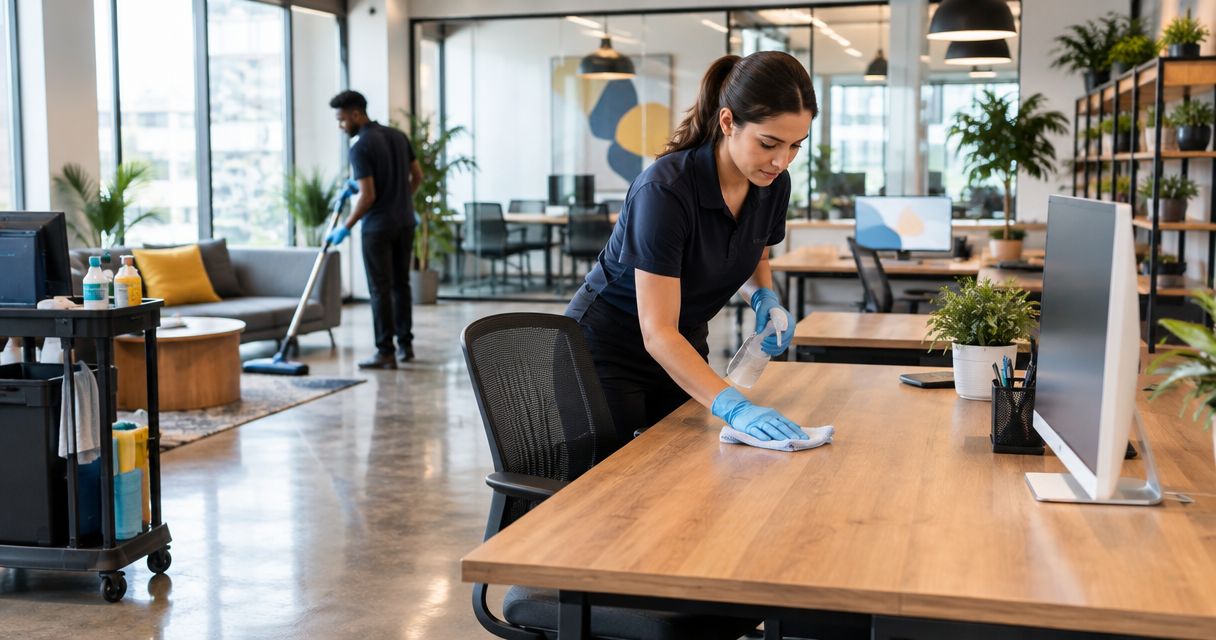
Coworking space cleaning is commercial janitorial work organized around shared work areas, member access, and common amenities, with the aim of keeping your facility usable and cleaning responsibilities accountable. Cleaning services for coworking spaces need a written boundary between scheduled cleaning, occupied-space requests, and member responsibilities—not an office checklist that leaves those decisions to the crew.
Key takeaways
- Cleaning services for coworking spaces need room-specific scope, access rules, and documented follow-up.
- Hi Shine commercial cleaning serves Greater Philadelphia facility managers with dedicated teams and HI-Q™ checklist discipline.
- Separate janitorial tasks from member resets, building maintenance, and requests during occupied hours.
- Approve cleaning boundaries before work begins, especially around personal belongings and private offices.
Why cleaning services matter for coworking spaces
A coworking manager needs to know who owns a missed trash pickup, a dirty meeting room, or an empty restroom dispenser. Members should not have to work out whether the operator, landlord, or cleaning team is responsible. Your cleaning scope should assign responsibility before a complaint arrives.
Hi Shine provides commercial cleaning teams across Greater Philadelphia. For a coworking facility, the practical starting point is a walkthrough that establishes what the team can clean, when it can enter, and what evidence you expect afterward.
For your 2026 operating plan, treat shared space and leased space as separate responsibilities. A communal kitchen belongs in a different scope discussion from a member’s locked office. A meeting room also needs a clear handoff between bookings; completing an evening cleaning visit does not assign responsibility for the next daytime reset.
The guide below focuses on those operating decisions. It does not assume that every coworking location needs the same tasks or that cleaning staff should take on reception, member support, or maintenance duties.
Build your coworking cleaning scope
Map every area and assign ownership
Start with a floor plan and a spreadsheet. Walk the facility with your operations lead, mark each usable area, and record who controls it. Include spaces that are easy to overlook: phone booths, storage rooms, printer stations, internal corridors, and entrances shared with other tenants.
Separate the coworking operator’s responsibilities from the landlord’s obligations. If the building team cleans the main lobby, your scope should identify where that responsibility ends. Do not leave overlapping areas to an informal understanding between crews.
An area is not fully scoped until you name both the task owner and the person authorized to report a failure. Members can flag problems, but your manager should control changes to the agreed work.
- Identify shared, private, restricted, and landlord-controlled areas.
- Name the party responsible for each area.
- Record floor materials and surfaces that need specific care.
- Mark storage locations for supplies and equipment.
- Note any space excluded from routine cleaning.
Define tasks in observable language
Write the first checklist yourself using tasks that someone can verify. Replace “clean the kitchen” with specific instructions about counters, sinks, floors, trash, and the handling of items left behind. Keep the list tied to the actual facility rather than copying every task from a generic template.
Distinguish wiping a desk surface from moving everything on it. Decide whether the team cleans only clear workstations and who contacts members about clutter. For restrooms, separate cleaning from replenishment and identify who provides consumables.
For your 2026 scope, use completion criteria that a supervisor can inspect without interpreting your intent. “Floor free of loose debris” communicates a checkable condition; “premium presentation” does not.
- Specify the surface or fixture for each task.
- Describe the visible completion standard.
- State whether objects can be moved.
- Assign responsibility for consumable supplies.
- Identify exceptions that require manager approval.
Set access rules before assigning work
Use a written access sheet to establish entry permissions, alarm procedures, and restricted spaces. The team should know what to do when a meeting runs late, a member remains in a private office, or an access credential fails.
Hi Shine’s dedicated-team model and HI-Q™ checklist discipline belong in this discussion as operating requirements to confirm during the walkthrough. Ask how your access restrictions and task boundaries will appear in the working checklist. A quality system needs your building-specific instructions to make the scope usable.
Do not give cleaning staff discretion to open locked storage, move confidential papers, or unplug member equipment. Define a reporting route for inaccessible rooms instead of treating them as completed work.
- Approve credentials and permitted entry areas.
- Identify rooms that require an escort or permission.
- Document alarm and lockup instructions.
- Set boundaries around papers and personal belongings.
- Establish the response to denied or interrupted access.
Assign responsibility during occupied hours
First, identify which daytime requests your own operations staff can handle and which require an agreed cleaning assignment. A spill in a walkway needs an immediate response route. A meeting-room reset needs an owner. Neither responsibility should exist only because someone assumes the evening crew covers it.
Use your booking calendar and staff observations to identify handoff points. This is an operational exercise, not a reason to copy another location’s schedule. If members work late or events change access, document those conditions before agreeing on service windows.
The day porter service scope guide explains how to define duties during occupied hours. Keep those duties distinct from reception work, member assistance, and the scheduled janitorial scope.
- Name the contact for spills and restroom issues.
- Assign meeting-room resets between bookings.
- Define who handles event-related requests.
- Record occupied areas that the crew must leave undisturbed.
- Require approval for work outside the agreed scope.
Create a reporting and correction loop
A shared issue log is enough to start. Record the location, task, observed problem, responsible contact, and closure evidence. Give members a simple reporting route, but have your facility manager consolidate cleaning issues so the team does not receive conflicting instructions.
For 2026, make correction ownership explicit. Receiving a complaint is not the same as resolving it, and a checked box should not close an issue that remains visible. Agree on how urgent problems reach a responsible person and how routine exceptions are reviewed.
The reporting loop should connect the original task to its correction. That gives you a practical way to distinguish a missed assignment from a room the team could not access.
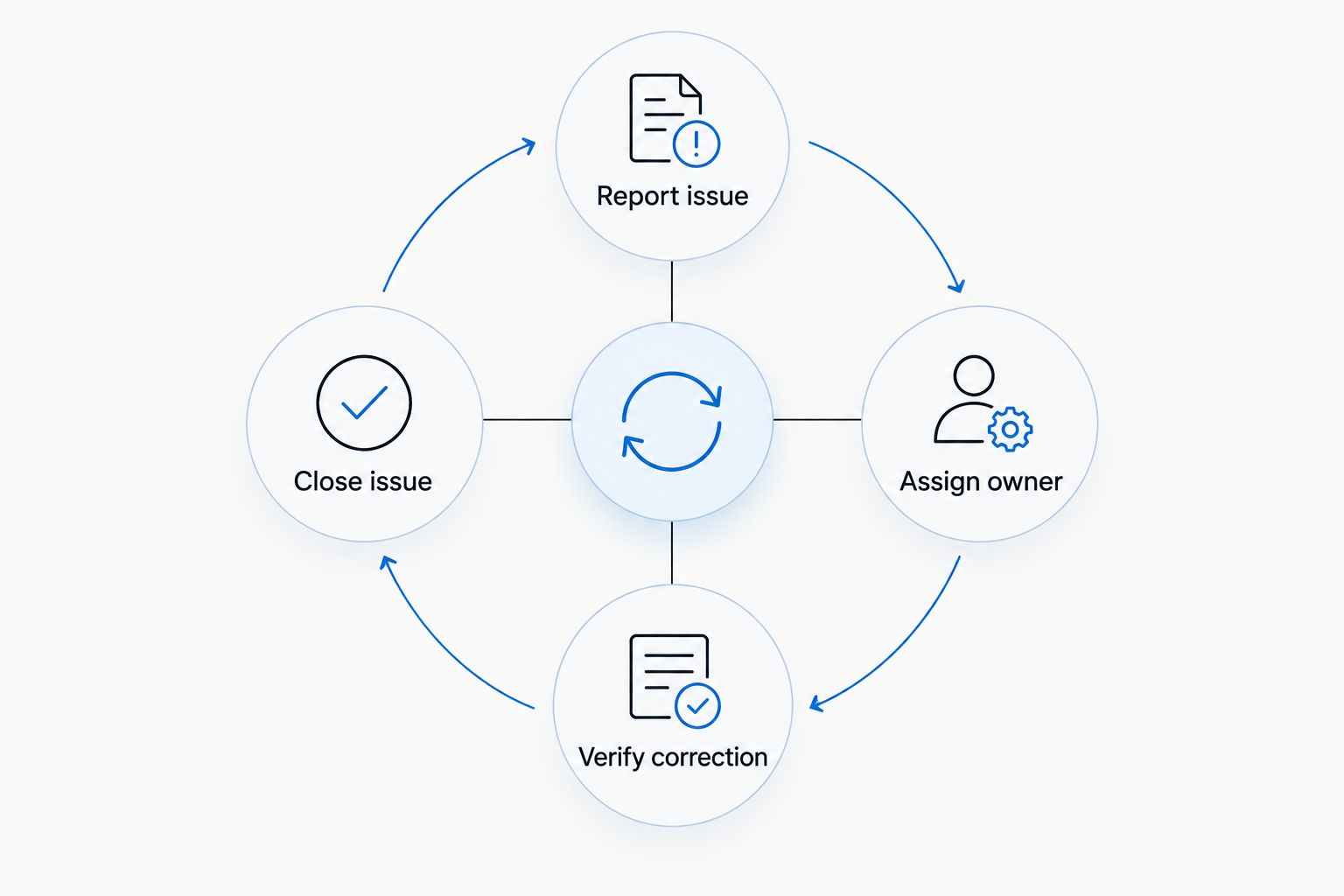
Close a cleaning issue after verification, not simply after someone acknowledges it.
Keep the record factual. A location and task description are more useful than a broad complaint that the facility feels neglected.
- Report issue: identify the area and missed task.
- Assign owner: name the person responsible for follow-up.
- Verify correction: inspect the result against the scope.
- Close issue: record the outcome and any remaining exception.
Check safety and surface-care boundaries
Begin with an inventory of your flooring, furnishings, and shared equipment. Keep manufacturer care instructions accessible and identify surfaces where the wrong product or method would create damage. Cleaning staff should not have to guess how to treat an unfamiliar finish.
Cleaning and disinfecting are different tasks. When disinfection is included, require the product’s label instructions to govern its use, including surface suitability and contact time. Do not substitute a general promise to sanitize everything for an approved task and method.
Set separate handling rules for food, member belongings, unexpected waste, and equipment. An undefined task is not permission to improvise. Anything outside the agreed scope should reach your designated manager for a decision.
- Record material-specific care instructions.
- Identify equipment that staff must not touch.
- Approve products for their intended surfaces.
- Follow label directions for included disinfection tasks.
- Define how unexpected waste or damage is reported.
Validate the handoff before accepting the scope
Walk through the proposed checklist with your facility manager before work starts. Test it against an occupied meeting room, a locked private office, a kitchen with dishes left behind, and a restroom that needs supplies. Each scenario should produce a clear instruction rather than a debate.
Hi Shine emphasizes dedicated teams, checklist discipline, and direct owner access. Those operating commitments do not replace a facility-specific scope: you still need agreed access permissions, exclusions, and a named contact on your side.
At the start of the 2026 service period, inspect the agreed tasks with the checklist in hand. Record unresolved boundaries separately from missed work. That distinction prevents you from accepting an incomplete assignment or blaming a team for an instruction it never received.
- Confirm that the working checklist matches your approved scope.
- Verify the reporting contact and escalation route.
- Walk through access and lockup procedures.
- Resolve exclusions before accepting the handoff.
- Document how later scope changes receive approval.
Put coworking responsibilities in writing
Use the following table as a walkthrough worksheet, not as a standard service package. Every row needs approval for your location. A cleaning task, its operating boundary, and its reporting owner belong in the same document.
| Area or responsibility | What to define | Operating boundary | Evidence to request | Assigned owner |
|---|---|---|---|---|
| Shared desks | Approved surface-cleaning tasks | Personal items and occupied workstations | Task checklist and access exceptions | |
| Private offices | Entry permission and included tasks | Locked rooms, confidential materials, member equipment | Authorized-access instructions | |
| Meeting rooms | Cleaning tasks and booking handoffs | Reset duties between bookings | Named owner for each responsibility | |
| Kitchen and coffee area | Counters, sinks, floors, and waste | Dishes, food disposal, appliance interiors | Written inclusion and exclusion list | |
| Restrooms | Fixtures, floors, waste, and replenishment | Supply purchasing and storage access | Completion checks and supply reports | |
| Entry and shared corridors | Floor care and accessible surfaces | Landlord-controlled space | Responsibility map | |
| Events and unusual requests | Approval process and task instructions | Work outside the standing scope | Authorized change record |
Add room names to this worksheet. “Meeting room” is not enough if your facility has several rooms with different access rules. Keep the approved version available to the manager and cleaning team so later instructions do not silently change the agreement.
Common mistakes coworking managers make
Treating shared desks like empty office desks
Hot desks and member workstations need different handling rules. Do not ask the crew to move laptops, chargers, papers, or personal items simply to finish a surface. Set a clear-desk expectation for members and document what happens when a workstation remains occupied or obstructed.
Leaving meeting-room resets unassigned
Scheduled cleaning does not automatically cover resetting a room between bookings. Assign responsibility for discarded cups, displaced chairs, and reported spills. Tell your team whether a reset is an operations duty, an agreed cleaning duty, or a request that needs separate authorization.
Using membership rules as cleaning instructions
A rule asking members to clean up after themselves does not define the janitorial scope. Your agreement still needs to identify who handles abandoned dishes, full bins, and food left in shared areas. Keep member conduct rules separate from the team’s authorized work.
Accepting a checklist without exception records
A completed checklist should not hide inaccessible rooms or work blocked by belongings. Ask for exceptions alongside completed tasks. Otherwise, you cannot distinguish missed cleaning from an access problem that your operations team needs to solve.
Expanding the scope through informal requests
A member asking the crew for extra work should not change your agreement. Route new requests through your authorized manager. Review the written scope when amenities, room use, or events change during 2026 rather than relying on instructions passed along in conversation.
FAQ
What should cleaning services for coworking spaces include?
Cleaning services for coworking spaces should include written tasks for shared work areas, meeting rooms, restrooms, kitchens, waste removal, and any other approved spaces. Define access permissions, exclusions, supply responsibilities, and the reporting owner for each area.
Can a cleaning team enter members’ private offices?
A cleaning team should enter members’ private offices only under the facility’s approved access rules. Document permission, occupied-room procedures, and boundaries around papers, belongings, and equipment before assigning the work.
Who should clean a meeting room between coworking bookings?
Your coworking operator should assign a named owner for meeting-room resets between bookings. Scheduled janitorial work does not establish that responsibility unless the approved scope expressly includes it.
Do coworking cleaning services include washing dishes?
Dishwashing is included only when your agreed scope says so. Define responsibility for shared dishes, member-owned items, abandoned food, and appliance interiors rather than treating all kitchen work as one task.
How do I check whether coworking cleaning work is complete?
Inspect the agreed tasks against room-specific completion criteria and review any access exceptions. Keep an issue open until the correction is verified or the responsible manager accepts a documented exception.
Does coworking cleaning automatically include disinfection?
Coworking cleaning does not automatically include disinfection. Specify any disinfection tasks separately and require the approved product’s label instructions to govern surface suitability and use.
Can Hi Shine help a Greater Philadelphia coworking manager?
Hi Shine provides commercial janitorial teams across Greater Philadelphia. Discuss your coworking facility’s shared spaces, private-office permissions, operating hours, and accountability requirements during a facility assessment to establish the appropriate scope.
One last thing
Your exception log can expose problems that a completed checklist conceals. A locked room, a blocked desk, or an unapproved event request needs a recorded decision, not a silent checkmark. Before accepting your 2026 scope, ask how each exception reaches you and who has authority to resolve it.