
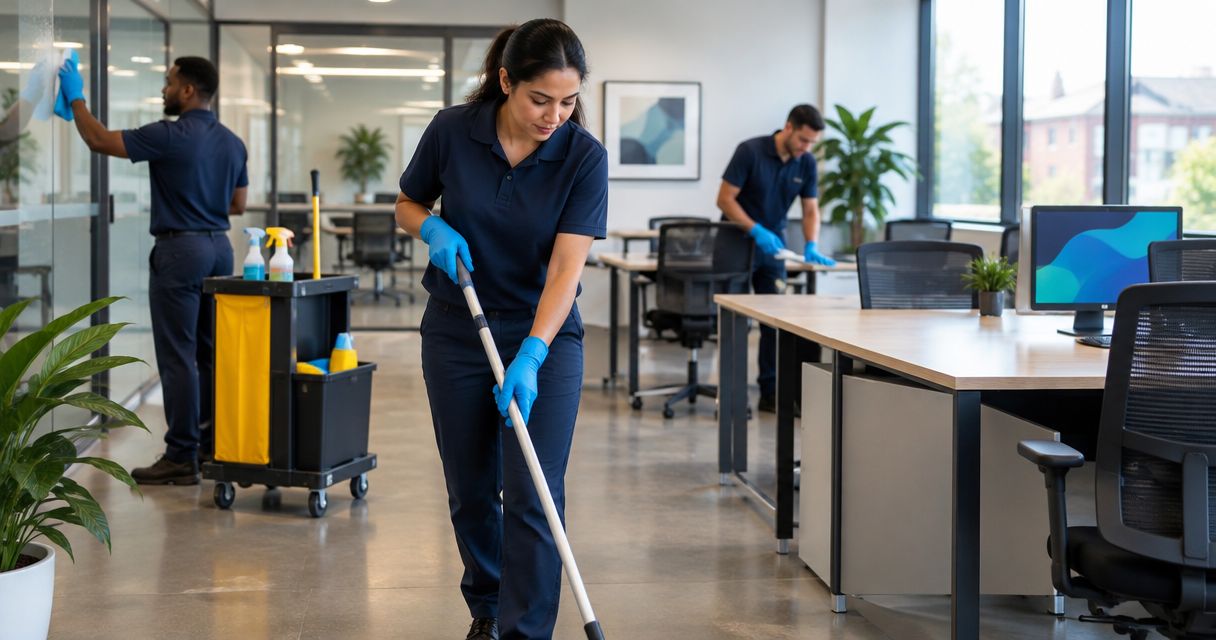
Sharon Hill janitorial cleaning is recurring commercial cleaning built around your facility’s rooms, operating hours, and service requirements. To hire for 2026, document the tasks, assigned team, access controls, completion checks, and correction process before signing—not just the number of visits.
Key takeaways
- Janitorial cleaning in Sharon Hill needs a written commercial scope, assigned team, and documented correction process.
- Set cleaning tasks and service windows room by room; do not assume one schedule fits every facility.
- Verify insurance, worker authorization, supply ownership, and backup coverage before service starts.
- Hi Shine serves Sharon Hill with dedicated commercial cleaning teams and facility-specific HI-Q™ checklists.
- Review the 90-day risk-free trial terms and judge service against the agreed scope.
Hi Shine’s Delaware County commercial cleaning service includes Sharon Hill. Use this checklist to prepare your facility assessment and turn the walkthrough into a written operating plan.
Why this matters for Sharon Hill facilities
Your cleaning scope has to protect the way your building operates. An office needs clear rules for occupied desks and confidential documents. A shared commercial property needs responsibility boundaries between tenant suites and common areas. A facility near airport-corridor operations needs service windows that respect its actual shifts and access arrangements.
A 2026 cleaning agreement should become a usable service checklist without anyone having to interpret it. If a task matters enough to raise a complaint, it needs a location, a schedule, an accountable person, and a way to confirm completion.
Build your Sharon Hill janitorial cleaning checklist
Define the rooms, tasks, and exclusions
Start with a floor plan or a room list. Walk each service area and write down the work you expect, including what the cleaning team must leave untouched. A room name alone is not a cleaning instruction: a restroom has fixtures, floors, dispensers, waste containers, and surfaces with different requirements.
Use the following worksheet as a structure, not a preset service schedule. Complete the frequency and service window after reviewing occupancy, building policies, and access with your facility contact.
| Service area | Tasks to define | Boundary to document |
|---|---|---|
| Lobby and entry | Floor care, approved glass, touchpoints, trash | Weather-related work and entry access |
| Restrooms | Fixtures, surfaces, floors, dispenser checks | Supply ownership and replenishment |
| Offices and tenant suites | Trash, vacuuming, approved dusting | Desks, documents, locked suites |
| Kitchens and breakrooms | Approved counters, sinks, floors, waste | Personal items and appliance interiors |
| Corridors and stairs | Floor care, spot cleaning, debris reporting | Shared-area responsibility and restricted doors |
| Exterior entrances | Agreed debris removal and condition reporting | Limits of exterior work |
Separate routine service from periodic floor work, special requests, and specialist cleaning. For medical or biotech facilities, identify the areas and procedures your facility controls; ordinary janitorial scope does not establish clinical or laboratory compliance.
Before approving the scope:
- List every included service area and task.
- Identify excluded rooms, surfaces, and specialist work.
- Define the expected condition after each task.
- Record who can authorize additions or changes.
Set service windows around actual building use
A facility-wide visit schedule is only the starting point. Each task also needs an agreed frequency and a time when the team can perform it. Restroom checks during occupied hours, office vacuuming after closing, and periodic floor care involve different access decisions.
Do not copy a universal daily or weekly schedule into your 2026 agreement. Decide the requirement from your building’s use and the standards your facility already follows. If an event, tenant change, or new shift changes demand, update the scope rather than relying on an informal message.
The schedule should also explain blocked work. A locked suite, occupied meeting room, or unavailable supply closet needs a recorded exception and an agreed next step. Otherwise, an unfinished task and an inaccessible task look identical when you review service.
Confirm these scheduling details:
- Approved service days and entry windows.
- Required completion time and lock-up responsibilities.
- Tasks that cannot happen during occupied hours.
- Holiday, closure, and event arrangements.
- How blocked access and rescheduled work are recorded.
Confirm the assigned team and backup process
Site familiarity matters when cleaners handle keys, restricted doors, different floor surfaces, and tenant-specific instructions. Require a staffing plan that identifies the regular assignment, the person responsible for on-site completion, and the coverage process when someone is absent.
Confirm screening standards and authorize workers before granting access.
Hi Shine uses dedicated commercial cleaning teams. During your facility assessment, ask how the assignment, backup coverage, and site orientation would work for your Sharon Hill property. A dedicated team still needs a documented replacement process; staffing continuity is not a reason to leave absence coverage undefined.
Record the staffing requirements:
- Regular team assignment and lead responsibility.
- Screening and site-orientation requirements.
- Backup coverage for absence or staffing changes.
- Notification and authorization rules for replacements.
- The contact responsible for resolving staffing gaps.
Verify insurance and control building access
Your facility’s insurance requirements belong in the agreement. Request current evidence showing the insured business, coverage types, limits, and policy dates, then have the responsible risk contact confirm that it meets your building’s requirements.
Hi Shine states $5MM insurance coverage on its Delaware County service page. That figure is a starting fact to verify for your engagement, not proof that every required coverage or contractual condition is satisfied. Confirm certificate details and any additional insured requirements through your organization’s insurance review process.
Access needs the same written discipline. Keys, badges, alarm instructions, and restricted zones should have accountable owners. Establish how credentials are issued, reported missing, recovered, and disabled when authorization ends; agree the required timing with your facility’s security contact.
Keep the onboarding record complete:
- Required insurance evidence and renewal responsibility.
- Authorized personnel and permitted service areas.
- Key, badge, and alarm credential controls.
- Lost-access and security-incident reporting.
- Credential removal and return procedures.
Assign supplies, products, and equipment ownership
Separate cleaning tools and chemicals from restroom consumables. The service agreement should say who buys each item, where it is stored, who checks stock, and who authorizes replacements. Restocking a dispenser is a task; purchasing its contents is a separate responsibility.
Document approved products and surface restrictions before the first visit. Your facility should also identify the process for product changes and the required safety information. Do not leave the team to infer what can be used on a specialized surface or in a restricted area.
Agree these responsibilities in writing:
- Cleaning products and equipment provided for service.
- Consumables included or supplied by the facility.
- Storage locations and approved access.
- Stock checks, reorder points, and purchasing authority.
- Equipment maintenance and damage reporting.
Require completion evidence and a correction owner
A checklist should reflect your scope, not a generic list of cleaning activities. Ask how the team records completed work, how exceptions are flagged, and who confirms the visit is finished. Then identify the person who can act when you report a miss.
The HI-Q™ system configures tasks to the facility, guides the dedicated team through each visit, and has the team lead confirm completion. Work that cannot be finished is flagged for follow-up. Ask to review how that process would cover your rooms and how service information will be shared with your facility contact.
The company also offers 24/7 owner access. Confirm how reporting, acknowledgement, correction, and closure will work for your facility, including the applicable response terms.
For your 2026 quality review, require:
- A task list matching the approved scope.
- A completion check with an accountable lead.
- An exception record for missed or blocked work.
- A named correction owner and reporting route.
- A way to confirm closure and review repeated issues.
Use the walkthrough to resolve unanswered questions
Bring the person who knows the building’s daily operation to the walkthrough. That might be the facility manager, property manager, or an authorized site contact. Open included areas, point out restricted spaces, and explain the work that creates interruptions or complaints.
Test the proposed service route rather than discussing the building only from a floor plan. Check where the team enters, where supplies are stored, which doors lock automatically, and how it leaves the building secure. Include tenant or shift constraints without sharing confidential information unnecessarily.
Leave the walkthrough with:
- A confirmed service-area list.
- Access and storage decisions.
- Surface and product restrictions.
- A list of exclusions and open questions.
- An owner for approving the final scope.
Review trial and agreement terms before starting
Use the same written scope to assess initial service. Check completion records, access handling, staffing continuity, and how reported misses are closed. Review the actual work, not just whether the building looks acceptable during a single visit.
Hi Shine offers a 90-day risk-free trial. Review the written trial terms, included work, and any exit requirements before starting. Ninety days does not cover every periodic task automatically: work scheduled outside that window still needs a separate review plan.
Before the first service visit:
- Approve the scope, schedule, and exclusions.
- Confirm trial, renewal, and exit terms.
- Complete staffing and access authorization.
- Agree how service evidence and issues will be reviewed.
- Assign the facility contact who approves changes.
Keep the 2026 approval file usable
Keep one current version of the scope, not conflicting instructions in separate emails. The approval file should let a new facility contact understand the service without reconstructing the original sales conversation.
| Document | What it should establish |
|---|---|
| Scope and schedule | Included tasks, locations, service windows, exclusions |
| Staffing and access plan | Assigned roles, backup coverage, authorized entry |
| Supply responsibility list | Purchasing, stock checks, storage, equipment ownership |
| Quality and correction process | Completion evidence, exceptions, reporting, closure |
| Agreement and trial terms | Start arrangements, review process, renewal and exit terms |
Common scope mistakes to remove before approval
Leaving shared spaces without an owner. Tenant suites and common areas need explicit boundaries. Mark who is responsible for each space and how a request outside that boundary is authorized.
Treating inaccessible work as completed. A locked room needs an exception record. Record the access problem, the person notified, and the next agreed service opportunity.
Leaving specialist work inside a general description. Define exactly which medical, laboratory, or equipment-adjacent areas are included. Keep specialist procedures under the facility’s approved requirements.
Changing instructions without updating the checklist. A new tenant, layout, or operating window changes the work. Approve the revision and make sure the team receives the current version.
FAQ
What should I require for janitorial cleaning in Sharon Hill, PA?
Require a room-level commercial scope, agreed service windows, assigned staffing, verified insurance, access controls, and a documented correction process. Confirm those requirements during a facility walkthrough before signing.
How often should my Sharon Hill commercial building be cleaned?
Set cleaning frequency by task, occupancy, facility policies, and available service windows. A single daily or weekly rule does not define the needs of every room or building.
What should a commercial janitorial agreement include?
Include tasks, locations, schedules, exclusions, staffing and backup arrangements, supplies, access rules, quality checks, correction ownership, and agreement terms. Keep the service checklist consistent with the signed scope.
How do I verify a cleaning company’s insurance?
Request current coverage evidence and have your organization’s risk contact check the insured business, coverage types, limits, and dates against your requirements. Confirm certificate details and any additional insured requirements through that review.
What happens if a cleaning task is missed or a room is locked?
The team should record the missed or blocked task and follow the agreed reporting and correction process. Identify who authorizes access or follow-up and how completion will be confirmed.
Does a 90-day trial cover all periodic cleaning work?
No. A 90-day trial only tests work scheduled and performed during that window; less frequent tasks need a separate review plan. Check the written trial scope and exit terms before service starts.
Does Hi Shine provide commercial janitorial cleaning in Sharon Hill?
Yes. The company’s Delaware County service coverage includes Sharon Hill, with dedicated commercial cleaning teams and facility-specific HI-Q™ checklists. Request a facility assessment to confirm your building’s scope, access, and service requirements.
One last thing
Choose one routine task and trace it from the agreement to the service checklist and correction process. Restroom restocking is a useful example: who supplies the product, who checks the dispenser, what happens during a stockout, and who confirms the issue is closed?
If those answers live in different places—or nowhere—resolve them before the first visit. Accountability starts with instructions people can actually use.
Related guides
- Commercial cleaning support for property managers
- How the HI-Q™ quality system works
- How to write a commercial cleaning RFP
Get a Free Facility Assessment in Sharon Hill
Tell us about your commercial facility so the walkthrough can define your scope, service windows, dedicated-team requirements, and accountability process.