
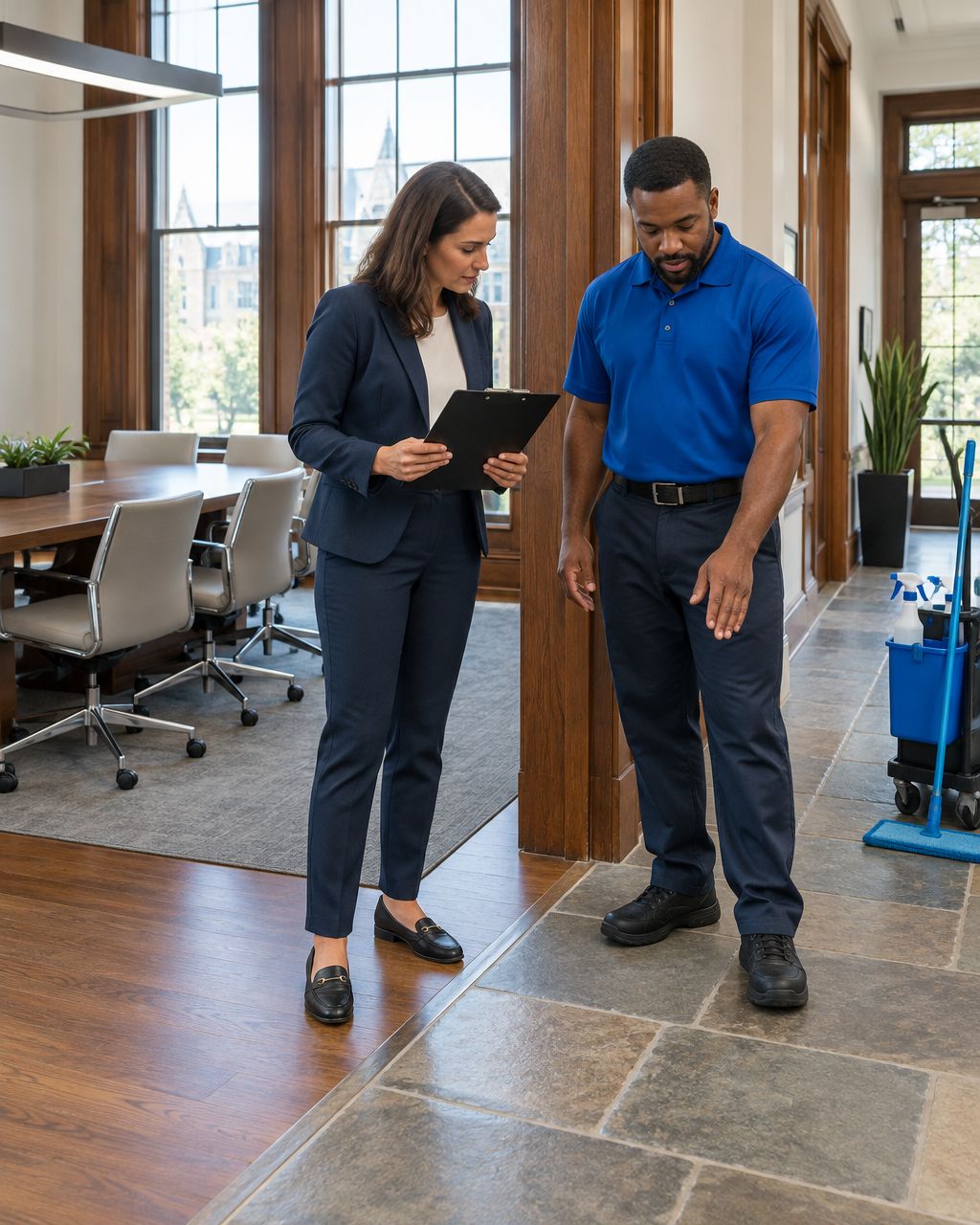
Commercial cleaning on the Main Line needs a written scope that matches your rooms, finishes, access rules and occupied hours. This 2026 checklist helps facility and property managers define the service before the first shift, with clear responsibility for assigned workers, missed tasks and changes to the building.
Key takeaways
- Scope Main Line commercial cleaning by room, approved surfaces, tasks and service windows.
- Identify sensitive finishes and confirm approved products before work begins.
- Require assigned personnel, authorized backups and current tenant access instructions.
- Verify insurance and agree on task confirmation, blocked-work reporting and corrections.
- Hi Shine provides dedicated commercial cleaning teams on the Main Line; confirm your building's assignment.
Why your building needs its own checklist
Hi Shine's Main Line service area identifies Wayne, Ardmore, Bryn Mawr, Narberth and Bala Cynwyd. Its published local facility mix includes offices, medical practices, retail and educational institutions. Your assignment still needs to reflect the particular building rather than assumptions about the corridor.
Older finishes, shared entries and occupied suites can affect what workers clean and when they can do it. A cleaning instruction that suits one surface or room is not automatically appropriate elsewhere. Bring those differences into the walkthrough and written scope.
A useful checklist identifies decisions, not adjectives. It tells your team which tasks are included, who may enter, what requires approval and how incomplete work is resolved. It should remain usable when the usual site contact is absent.
Prepare the Main Line scope for 2026
Write a room-level task list
Start with the rooms you manage. Identify reception, client areas, offices, meeting rooms, restrooms, kitchens, corridors and approved support spaces. Mark landlord-controlled or tenant-controlled areas separately so responsibility does not change at an unmarked doorway.
For each room, record:
- Included surfaces and routine tasks.
- Frequency agreed for those tasks.
- Service window and occupancy restrictions.
- Excluded equipment, materials and spaces.
- Contact who approves questions or changes.
Name the work specifically. For a meeting room, distinguish table surfaces, chairs, floors, ordinary trash and any excluded technology. Do not instruct workers to clear documents or move equipment simply to reach a surface unless the building owner has explicitly authorized a procedure.
Record finish and product restrictions
Walk the actual surfaces instead of relying on floor area. Identify flooring, entry mats, glass, counters and furniture finishes, and ask the building owner for applicable care instructions. Do not prescribe a method because a surface looks like a familiar material.
Where relevant, document:
- Manufacturer or property-approved care instructions.
- Products and tools permitted for the included work.
- Methods or materials that are prohibited.
- Who approves substitutions.
- Areas requiring a separate specialist assessment.
For your 2026 agreement, keep routine maintenance separate from restoration or repair. A janitorial visit does not automatically include repairing wear, removing an unknown stain or restoring a historic finish. Unresolved work should remain an open question until the responsible person approves the assignment.
Set service windows around occupants
Identify when cleaning can happen in each space. A retail entry, shared corridor and private office can have different occupied periods. Discuss noise, wet floors, privacy and access with the people responsible for the building.
Include what happens when the planned window is unavailable. Workers need a way to report the blocked task and move to other approved work without deciding to enter an occupied or restricted room. Record who can authorize a revised window.
Periodically review the schedule against actual use. A later opening time, an additional tenant or a new meeting pattern can alter the route. The agreement should explain how those changes reach the task list and assigned team.
Define credentials and tenant boundaries
A shared building needs written instructions for each controlled space. Identify the approved entrance, movement route, credentials and lock-up responsibilities. Tenant permission and landlord permission are not necessarily the same decision.
Confirm:
- Which suites the assignment includes.
- Who authorizes entry and credentials.
- How expected workers are recognized.
- Whether an escort or sign-in is required.
- Who handles lost credentials and access removal.
Keep sensitive codes and personal information within the building's approved sharing process. The crew needs enough instruction to perform the authorized work, not unrestricted visibility into building security arrangements.
Agree on assigned staffing and backup coverage
Ask who is assigned, who supervises the account and what happens during an absence. Dedicated workers can retain site familiarity, but changes still require orientation and authorization. An absence should not create an exception to tenant access rules.
Hi Shine provides dedicated commercial cleaning teams on the Main Line. Confirm how the assignment will work at your building, including approved replacements and notice to the property contact. A dedicated team is an operating arrangement, not a promise that an individual never changes.
Keep the route, finish restrictions and contacts documented. If one worker holds all the knowledge, the building is dependent on that person's attendance. Approved backups need current instructions rather than a hurried verbal handoff.
Make completion and corrections observable
Hi Shine's HI-Q™ Quality System configures tasks to facility specifications, guides each visit and requires team-lead confirmation. Unfinished work is flagged for follow-up. Confirm what information your property team receives before relying on a particular report.
Ask how the records distinguish completed, missed, blocked and excluded work. A locked suite should not receive a completed checkbox. A task stopped because the approved product is unavailable needs a reason and next decision.
Agree on how a local contact reports an issue and who verifies closure. The completion record should help you understand what happened, not force you to reconstruct the visit from messages sent to several people.
Check the proposal against the building
Use the following table to locate missing decisions. It describes requirements, not service-provider rankings.
| Scope item | Question to resolve |
|---|---|
| Reception and client areas | Which floors, glass, seating and surfaces are included? |
| Sensitive finishes | Which methods and products are approved? |
| Offices and meeting rooms | What is the surface and document-handling boundary? |
| Shared restrooms | Who owns cleaning, supplies and checks? |
| Tenant suites | Who authorizes entry and changes? |
| Periodic work | What is scheduled separately from recurring service? |
| Staffing | Who is assigned and how are backups approved? |
| Exceptions | Who receives the report and confirms the decision? |
Read the answers with the people who manage the spaces. A proposal can be clear to the purchaser but unusable to the person handling access at the building. Resolve that gap before scheduling the first service visit.
Verify insurance and service terms
Request current insurance documentation and match the legal entity to the agreement. Compare the proposed coverage with the building's requirements and ask the responsible risk contact about any required endorsements or additional documentation.
Hi Shine identifies $5MM insurance coverage. Confirm the documentation for your assignment rather than treating that figure as automatic satisfaction of every lease or ownership requirement. Insurance does not authorize work on a restricted finish or establish specialist qualifications.
For your 2026 agreement, separate the coverage check from response expectations. Hi Shine provides 24/7 owner access; agree on the specific acknowledgment and correction process your property needs. A direct contact and a completed correction are different parts of the service.
Define supplies and additional work
Supplies need clear responsibility. Record who purchases approved products and consumables, who stores them, who restocks dispensers and who reports shortages. Do not let an empty storage shelf become an unexplained failure at the next visit.
Distinguish included routine work from added requests. A request to restore a floor, clean an appliance interior or service an excluded room needs the applicable approval. The person on site should know who can authorize it and where the revised instruction is recorded.
Billing should follow the agreed assignment. Confirm how periodic projects, supplies and approved changes are shown. Do not assume a particular pricing policy, discount or savings unless the actual agreement establishes it.
Evaluate service in your own building
Hi Shine offers a 90-day risk-free trial. Confirm written terms and the included assignment before starting. The trial should test your building's routine conditions, including occupied rooms, access constraints and a representative staffing handoff.
Set acceptance criteria around:
- Approved workers and the expected service window.
- Task completion against the room list.
- Correct handling of finish and product restrictions.
- Accurate records for blocked or incomplete work.
- A reachable contact and documented follow-up.
- Verified corrections rather than acknowledgment alone.
Use the same review method throughout the trial. Record the room, task, visit and result rather than a broad impression of quality. If work is repeatedly blocked, decide whether the schedule or instructions need revision before concluding it is an execution issue.
A trial is not evidence about excluded tasks or periodic work that never occurred. List what remains untested and decide how it will be reviewed before accepting the full ongoing assignment.
Keep the checklist current
At your 2026 review, check the scope against tenant occupancy, room use and finish changes. A refurbished lobby or newly occupied suite can require revised methods and access instructions even if the service frequency stays the same.
Give permanent changes a formal owner. Update the written scope and communicate it to regular and backup workers. A message to one individual does not establish that the next person on the route received the instruction.
Keep unresolved exceptions visible until someone authorizes a decision. If the building repeatedly prevents a scheduled task, agree on a workable window or revise the assignment. Repeatedly carrying an impossible task forward does not make the agreement more accountable.
Common Main Line scope gaps
Using floor area as the whole assignment
Floor area does not identify finishes, restricted rooms or access. Keep the room list and surface instructions attached to the agreement.
Allowing tenant requests to bypass approval
Give tenants the agreed request route. Changes need the appropriate authorization before becoming recurring duties.
Treating blocked work as poor performance without checking why
Read the exception and confirm the access conditions. A correctly respected boundary should lead to a decision, not an instruction to ignore it next time.
Relying on references instead of your own records
Evaluate the actual assignment through completion, exceptions and corrections. Evidence from another building does not establish performance in yours.
FAQ
Which Main Line towns are in the published service area?
The published Main Line service area includes Wayne, Ardmore, Bryn Mawr, Narberth and Bala Cynwyd. Confirm the specific address and proposed scope before service starts.
What should a Main Line commercial cleaning scope include?
Include rooms, approved surfaces, tasks, frequencies, service windows, exclusions, staffing, supplies and correction procedures. Identify landlord and tenant responsibilities separately.
How should sensitive finishes be handled?
Use property or manufacturer-approved care instructions for the actual material. Record product restrictions and obtain approval before substitutions or restoration work.
Does dedicated staffing remove the need for backups?
No. Absences and staffing changes still need approved coverage and current site instructions. Define the backup process alongside the assigned roster.
What should happen when a suite is occupied?
Follow the agreed occupancy and access rules. Record blocked work and seek an approved alternative window rather than assuming entry is allowed.
How should insurance be checked?
Match current documentation to the contracted entity and property requirements. Confirm renewal responsibilities and any required endorsements with the appropriate risk contact.
What should the trial demonstrate?
The trial should demonstrate the approved tasks, access discipline, staffing, exception reporting and completed corrections in your building. Confirm written terms and identify any work not tested.
One last thing
Make the checklist usable by an authorized backup. If someone cannot identify the included rooms, finish limits and exception contact from the instructions, the scope still depends on memory. Request a free facility assessment with those open questions ready.