
Philadelphia Healthcare Cleaning Checklist (2026)
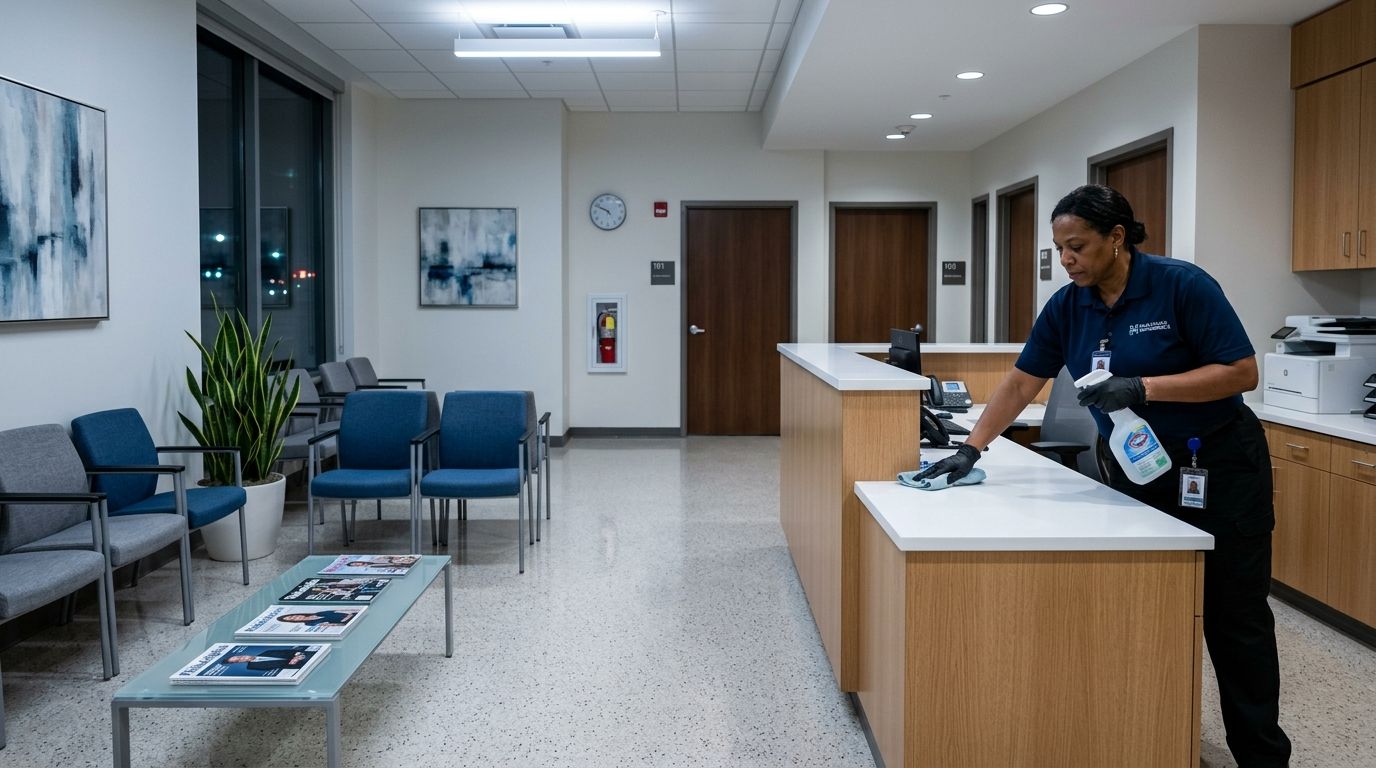
Healthcare facility cleaning services in Philadelphia are structured janitorial programs built around patient flow, controlled access, written task ownership, and fast correction when work is missed. In 2026, the right vendor is the one your facility can verify after every shift, not the one with the broadest sales claims.
- Healthcare cleaning services Philadelphia buyers should require a room-level scope and named task owners.
- Dedicated crews reduce repeated access setup and site-specific retraining.
- Hi Shine uses HI-Q™ checklists, $5MM insurance, and 24/7 owner access.
- A 90-day risk-free trial tests execution inside the real facility before a longer commitment.
Use this checklist to expose weak vendor controls
A healthcare cleaning proposal is weak when it cannot name the room, task owner, assigned crew, access rule, and correction path. Those gaps turn one missed task into interrupted patient flow, confused waste handoffs, missing records, and hours of follow-up for the facility team.
The cleaning vendor does not replace clinical staff, infection-control leadership, regulated-waste providers, or facility protocols. Its responsibility is narrower and more operational: complete the approved janitorial scope, respect restricted areas, document exceptions, and respond when something is missed.
Hi Shine's medical and healthcare cleaning program is built for facilities that need permanent accountability around those tasks. Hi Shine fits Philadelphia-area healthcare facilities that want a dedicated team, a written checklist, and a direct escalation path.
Define the cleaning boundary before requesting proposals
Start with a room-by-room responsibility map. Mark each space and task as included, excluded, conditional, or owned by another team. This prevents a cleaner from making a judgment about clinical equipment, sharps, specimens, or regulated material after hours.
Your 2026 scope should identify:
- Patient-facing areas such as entrances, waiting rooms, and reception.
- Administrative offices, staff rooms, breakrooms, and conference areas.
- Restrooms, floors, interior glass, ordinary trash, and recycling.
- Approved non-clinical surfaces in exam or treatment areas.
- Restricted equipment, clinical procedures, sharps, and regulated waste.
- Tasks that require a facility employee or specialist provider.
A proposal cannot be compared fairly until every vendor is pricing the same rooms, surfaces, frequencies, and exclusions.
Tie frequency to patient and staff traffic
Daily service is not a complete schedule. A healthcare facility needs task-level frequencies based on how each space is used. The waiting room may need a different cadence from an administrative office, and a restroom may need checks during operating hours as well as end-of-day service.
Document:
- Which tasks happen every visit.
- Which tasks happen during operating hours.
- Which tasks happen after the final appointment.
- Which periodic work needs advance approval.
- Which areas become available only during specific windows.
- What changes during seasonal or operational peaks.
In 2026, the schedule should also name the condition that pauses work. A locked room, active procedure, unidentified spill, or restricted container needs an escalation rule, not an improvised response.
Require a room-level quality checklist
A service agreement describes the commercial relationship. The checklist controls the shift. Each checklist line should name the exact zone, task, frequency, completion standard, and exception path.
Hi Shine's HI-Q™ Quality System turns the approved scope into repeatable tasks for the assigned team. That structure directly addresses the failures facility managers notice first: missed trash, incomplete restrooms, skipped zones, and work nobody can confirm.
A useful checklist records:
- The room or zone.
- The surface or task.
- The required frequency.
- Completion or exception status.
- The reason a task was blocked.
- Who received the escalation.
- When the correction was confirmed.
The checklist should be available to both the vendor supervisor and the facility contact. If the document exists only during the sales process, it is not an operating control.
Verify the staffing and access model
Healthcare facilities should know who is expected on-site before service starts. Repeated crew changes create repeated orientation, access, route, confidentiality, and site-rule work for the facility manager.
Ask each vendor to state in writing:
- Whether the facility receives a dedicated or rotating team.
- How staffing changes are communicated.
- Who approves keys, badges, alarm codes, and restricted routes.
- How replacement workers receive site-specific instructions.
- Who supervises the shift.
- Who holds the current authorized-personnel list.
The strongest answer is not a promise that staffing never changes. It is a controlled replacement process with notice, approval, and documented onboarding.
Check insurance against the facility's requirements
Insurance limits should match the lease, ownership structure, and vendor-risk policy for the building. Request current documentation before award and track its renewal date after service starts.
Hi Shine carries $5MM in insurance coverage. Treat that as an input to your own risk review, not as a substitute for it. Confirm:
- Required liability limits.
- Incident and property-damage reporting.
- Product and equipment responsibilities.
- Subcontractor disclosure, if applicable.
- Certificate renewal and notification procedures.
- Any facility-specific contract language.
In 2026, certificate tracking belongs in the operating calendar. An expired document discovered during an incident is already too late.
Put escalation and correction in the contract
Quality problems become vendor-management problems when the agreement says what should be cleaned but not what happens after a miss. Name both routine and urgent contacts before the first shift.
The correction process should include:
- One route for routine feedback.
- One route for urgent service failures.
- Confirmation that the issue was received.
- A correction owner and completion time.
- A record of the original miss and response.
- Follow-up when the same task fails again.
Hi Shine provides 24/7 owner access. That matters when a facility cannot wait for a ticket queue or the next account review to identify who owns the response.
Test the vendor in the real facility
References and proposals cannot show how a team performs through schedule changes, blocked rooms, access problems, staff turnover, or an ordinary busy week. A live trial should use a scorecard agreed before service begins.
Hi Shine offers a 90-day risk-free trial. Use the 90 days to measure:
- Checklist completion by zone.
- Repeat misses by task.
- Stability of the assigned team.
- Access and lock-up accuracy.
- Response time after a reported issue.
- Staff complaints tied to a specific room or task.
- Completion of agreed periodic work.
A 2026 trial should end with a documented decision: continue, correct defined gaps, or exit. Do not let the trial become an unmeasured waiting period.
Healthcare cleaning service models at a glance
| Service model | When it fits | What to verify | Main management tradeoff |
|---|---|---|---|
| In-house facility team | Direct control is required across daily operations | Hiring, training, supervision, and coverage | The facility owns staffing and management |
| Multi-location service model | One agreement must cover several markets | Local staffing, escalation, and site-level accountability | Central standards still need local verification |
| Local commercial cleaning team | A facility values local management and a defined scope | Team stability, documentation, and backup coverage | Geographic coverage may be limited |
| Specialist service provider | A narrow regulated or controlled task needs separate expertise | Exact authorization, qualifications, and handoffs | A second provider adds coordination work |
| Mixed-provider model | Ordinary janitorial and specialist scopes are clearly separated | Responsibility map and exception routing | Gaps appear when ownership is vague |
Choose the operating model that matches the facility's scope, geography, internal management capacity, and specialist requirements.
Before award, require the final proposal to restate the room list, task frequencies, exclusions, assigned staffing model, service windows, insurance documents, escalation contacts, and trial scorecard in one place. This becomes the handoff document for operations. If an item appears in the sales presentation but not in the signed scope, the facility should treat it as uncommitted work. That check prevents the most common gap between what was discussed and what the cleaning team is actually instructed to perform.
Questions to ask during the facility walkthrough
Use the walkthrough to test how the vendor thinks, not just to count rooms. Ask:
- Who will be assigned to this building on the first night?
- Which tasks will appear on the room-level checklist?
- What work will your team refuse without written authorization?
- How will a blocked task be recorded and escalated?
- Who answers after hours when a critical task is missed?
- How are staffing changes approved and documented?
- What insurance documentation will remain on file?
- How will performance be reviewed during the first 90 days?
A vendor that answers with roles, records, and time-bound steps is easier to manage than one that answers only with promises about quality.
Common healthcare cleaning procurement mistakes
Comparing totals before comparing scope
Two proposals with different rooms, frequencies, exclusions, and periodic work are not comparable. Normalize the task list first.
Treating clinical and janitorial work as one category
The facility must define the boundary and assign specialist work to the correct owner. Do not let a broad phrase such as healthcare cleaning erase that distinction.
Ignoring replacement-worker access
A new cleaner can be capable and still lack site authorization or route knowledge. Require controlled notice and onboarding.
Waiting for complaints to inspect work
Complaints are a lagging indicator. Review task completion, blocked-work records, and repeated misses before they become routine.
Accepting an unnamed escalation path
A shared inbox is not an owner. Put a responsible person and a response process in the agreement.
FAQ
What should healthcare cleaning services in Philadelphia include?
The scope should name patient-facing areas, offices, staff spaces, restrooms, floors, approved non-clinical surfaces, frequencies, exclusions, access rules, and correction steps.
How do I compare healthcare cleaning proposals?
Normalize the room list, task frequency, exclusions, staffing model, insurance, and escalation process before comparing totals. Different scopes produce misleading price comparisons.
Should a healthcare facility use a dedicated cleaning crew?
A dedicated crew reduces repeated site orientation and access setup. The agreement should still define how replacements are approved and onboarded.
Does healthcare janitorial cleaning include clinical disinfection?
Not automatically. The facility must assign clinical procedures, regulated waste, sharps, and equipment work under its own protocols and approved scope.
What insurance should a healthcare cleaning vendor carry?
The required coverage depends on the facility's lease and vendor-risk policy. Hi Shine carries $5MM in insurance coverage, which should be checked against those requirements.
How should missed cleaning tasks be handled?
The contract should name the contact, correction owner, completion expectation, and follow-up process. Repeated misses should be tracked by room and task.
What should happen during a cleaning vendor trial?
Measure checklist completion, staffing stability, access accuracy, issue response, and repeated misses. Hi Shine offers a 90-day risk-free trial for this facility-specific test.
One last thing
Ask every vendor what happens when the assigned team cannot complete one task after hours. The answer should name who records it, who is notified, who corrects it, and how the facility confirms closure. That single question exposes whether accountability survives past the sales meeting in 2026.