
Commercial Cleaning Chester County PA: 2026 Checklist
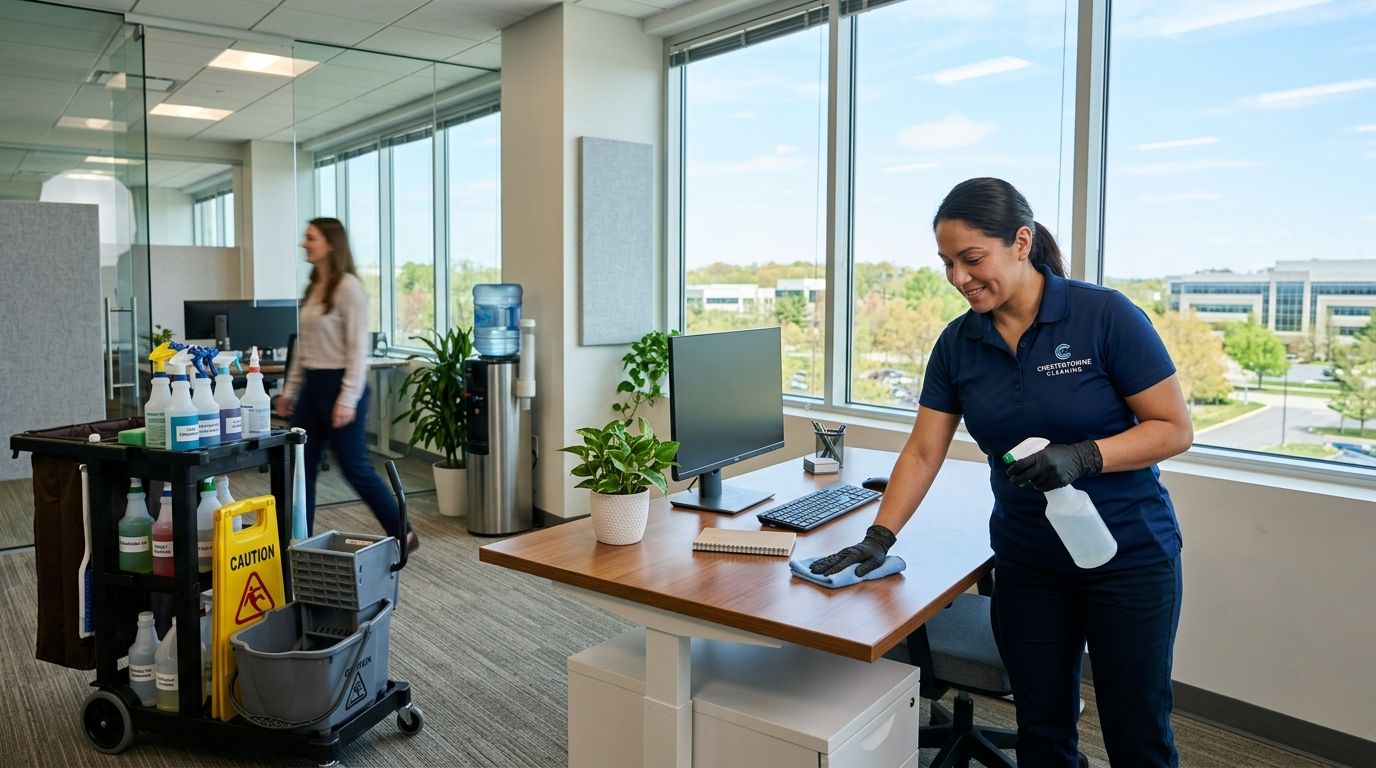
If you manage a corporate campus, an engineering office, or a life sciences facility anywhere along the Route 202 or Route 30 corridor, this 2026 checklist is how you evaluate commercial cleaning companies in Chester County before they touch your building — and how you hold the one you hire to a standard you can actually verify.
- Commercial cleaning relationships fail at scope, staffing, and proof — not price.
- Demand a written, room-level scope before you compare any bids.
- A dedicated crew beats a rotating sub pool on consistency and security.
- HI-Q™ checklist discipline turns 'quality' into something you can audit.
- Start with a 90-day risk-free trial before signing anything long.
Why Chester County facilities need a stricter standard
Chester County carries one of the most demanding commercial real estate mixes in the Philadelphia region: corporate campuses and engineering firms along the Route 202 corridor, life sciences offices in Malvern and Exton, professional firms in West Chester. The tenants in those buildings notice everything. A missed trash pickup on a Friday, a restroom left unfinished before a Monday client visit, a lobby that looks fine on inspection day and neglected the rest of the month — those failures land on you, the facility or property manager, to explain.
The problem is rarely that a vendor cannot clean. It is that nobody defined what clean means, nobody stable showed up to do it, and nothing proves it happened. Vague scopes, rotating crews, and invisible quality checks are the three failure points behind almost every vendor complaint we hear from Chester County facility managers. This checklist addresses each one directly, in the order you should address it.
Hi Shine serves Chester County facilities with the same dedicated-team, checklist-driven model we run across Greater Philadelphia. If you want the local baseline first, start with our commercial cleaning across Chester County, then work through the checklist below before your next vendor conversation.
1. Require a written, room-level scope
A vague scope is how vendors win bids and lose buildings. "General office cleaning, five nights per week" tells you nothing about what happens on a bad week — and a vendor who priced a vague scope has no obligation to cover the details when costs tighten.
Insist on a scope that names every room and every task:
- Lobbies and entrances: floors, entry glass, mats, high and low dusting
- Restrooms: fixtures, partitions, floors, restock levels, trash
- Kitchens and breakrooms: counters, sinks, appliance surfaces, trash and recycling
- Conference rooms, executive areas, and open office zones
- Corridors, stairwells, and elevators
- Periodic work: floor care cycles, high dusting, detail work on a documented schedule
A room-level scope does two jobs. It makes bids comparable, because every vendor prices the identical list. And it converts arguments into facts: when a restroom is missed, the discussion is a documented task that was or was not completed — not your word against a crew's.
2. Insist on a dedicated team
Ask one question of every bidder: will the same people be in this building every night, or will whoever is available show up? Rotating crews are the most common complaint we hear from facility managers who switch to Hi Shine, and the damage is cumulative. A new face every few months never learns which side door sticks, which conference room books solid on Tuesdays, or which restroom sees weekend traffic.
A dedicated team inverts that. The same people learn the building, take ownership of outcomes, and get faster and more consistent at the work. Security improves too: the same known faces, badged and expected, are easier for your front desk and your tenants to trust than a stranger with a lanyard every month.
Continuity also compounds on documentation. A crew that has written the same building's reports for a year produces records you can trend; a crew that changes monthly produces noise. When you review any vendor's reporting, ask how long the crew generating it has been assigned to your building. The answer tells you how much weight the trend carries.
3. Verify insurance and access controls
Insurance is a screening requirement, not a formality. Hi Shine carries $5MM in coverage, and we recommend you hold every Chester County vendor to a documented certificate pulled directly from the insurer — not a PDF the vendor's salesperson emailed you.
Then get specific about access. Who holds keys or badges to your building? How are they logged and returned? What happens when a crew member leaves the vendor — when does your access list get updated? A company that cannot answer those three questions in one phone call will eventually hand your building's access to someone you have never met.
Access answers belong in four documents: the personnel list currently badged to your building, the key or badge inventory with counts, the return protocol at contract end, and the update rule when staff change. Any vendor can promise security; these four documents are how you verify it. If a bidder treats that request as unusual, remember that you will be the one explaining the badge to your tenant, not them.
4. Tie every task to a documented checklist
"We do quality work" is a claim, and a claim cannot be audited. Hi Shine built the HI-Q™ Quality System to replace the claim with a routine: every task is defined, completed work is recorded, and blocked or skipped tasks are flagged with a reason instead of quietly disappearing.
When you evaluate any vendor, ask to see the documentation itself — what a completed checklist looks like, what happens when a task is blocked, who reviews it and when. If a vendor cannot show you what "done" looks like for a restroom on a Tuesday night, you will have no way to hold them to it in month six. A checklist you can audit is the difference between a vendor and a partner. See how the HI-Q™ Quality System works.
Checklist discipline also changes your side of the relationship. Instead of walking the building to hunt for misses, you review a report: tasks completed, tasks blocked with reasons, and corrections in motion. Facility managers who move to documented systems consistently describe the same shift — fewer surprise findings, because findings surface in the record before they surface in a tenant email.
5. Set an escalation path with a real name
The worst vendor relationship is the one where problems go into a portal and die. Your contract should name who answers the phone and when. Hi Shine gives every client 24/7 owner access — when something is wrong at 10 p.m. before a morning event, you call the owner directly, not an account manager reading from a script.
Before signing with anyone, test the path. Send a routine service question during off hours and see who responds and how fast. The response time you get during the sales process is the best response time you will ever see. If it is slow while they are competing for your business, it will be worse once they have the contract.
6. Put the trial terms in writing
A vendor confident in its service will prove it before asking for a long commitment. Hi Shine starts every Chester County engagement with a 90-day risk-free trial — long enough to see real performance across ordinary weeks, short enough that you are never locked into hope.
Whatever terms you negotiate, get three things in writing: what the trial covers, how you exit it, and what happens to pricing afterward. A trial without defined exit terms is just a discount on the first three months.
7. Compare proposals on identical terms
When proposals arrive, normalize them before you look at price. Same room list, same frequency, same periodic tasks, same supply responsibilities, same reporting expectations. Build a one-page grid with every bidder as a column and every checklist item as a row; the cells you cannot fill from a proposal are the answers that vendor is hoping you will not ask for. A proposal that comes in lower because it quietly dropped carpet care or high dusting is not cheaper — it is incomplete, and you will pay for the difference in complaints.
Then rank every proposal on the four questions this checklist is built around: Is the scope complete? Is the staffing dedicated? Is the quality system documented and auditable? Is the escalation path a real person? Price is the fifth question, not the first.
8. Red flags that should end the conversation
Some answers disqualify a vendor faster than any price advantage can justify them:
- "We'll build the scope after we start" — a vendor who cannot scope your building before winning the bid will improvise on your dime.
- "We send whoever is available" — said plainly, this is a rotating-crew program at a dedicated-team price.
- "Our checklists are internal" — documentation you cannot see is documentation you cannot use in a dispute.
- "The insurance certificate is coming" — legitimate vendors produce certificates in a day; delays mean gaps.
- "We can start Monday" — real onboarding includes key control, badge lists, and site instructions. A vendor who skips those steps is improvising inside your building.
Any single one of these is worth a second look. Two together usually mean the low price was priced by leaving these answers out.
How to use this checklist
Walk your building once with this list before your next vendor conversation — one pass, thirty minutes, no vendor present. Mark every item you can verify today, every item you cannot, and every question your current vendor would fail. That gap is your vendor evaluation — and your negotiation agenda.
Then score the proposals you are holding against the same list. Managers who run this exercise usually find the same three gaps: the scope is not room-level, the crew is not dedicated in writing, and the quality documentation does not exist. Those three gaps explain most of the price spread between bids, and closing them is worth more than any discount you are negotiating.
When you are ready for a concrete number, request a free facility assessment and we will scope your Chester County facility line by line, with the trial terms in writing.
FAQ
How much does commercial cleaning cost in Chester County, PA?
Cost depends on your building's size, room-level scope, and cleaning frequency, so the only reliable number comes from a walkthrough-based quote. Treat any price given before a vendor has seen your scope as a placeholder.
What should a commercial cleaning contract include?
At minimum: a written room-level scope, service frequencies, staffing commitments, insurance requirements, quality documentation, and a named escalation contact with response expectations.
How do I know whether scheduled cleaning actually happened?
Ask how the vendor records completed and blocked tasks. With Hi Shine's HI-Q™ Quality System, completion is documented and missed tasks are flagged with a reason rather than left silent.
Do cleaning crews need after-hours access to our building?
Most Chester County offices are cleaned after business hours. Before signing, confirm how keys and badges are issued, tracked, and returned, and what happens when staff change.
What is a 90-day risk-free trial?
It is a defined trial period, long enough to evaluate real performance and short enough to exit cleanly. Hi Shine starts every engagement on these terms.
Which Chester County areas does Hi Shine serve?
Coverage commonly includes West Chester, Malvern, Paoli, Exton, Downingtown, and Phoenixville, along the Route 202 and Route 30 corridors.
One last thing
The strongest predictor of a good cleaning vendor is not the proposal — it is what happens after the first missed task. A vendor that treats a miss as your problem stays a vendor. One that documents the miss, fixes it, and tells you before you notice becomes a partner. Build that expectation into day one of the trial, and the rest of the relationship takes care of itself.