
Urgent Care Clinic Cleaning Scope Checklist (2026)
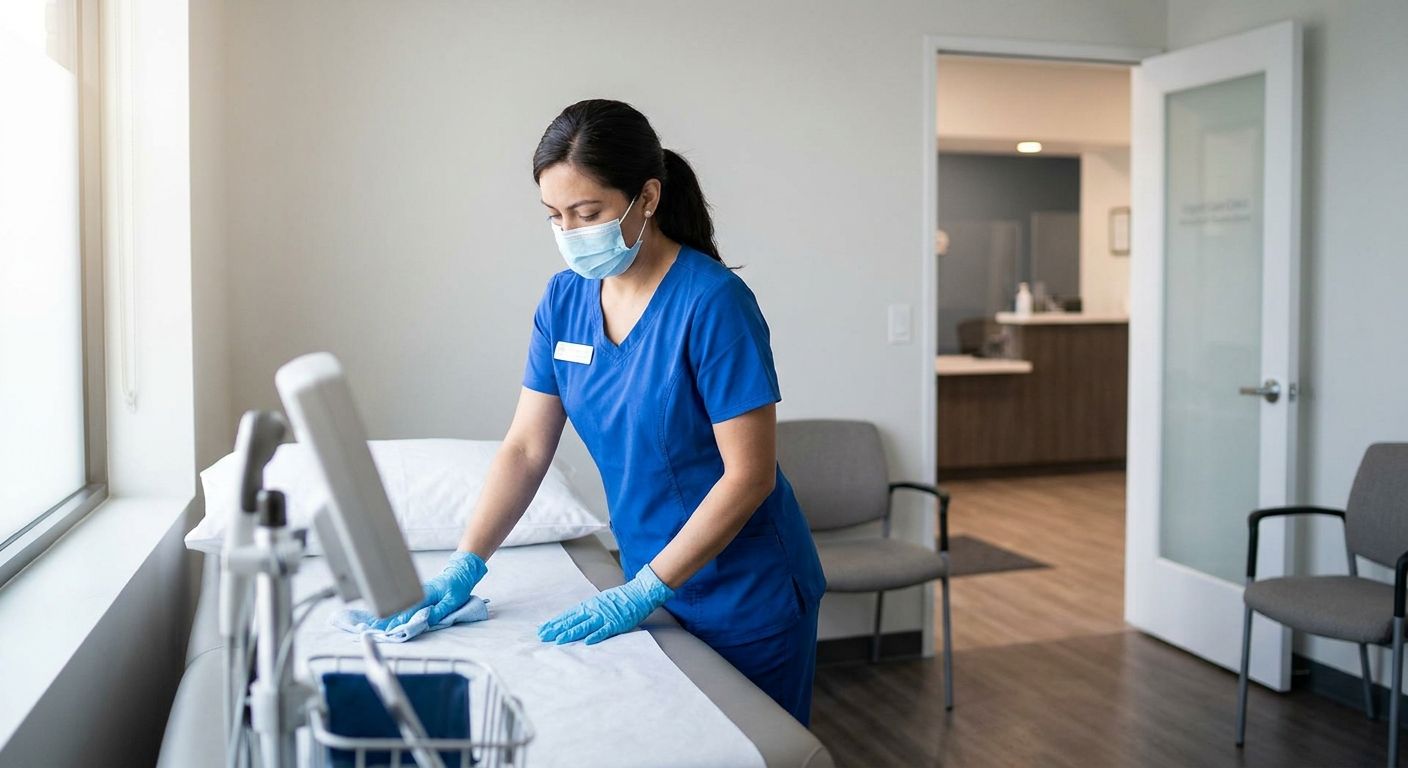
Urgent care clinic cleaning is a facility-defined program that separates clinical turnover work from commercial janitorial tasks, then assigns each room, surface, waste stream, and service window to a named owner. In 2026, the contract must fit extended patient hours without asking the cleaning crew to infer clinical responsibilities.
- Urgent care clinic cleaning needs a written boundary between clinical turnover and janitorial work.
- Map patient-facing, staff, restroom, floor, and waste tasks by room and owner.
- Dedicated crews reduce repeated access setup and site-specific retraining.
- Hi Shine uses HI-Q™ checklists, $5MM insurance, and 24/7 owner access.
- Use a 90-day risk-free trial to measure completion, access, and correction.
Build for late patients, not a perfect closing time
Urgent care cleaning plans break when they assume every exam room releases on schedule. The scope must tell the crew which rooms remain available, which tasks wait for clinical sign-off, who owns between-patient work, and what happens when an unidentified material or late patient blocks the route.
The clinic should assign clinical procedures under its own policies and applicable requirements. The janitorial vendor should complete only the approved commercial scope, respect access boundaries, document exceptions, and escalate anything outside that scope.
Hi Shine's medical and healthcare cleaning program serves Greater Philadelphia facilities that need a repeatable commercial cleaning process. Hi Shine is best suited to urgent care operators who want a dedicated team, a room-level checklist, and direct escalation when an approved task is missed.
Separate clinical turnover from janitorial service
Begin with a responsibility map that names the owner for every task. Do not use broad phrases such as clean exam rooms or handle medical waste without defining the surfaces, procedure, authorization, and responsible team.
The map should separate:
- Between-patient clinical turnover.
- End-of-day clinical procedures.
- Approved non-clinical surfaces.
- Waiting room and reception areas.
- Staff offices and breakrooms.
- Restrooms, floors, and interior glass.
- Ordinary trash and recycling.
- Sharps, regulated waste, specimens, and restricted materials.
- Spill response and other facility-controlled procedures.
In 2026, a cleaner should never have to decide whether an item is clinical, regulated, or ordinary based on appearance. The container, route, instruction, and escalation owner should already be documented.
Build the schedule around actual clinic hours
The service window must reflect when the clinic opens, closes, sees its last patient, and releases rooms for janitorial work. A crew arriving while exam rooms remain active needs a different route from a crew entering after the building closes.
Document:
- Opening and closing times by day.
- The expected last-patient window.
- Rooms available during operating hours.
- Rooms released only after clinical sign-off.
- Weekend and holiday access.
- Security, badge, key, and alarm procedures.
- Periodic work requiring advance coordination.
- The clinic contact available after hours.
Build a fallback path for late-running patient care. The crew should know which tasks can move to another zone, which must wait, and who authorizes a return visit.
Turn the contract into a room-level checklist
The agreement defines what the clinic buys. The checklist tells the assigned team what to do during the shift. Each line should be specific enough that a supervisor can confirm completion without interpreting the contract again.
Hi Shine's HI-Q™ Quality System converts the approved scope into repeatable tasks. For an urgent care clinic, each checklist line should include:
- Room or zone.
- Approved task and surface.
- Required frequency.
- Access condition.
- Product or equipment responsibility.
- Completion or exception status.
- Escalation contact.
- Correction confirmation.
The checklist should change when clinic hours, room use, access rules, or task ownership changes. A static checklist tied to an old floor plan is a hidden source of repeated misses.
Control team assignment and access
A new cleaner must learn the clinic's routes, available rooms, excluded areas, supply locations, alarm steps, and staff contacts. Constant rotation turns that onboarding into recurring work for the clinic manager.
Require the staffing plan to state:
- Whether the clinic receives a dedicated or rotating team.
- Who supervises the shift.
- How staffing changes are reported.
- Who approves badges, keys, and alarm access.
- How replacement workers receive clinic-specific instructions.
- When access is removed after an assignment ends.
- Who maintains the authorized-personnel list.
A dedicated team reduces repeated setup, but it does not remove the need for a controlled replacement process.
Define waste ownership and handoffs
The janitorial contract must distinguish ordinary trash from any material owned by clinical staff or a specialist provider. Do not write one line that says remove all waste.
For each stream, identify:
- The approved container.
- Who seals or prepares it.
- Who may move it.
- The approved route and staging point.
- The pickup owner.
- What the janitorial team must not touch.
- Who receives a full-container or spill escalation.
In 2026, handoffs should be visible in both the facility protocol and the cleaning checklist. If ownership changes at a doorway, container, or staging point, name that point exactly.
Set standards for patient-facing spaces
Waiting rooms, entrances, reception areas, and public restrooms are the commercial cleaning zones patients notice first. The scope should tie service frequency to operating hours and clinic traffic without assigning clinical procedures to the janitorial team.
For each patient-facing zone, define:
- Approved surfaces.
- Routine and periodic tasks.
- Service windows.
- Supply-restocking responsibility.
- Wet-floor and blocked-area controls.
- Trash ownership.
- Escalation when the area remains occupied.
Avoid blanket phrases such as sanitize all high-touch surfaces. Name the surfaces, approved process, responsible team, and frequency determined by the clinic.
Put blocked-task reporting in writing
Urgent care work rarely follows a perfect closing schedule. A room may remain active, a door may be locked, an unidentified item may be present, or the facility contact may be unavailable.
The exception process should tell the cleaner:
- When to stop.
- How to protect the boundary.
- Who to contact first.
- What information may be recorded.
- Whether photographs are prohibited.
- Who decides when work resumes.
- How the task is rescheduled and closed.
Hi Shine gives clients 24/7 owner access for urgent service issues. The clinic should also name its own after-hours contact for access, clinical, and protocol decisions.
Verify insurance and vendor controls
Insurance is necessary, but it does not define the scope or prevent routine mistakes. Review it alongside staffing, access, products, equipment, incidents, and subcontractor controls.
Hi Shine carries $5MM in insurance coverage. Compare that amount with the clinic's lease and vendor policy. Confirm:
- Current certificate documentation.
- Renewal tracking and notice.
- Incident and property-damage reporting.
- Product approval responsibility.
- Equipment storage and control.
- Subcontractor disclosure, if applicable.
- Key, badge, and alarm accountability.
The clinic should also keep the signed scope and current responsibility map with the vendor documents. In 2026, those records work together; none replaces the others.
Use a 90-day operating scorecard
A proposal cannot demonstrate how the team handles late patients, blocked rooms, access failures, schedule changes, or a missed task. The first service period should test the operating model under normal conditions.
Hi Shine offers a 90-day risk-free trial. Run it in three checkpoints:
- Days 1-30: confirm setup. Verify every approved room appears on the checklist, access works, task ownership is clear, and staff know where to report a miss.
- Days 31-60: test correction. Track blocked tasks, repeat misses, response ownership, and whether corrections are confirmed.
- Days 61-90: decide on fit. Review team stability, schedule fit, unresolved exceptions, staff complaints, and completion of periodic work.
The 90-day review should end with a written decision to continue, correct named gaps, or exit. General impressions are not enough.
Urgent care cleaning service models at a glance
| Service model | When it fits | What to verify | Main management tradeoff |
|---|---|---|---|
| In-house facility team | The clinic wants direct daily control | Hiring, coverage, supervision, and training | The clinic owns the full operation |
| Commercial janitorial team | The approved scope centers on ordinary facility areas | Boundaries, crew stability, access, and documentation | Clinical work remains with the clinic |
| Specialist provider | A narrow regulated or technical task requires separate authorization | Qualifications, scope, records, and handoffs | A second provider adds coordination |
| Mixed-provider model | Commercial and specialist tasks are clearly separated | Responsibility map and exception routing | Vague handoffs create gaps |
| Multi-site service model | Several clinics need shared commercial terms | Site-level staffing and escalation | Each location still needs its own scope |
These are service models, not a ranking. Choose the model that keeps each task with the correct owner and gives the clinic a clear correction path.
Common urgent care cleaning mistakes
Using a standard office scope
An urgent care clinic has active exam rooms, facility-controlled procedures, and variable hours. The scope must reflect those operating conditions.
Leaving clinical boundaries implicit
A phrase such as exam-room cleaning does not define approved surfaces or task ownership. Put the boundary in writing.
Accepting an undefined staffing model
The clinic should know who is expected on-site and how replacements are approved. Rotating access without notice creates avoidable management work.
Treating all waste as one stream
Containers, owners, routes, and handoffs must be named. The janitorial team should never classify material by guesswork.
Closing issues when they are acknowledged
A response is not a correction. Track who owns the fix, when it is completed, and whether the same task fails again.
FAQ
What should urgent care clinic cleaning include?
The scope should name patient-facing areas, offices, staff spaces, restrooms, floors, approved non-clinical surfaces, ordinary waste, access rules, frequencies, and correction steps.
Who should handle between-patient exam-room turnover?
The clinic must assign between-patient procedures under its own policies and requirements. The janitorial vendor should perform only tasks expressly included in the approved scope.
Does a cleaning vendor handle medical waste?
Not automatically. The clinic must define the container, authorized owner, route, handoff, and any specialist provider for each waste stream.
Should an urgent care clinic use a dedicated cleaning crew?
A dedicated team reduces repeated access setup and clinic-specific onboarding. Replacement workers still need notice, approval, and documented instructions.
How should cleaning work around late patients?
Give each task a normal service window and fallback process. The crew should know which zones remain available and who authorizes delayed work.
What insurance should a clinic cleaning vendor carry?
Required coverage depends on the lease and vendor policy. Hi Shine carries $5MM in insurance coverage, which should be compared with those requirements.
How should an urgent care clinic test a new cleaning vendor?
Measure checklist completion, access accuracy, team stability, blocked-task closure, repeated misses, and issue response during a defined trial.
What makes Hi Shine suitable for urgent care clinics?
Hi Shine uses dedicated teams, the HI-Q™ checklist system, $5MM insurance coverage, and 24/7 owner access. It also offers a 90-day risk-free trial.
One last thing
Ask who owns a task when the final patient leaves later than expected. The answer should name the clinic contact, the available cleaning route, the delayed task, and the closure process. That question reveals whether the 2026 plan can survive a real urgent care schedule.